American Options
In the following the cursive symbols \mathcal{C} or \mathcal{P} are used to denote an American call or put respectively, whereas their European counterparts are denoted by C or P.
American Options Characteristics
Early-Exercise of American Options
It is never optimal to exercise early an American call option when the asset pays no dividends as long as the risk-free rate is positive. To see why, notice that if r > 0, then we have that: \mathcal{C}\geq C \geq S - K e^{-r T} > S - K.
If it were optimal to exercise early, the price of the American call would be equal to its intrinsic value, violating the strict inequality. Intuitively, if interest rates are positive, there is no opportunity cost for not holding the stock but there is a benefit for holding cash. Hence, you are better off waiting until maturity to get the stock.
This implies that for non-dividend paying stocks the value of an American call option with maturity T and strike price K is the same as the value of a European call option with the same characteristics.
When there are dividends, it might be optimal to exercise early an American call option just before the stock goes ex-dividend. For American puts, early exercise can be optimal even when the asset pays no dividends: exercising a deep in-the-money put delivers K now, and the interest earned on it can be worth more than keeping the option alive.
Negative interest rates reverse these conclusions. When r < 0, holding cash costs money, so receiving K early is no longer attractive and an American put on a non-dividend paying asset is never exercised early, since \mathcal{P}\geq P \geq K e^{-r T} - S > K - S. For an American call, deferring the payment of the strike no longer saves interest: paying K at maturity is worth K e^{-r T} > K today, so a deep in-the-money call can be worth exercising early.
In summary, exercising early is all about opportunity costs. If there is no opportunity cost in waiting, then it is never optimal to exercise early.
Option Bounds
As with European options, the premium of an American type option must be bounded above and below to prevent arbitrage opportunities.
If it is not optimal to exercise early, then an American call option is just a European call option and the pricing bounds that we saw before apply. For example, it is never optimal to early-exercise an American call written on a non-dividend paying asset if r > 0. In that case we must have: \max(S - K e^{-r T}, 0) \leq \mathcal{C}= C \leq S
If we are analyzing a case where it might be optimal to exercise the American call option early, such as when the stock pays a dividend yield \delta > 0, we then have the following pricing bounds.
First, the American call premium cannot be less than its intrinsic value. Indeed, we must have that \mathcal{C}\geq 0. Additionally, when the American call is in-the-money, if its premium was less than its intrinsic value, it would make sense to purchase the American call and exercise immediately which would yield an instantaneous arbitrage profit. This implies that the time value of the American call cannot be negative.
Second, the American call cannot trade for more than the price of its underlying asset. If not, it would make sense for an arbitrageur to sell the American call and buy the stock, generating an instantaneous profit. If the call is exercised at any point before or at maturity, the payoff of this strategy would be the strike price of the call. If not, the call will expire out-of-the-money and the arbitrageur could then sell the stock. This strategy is clearly an arbitrage since it generates a positive cash flow today and in the future.
Therefore, the principle of no-arbitrage implies that \max(S - K, 0) \leq \mathcal{C}\leq S. Since \mathcal{C}\geq C, the lower bound of the European call also applies, so the American call is worth at least the larger of S - K and S e^{-\delta T} - K e^{-r T}.
For American put options we have a similar result. On the one hand, to prevent arbitrage opportunities, the put premium cannot be negative and when the American put is in-the-money, the time-value of the American put cannot be negative as well.
On the other hand, the American put cannot trade for more than the strike. If not, it would make sense for an arbitrageur to sell the put and set aside an amount equal to the strike, in cash or, if the interest rate is positive, in a risk-free account. This strategy generates a positive cash flow today and if the put is exercised, the arbitrageur has at least K to buy the stock from the buyer of the put, at which point it can be sold at its current price.
Thus, \max(K - S, 0) \leq \mathcal{P}\leq K.
Put-Call Parity for American Options
Proof
To see why \mathcal{C}- \mathcal{P}\leq S - K e^{-r T} when r > 0, note that the American call is never exercised early when the asset pays no dividends and r > 0, hence its value is equal to that of the European option, i.e. \mathcal{C}= C. For the American put, on the other hand, it might be optimal to exercise early if the option is deep in-the-money, implying that \mathcal{P}\geq P. Putting everything together: \mathcal{P}\geq P = C - S + K e^{-r T} = \mathcal{C}- S + K e^{-r T} or \mathcal{C}- \mathcal{P}\leq S - K e^{-r T}
Now we turn our attention to see why S - K \leq \mathcal{C}- \mathcal{P} when r > 0.
Strategy A: Long put and long stock \begin{aligned} \text{Cost} & = \mathcal{P}+ S \\ \text{Payoff} & = \begin{cases} K - S_{\tau} + S_{\tau} = K & \text{if put is exercised at time $\tau \leq T$} \\ S_{T} & \text{if put is never exercised} \end{cases} \end{aligned} Strategy B: Long call and K today in a money-market account \begin{aligned} \text{Cost} & = \mathcal{C}+ K \\ \text{Payoff} & = \begin{cases} \mathcal{C}_{\tau} + K e^{r \tau} \geq K & \text{if put is exercised at time $\tau \leq T$} \\ S_{T} - K + K e^{r T} \geq S_{T} & \text{if put is never exercised} \end{cases} \end{aligned} Since the payoffs of strategy B dominate those of strategy A, we can conclude that the cost of B is greater than the cost of A, or that \mathcal{C}+ K \geq \mathcal{P}+ S which is the same as S - K \leq \mathcal{C}- \mathcal{P}.
What happens when r < 0? In this case the American put is never exercised early when the asset pays no dividends and r < 0, hence its value is equal to that of the European option, i.e. \mathcal{P}= P. For the American call, on the other hand, it might be optimal to exercise early if the option is deep in-the-money, implying that \mathcal{C}\geq C. Thus: \mathcal{C}\geq C = P + S - K e^{-r T} = \mathcal{P}+ S - K e^{-r T} which shows that: \mathcal{C}- \mathcal{P}\geq S - K e^{-r T}
To see why \mathcal{C}- \mathcal{P}\leq S - K when r < 0, let us analyze the following strategies.
Strategy A: Long put and long stock \begin{aligned} \text{Cost} & = \mathcal{P}+ S \\ \text{Payoff} & = \begin{cases} S_{\tau} + \mathcal{P}_{\tau} \geq S_{\tau} & \text{if call is exercised at time $\tau \leq T$} \\ K - S_{T} + S_{T} = K & \text{if call is never exercised} \end{cases} \end{aligned} Strategy B: Long call and K today in a money-market account \begin{aligned} \text{Cost} & = \mathcal{C}+ K \\ \text{Payoff} & = \begin{cases} S_{\tau} - K + K e^{r \tau} \leq S_{\tau} & \text{if call is exercised at time $\tau \leq T$} \\ K e^{r T} \leq K & \text{if call is never exercised} \end{cases} \end{aligned} Since the payoffs of strategy A dominate those of strategy B, we can conclude that the cost of A is greater than the cost of B, or that \mathcal{C}+ K \leq \mathcal{P}+ S which is the same as \mathcal{C}- \mathcal{P}\leq S - K.Example 1 On 2/8/17, Facebook (FB) closing price was $134.20. As of that date, the stock does not pay dividends. Options on FB as on other stocks are American. Let us consider options on FB with maturity date 6/17/17. This implies that T = 129 / 365 = 0.35. If we use a continuously compounded interest rate of 1.5% per year, we can compute the no-arbitrage bounds on these options.
| Strike | Call Price | Put Price | S - K | \mathcal{C}- \mathcal{P} | S - K e^{-r T} |
|---|---|---|---|---|---|
| 120 | 17.30 | 2.50 | 14.20 | 14.80 | 14.83 |
| 125 | 13.61 | 3.75 | 9.20 | 9.86 | 9.86 |
| 130 | 10.25 | 5.45 | 4.20 | 4.80 | 4.89 |
| 135 | 7.45 | 7.60 | -0.80 | -0.15 | -0.09 |
| 140 | 5.13 | 10.35 | -5.80 | -5.22 | -5.06 |
| 145 | 3.47 | 13.65 | -10.80 | -10.18 | -10.03 |
As can be seen from the table, the difference between calls and puts is well within the bounds predicted by the theory for all strikes.
Factors Affecting American Option Prices
| Variable | American Call | American Put |
|---|---|---|
| Current stock price | + | - |
| Strike price | - | + |
| Time-to-expiration | + | + |
| Volatility | + | + |
| Risk-free rate | + | - |
Unlike European options, time-to-expiration has an unambiguous effect on American options: a longer-dated American option can do everything a shorter-dated one can, since its holder can always choose to exercise by the earlier date.
Binomial Pricing of American Options
In order to accommodate the binomial pricing framework to American options, we need to allow for the possibility of early exercise at any point in time. This means that we should always compare the intrinsic value of the option, i.e. the value of exercising now, with the value of continuing given by the discounted risk-neutral expected value of future payoffs.
No arbitrage pins down the value of the option at each node. Call I the intrinsic value and H the continuation value. The option cannot trade below I, since otherwise we would buy it and exercise immediately. It cannot trade below H either, since otherwise we would buy it, hold it for one more period, and sell the one-period replicating portfolio of its values next period, which costs H today. And since the holder’s only choices are to exercise now or to wait, nobody would pay more than the better of the two. Hence the value of the option at each node is \max(H, I).
We will start by pricing an American put option on a non-dividend paying asset. To make the valuation problem interesting, we will use a two-period binomial tree.
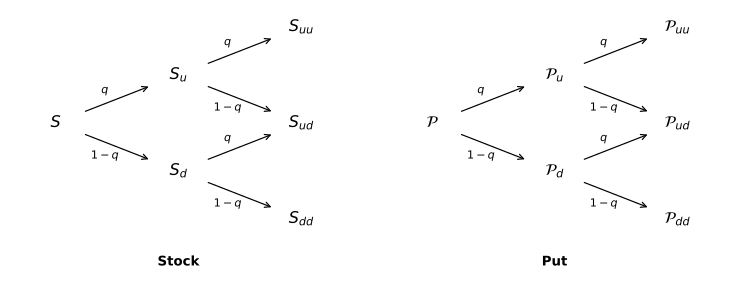
As with European options, the stock price is S and each period it goes up by u or down by d with risk-neutral probabilities q and 1 - q, respectively. Therefore:
- S_{u} = S \times u and S_{d} = S \times d
- S_{uu} = S_{u} \times u, S_{ud} = S_{u} \times d = S_{d} \times u = S_{du} and S_{dd} = S_{d} \times d
An American put option expiring at T and strike K trades at \mathcal{P}. The time-step is then \Delta t = T / 2.
The figure below shows the two-period tree for the stock and the American put option.
We now turn our attention to price the American put. First, note that the value of the American put at expiration is just the intrinsic value of the option: \begin{aligned} \mathcal{P}_{uu} & = \max(K - S_{uu}, 0) \\ \mathcal{P}_{ud} & = \max(K - S_{ud}, 0) \\ \mathcal{P}_{dd} & = \max(K - S_{dd}, 0) \end{aligned} If the stock price goes up:
- The intrinsic value of the put is I_{u} = \max(K - S_{u}, 0).
- The continuation value is H_{u} = (q \mathcal{P}_{uu} + (1 - q) \mathcal{P}_{ud}) e^{-r \Delta t}.
- If I_{u} > H_{u} then the option should be exercised immediately, otherwise we should wait.
- Therefore, the price of the option at that time is \mathcal{P}_{u} = \max(H_{u}, I_{u}).
Similarly, if the stock price goes down, we have that \mathcal{P}_{d} = \max(H_{d}, I_{d}).
Finally, the value of the American put is given by \mathcal{P}= \max(H, I), where: \begin{aligned} H & = \left( q \mathcal{P}_{u} + (1 - q) \mathcal{P}_{d} \right) e^{-r \Delta t} \\ I & = \max(K - S, 0) \end{aligned}
Example 2 Let us price an American put option with maturity 6 months and strike $100 written on a non-dividend paying stock using a two-step binomial model. The current stock price is $100, and it can go up or down by 5% each period for two periods. Each period represents 3-months, i.e. \Delta t = 0.25. The risk-free rate is 6% per year (continuously compounded).
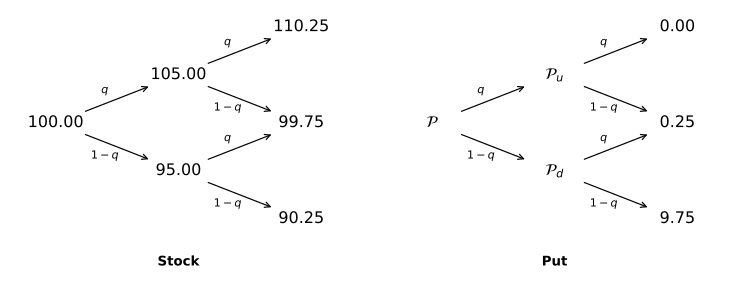
The risk-neutral probability of an up-move is: q = \frac{e^{r \Delta t} - d}{u - d} = \frac{e^{0.06 \times 0.25} - 0.95}{1.05 - 0.95} = 0.6511 The risk-neutral probability of a down-move is just 1 - q = 0.3489. We then have that: \begin{aligned} H_{u} & = \left( 0 \times q + 0.25 \times (1 - q) \right) e^{-0.06 \times 0.25} = 0.0859 \\ I_{u} & = \max(100 - 105, 0) = 0 \end{aligned} so that \mathcal{P}_{u} = \max(0.0859, 0) = 0.0859, and \begin{aligned} H_{d} & = \left( 0.25 \times q + 9.75 \times (1 - q) \right) e^{-0.06 \times 0.25} = 3.51 \\ I_{d} & = \max(100 - 95, 0) = 5 \end{aligned} which implies that \mathcal{P}_{d} = \max(3.51, 5) = 5.
Finally, \begin{aligned} H & = \left( 0.0859 \times q + 5 \times (1 - q) \right) e^{-0.06 \times 0.25} = 1.77 \\ I & = \max(100 - 100, 0) = 0 \end{aligned} so that \mathcal{P}= \max(1.77, 0) = \$1.77.
Note that the value of a European put with the same characteristics is P = \$1.26, implying that the early-exercise premium is 1.77 - 1.26 = \$0.51. Also, you can verify that the value of an American call with the same characteristics is the same as the value of a European call, which is $4.22.
Of course, the method can be used to price American options in trees with more than two periods, as the following example shows.
Example 3 (Pricing an American Put Option Using Four Periods) In this example we price a one year American put option with strike price $100 written on a non-dividend paying stock that currently trades at $100 and whose volatility of stock returns is 35% per year. We use an interest rate of 6% per year with continuous compounding.
The option expires in one year and the binomial tree has four periods. Therefore, we have that T = 1 and \Delta t = T / 4 = 0.25, so that u = e^{0.35 \sqrt{0.25}} = 1.1912 and d = 1 / 1.1912 = 0.8395. The table below describes the binomial tree for the stock. Note that for convenience I wrote the tree as a lower triangle. The horizontal line describes the path where the stock price increases every period whereas the lower diagonal describes the path where the stock price goes down every period.
| Time | 0 | 0.25 | 0.50 | 0.75 | 1.00 |
|---|---|---|---|---|---|
| Stock | 100.00 | 119.12 | 141.91 | 169.05 | 201.38 |
| 83.95 | 100.00 | 119.12 | 141.91 | ||
| 70.47 | 83.95 | 100.00 | |||
| 59.16 | 70.47 | ||||
| 49.66 |
The risk-neutral probability of an up-move is given by: \begin{aligned} q = \frac{e^{0.06 \times 0.25} - 0.8395}{1.1912 - 0.8395} = 0.4993. \end{aligned} We can now price the American put as follows.
| Time | 0 | 0.25 | 0.50 | 0.75 | 1.00 |
|---|---|---|---|---|---|
| Put | 11.03 | 3.91 | 0.00 | 0.00 | 0.00 |
| 18.46 | 7.92 | 0.00 | 0.00 | ||
| 29.53 | 16.05 | 0.00 | |||
| 40.84 | 29.53 | ||||
| 50.34 |
In the table above, the last column contains the payoffs of the American put at maturity if it has not been exercised before. For example, if the stock price at maturity is 49.66, then the payoff of the put is 100 - 49.66 = \$50.34 which is the last number on the last column. On the other hand, if the stock price at maturity 201.38, then the put is out-of-the-money and the payoff is 0.
We work backwards on the tree by comparing the payoff generated by early-exercising the put with the value of continuation, which is computed as the expected payoff using the risk-neutral probabilities discounted at the risk-free rate for 0.25 years.
For example, in the third period, if the stock price is $59.16, we could exercise the put and generate 100 - 59.16 = \$40.84. Alternatively, the value of waiting is (29.53 q + 50.34 (1 - q)) e^{- 0.06 \times 0.25} = \$39.35 < \$40.84. In this case, it is better to exercise early and therefore the value of the American put in that node is $40.84. We keep doing this for all nodes until we reach the beginning of the tree. The price of the put is then $11.03.
A spreadsheet that shows the computations can be found here.
Practice Problems
Problem 1 Explain why an American option is always worth at least as much as a European option on the same asset with the same strike price and exercise date.
Solution
The American option has the same payoff at maturity as its European counterpart, which implies that it cannot be worth less. However, the American option can be exercised before maturity, which might have some value.Problem 2 Explain why an American call option is always worth at least as much as its intrinsic value. Is the same true of a European call option? Explain your answer.
Solution
Let \mathcal{C} denote the premium of the American call option. First, \mathcal{C}\geq 0, since otherwise everyone would want to go long such contracts. Second, if \mathcal{C}< S - K, buying the call and exercising it immediately would yield an arbitrage profit of S - K - \mathcal{C}> 0. Hence \mathcal{C}\geq \max(S - K, 0).
A European call cannot be exercised before maturity, so this argument does not apply, and its price can fall below intrinsic value when waiting is costly. This happens when the stock pays dividends, since the holder of the call does not receive them, or when the interest rate is negative, since paying the strike at maturity then costs more than paying it today.Problem 3 Give an intuitive explanation of why the early exercise of an American put becomes more attractive as the risk-free rate increases and volatility decreases.
Solution
First, as the risk-free rate increases, so does the benefit of exercising the American put early since we can use the proceeds to earn a high interest rate. Second, the higher the volatility, the more valuable it is to keep the option alive, since there is a higher chance that it ends up deeper in-the-money, so early exercise becomes less attractive as volatility decreases.Problem 4 The price of an American call on a non-dividend-paying stock is $4. The stock price is $31, the strike price is $30, and the expiration date is in three months. The risk-free interest rate is 8% per year with continuous compounding. Derive upper and lower bounds for the price of an American put on the same stock with the same strike price and expiration date.
Solution
\begin{gathered} S - K \leq \mathcal{C}- \mathcal{P}\leq S - K e^{-r T} \\ 31 - 30 \leq 4 - \mathcal{P}\leq 31 - 30 e^{-0.08 \times 3/12} \\ 1 \leq 4 - \mathcal{P}\leq 1.59 \\ -1.59 \leq \mathcal{P}- 4 \leq -1 \\ 2.41 \leq \mathcal{P}\leq 3 \end{gathered}Problem 5 Suppose that S = 110, r = 4\%, \delta = 8\%, and \sigma = 40\%. Using a two-period binomial tree, compute the no-arbitrage price of an American call option with strike $112 and maturity 8 months.
Solution
First, we have that \Delta t = 4/12, which implies that u = e^{0.40 \sqrt{4/12}} = 1.2598 and d = 1/u = 0.7938. The binomial trees for the stock and the American call are as follows:
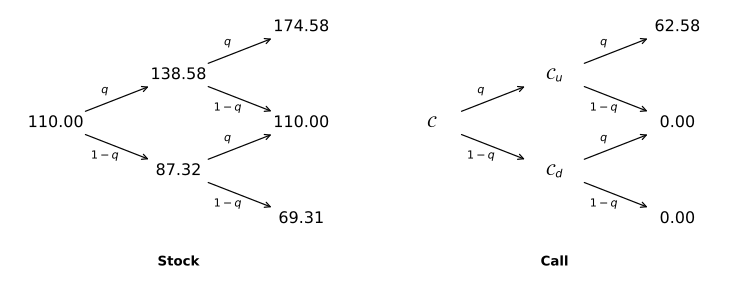
The risk-neutral probability of an up move is: q = \frac{e^{(0.04 - 0.08) \times 4/12} - 0.7938}{1.2598 - 0.7938} = 0.4141.
We can then compute the continuation and intrinsic value in each node denoted by H and I, respectively:
| Node | Continuation value H | Intrinsic value I | Option value |
|---|---|---|---|
| Up, S = 138.58 | H_{u} = (62.58 q + 0 (1 - q)) e^{-0.04 \times 4/12} = 25.57 | I_{u} = \max(138.58 - 112, 0) = 26.58 | \mathcal{C}_{u} = \max(25.57, 26.58) = 26.58 |
| Down, S = 87.32 | H_{d} = (0 q + 0 (1 - q)) e^{-0.04 \times 4/12} = 0 | I_{d} = \max(87.32 - 112, 0) = 0 | \mathcal{C}_{d} = \max(0, 0) = 0 |
| Today, S = 110 | H = (26.58 q + 0 (1 - q)) e^{-0.04 \times 4/12} = 10.86 | I = \max(110 - 112, 0) = 0 | \mathcal{C}= \max(10.86, 0) = 10.86 |
Problem 6 The current price of a non-dividend paying stock is $100. Every three months, it is expected to go up or down by 16% or 12%, respectively. The risk-free rate is 9% per year with continuous compounding. Compute the price of an American put option with strike price $98 and maturity six months written on the stock.
Solution
We have that \Delta t = 3/12, u = 1.16 and d = 0.88. The binomial trees for the stock and the American put are as follows:
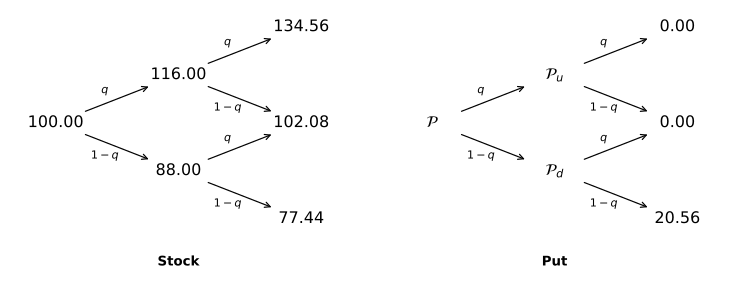
The risk-neutral probability of an up move is: q = \frac{e^{0.09 \times 3/12} - 0.88}{1.16 - 0.88} = 0.5098.
We can then compute:
| Node | Continuation value H | Intrinsic value I | Option value |
|---|---|---|---|
| Up, S = 116 | H_{u} = (0 q + 0 (1 - q)) e^{-0.09 \times 3/12} = 0 | I_{u} = \max(98 - 116, 0) = 0 | \mathcal{P}_{u} = \max(0, 0) = 0 |
| Down, S = 88 | H_{d} = (0 q + 20.56 (1 - q)) e^{-0.09 \times 3/12} = 9.85 | I_{d} = \max(98 - 88, 0) = 10 | \mathcal{P}_{d} = \max(9.85, 10) = 10 |
| Today, S = 100 | H = (0 q + 10 (1 - q)) e^{-0.09 \times 3/12} = 4.79 | I = \max(98 - 100, 0) = 0 | \mathcal{P}= \max(4.79, 0) = 4.79 |
Problem 7 The current price of a stock is $100. Every three months, it is expected to go up or down by 19% or 11%, respectively. The stock pays a dividend yield of 7% per year and the risk-free rate is 7% per year with continuous compounding. Compute the price of an American call option with strike price $98 and maturity six months written on the stock.
Solution
We have that \Delta t = 3/12, u = 1.19 and d = 0.89. The binomial trees for the stock and the American call are as follows:
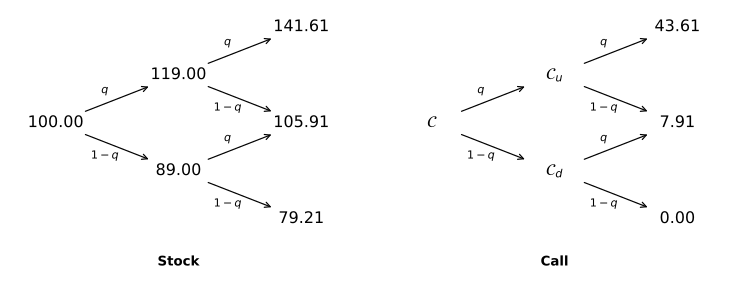
The risk-neutral probability of an up move is: q = \frac{e^{(0.07-0.07) \times 3/12} - 0.89}{1.19 - 0.89} = 0.3667.
We can then compute:
| Node | Continuation value H | Intrinsic value I | Option value |
|---|---|---|---|
| Up, S = 119 | H_{u} = (43.61 q + 7.91 (1 - q)) e^{-0.07 \times 3/12} = 20.64 | I_{u} = \max(119 - 98, 0) = 21 | \mathcal{C}_{u} = \max(20.64, 21) = 21 |
| Down, S = 89 | H_{d} = (7.91 q + 0 (1 - q)) e^{-0.07 \times 3/12} = 2.85 | I_{d} = \max(89 - 98, 0) = 0 | \mathcal{C}_{d} = \max(2.85, 0) = 2.85 |
| Today, S = 100 | H = (21 q + 2.85 (1 - q)) e^{-0.07 \times 3/12} = 9.34 | I = \max(100 - 98, 0) = 2 | \mathcal{C}= \max(9.34, 2) = 9.34 |
Problem 8 Consider an American put option written over a non-dividend paying asset. Which of the following alternatives is correct?
- The option should never be exercised early.
- It might be optimal to exercise the option early if the interest rate is positive.
- The price of the American put should be the same as an American call with the same characteristics.
- It might be optimal to exercise the option early if the interest rate is negative.
Solution
An American put option on a non-dividend paying asset might be worthwhile to exercise early if the interest rate is positive since the time-value of an equivalent European put will be negative for stock prices that are low enough. The correct alternative is b.Problem 9 The current price of a non-dividend paying stock is $150. Every three months, it is expected to go up or down by 20% or 15%, respectively. The risk-free rate is 6% per year with continuous compounding. Compute the price of an American put option with strike price $155 and maturity six months written on the stock.
Solution
The binomial tree for the stock is as follows.
| Time | 0 | 0.25 | 0.5 |
|---|---|---|---|
| 216 | |||
| 180 | |||
| 150 | 153 | ||
| 127.5 | |||
| 108.375 |
The risk-neutral probability of an up-move is q =\frac{e^{0.06 \times 3/12} - 0.85}{1.20 - 0.85} = 0.4718
The binomial tree for the put can be computed as,
| Time | 0 | 0.25 | 0.5 |
|---|---|---|---|
| 0 | |||
| \mathcal{P}_{u} | |||
| \mathcal{P} | 2 | ||
| \mathcal{P}_{d} | |||
| 46.625 |
Problem 10 The current price of a stock is $150. Every six months, it is expected to go up or down by 18% or 11%, respectively. The stock pays a dividend yield of 9% per year and the risk-free rate is 5% per year with continuous compounding. Compute the price of a one-year American call option with strike price $145 written on the stock.
Solution
The binomial tree for the stock is as follows.
| Time | 0 | 0.5 | 1.0 |
|---|---|---|---|
| 208.86 | |||
| 177 | |||
| 150 | 157.53 | ||
| 133.5 | |||
| 118.815 |
The risk-neutral probability of an up-move is q =\frac{e^{(0.05 - 0.09) \times 6/12} - 0.89}{1.18 - 0.89} = 0.3110
The binomial tree for the call can be computed as,
| Time | 0 | 0.5 | 1.0 |
|---|---|---|---|
| 63.86 | |||
| \mathcal{C}_{u} | |||
| \mathcal{C} | 12.53 | ||
| \mathcal{C}_{d} | |||
| 0 |