Interest Rate Risk Management
Bond Price Sensitivity
The term structure of interest rates changes over time, and this of course affects the prices of fixed-income securities. We call interest rate sensitivity how much bond prices change when interest rates change.
The figure below shows how the price of four different bonds change when the YTM changes. We say that a bond is more price sensitive than another if the percentage price change is larger for an equal change in YTM.
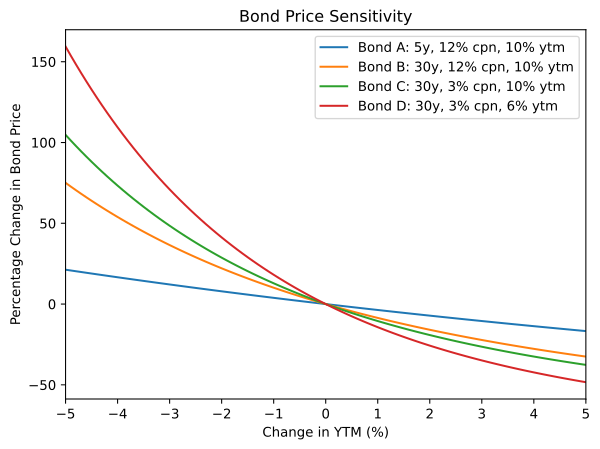
We already saw that bond prices and yields are inversely related, although not in a linear fashion. Indeed, an increase in a bond’s yield to maturity results in a smaller change in price than a decrease in the yield of equal magnitude.
Comparing bonds A and B that have the same coupon rate and the same initial YTM, we can see that long-term bonds are more price sensitive than short-term bonds. Comparing bonds B and C, we can see that for the same maturity the price sensitivity is inversely related to the bond’s coupon rate. Finally, comparing bonds C and D we can see that the price sensitivity of a bond is inversely related to the yield to maturity at which the bond is selling.
Duration
It turns out that the right way to measure bond price sensitivity is to compute the derivative of the bond price with respect to its yield, and that leads to the concept of duration. To make the analysis general, consider a series of cash flows C_{t} paid at the end of each year t = 1, 2, \ldots, T. Let us assume for the moment that the yield curve is flat for all maturities so that all cash flows are discounted at the same rate y expressed per year with annual compounding. V(y) = \frac{C_{1}}{(1+y)^{1}} + \frac{C_{2}}{(1+y)^{2}} + \cdots + \frac{C_{T}}{(1+y)^{T}} In the analysis that follows we will keep the maturity T of the cash flows constant. That is, we are trying to measure the sensitivity of V with respect to an unforeseen and instantaneous change in y. We then have that: \frac{dV}{dy} = -1 \times \frac{C_{1}}{(1+y)^{2}} - 2 \times \frac{C_{2}}{(1+y)^{3}} - \cdots - T \times \frac{C_{T}}{(1+y)^{T+1}}. The previous expression can be rewritten as: \frac{dV}{V} = - \frac{D}{1+y} dy, where D = 1 \times w_{1} + 2 \times w_{2} + \cdots + T \times w_{T}, and w_{t} = \frac{C_{t}/(1+y)^{t}}{V}. The term D is usually called the Macaulay duration of the cash flows. The effective price sensitivity of the cash flows is given by: D_{\text{mod}} = \frac{D}{1+y} and is usually called the modified duration of the cash flows.
The figure below shows the duration of different bonds as a function of their time to maturity.
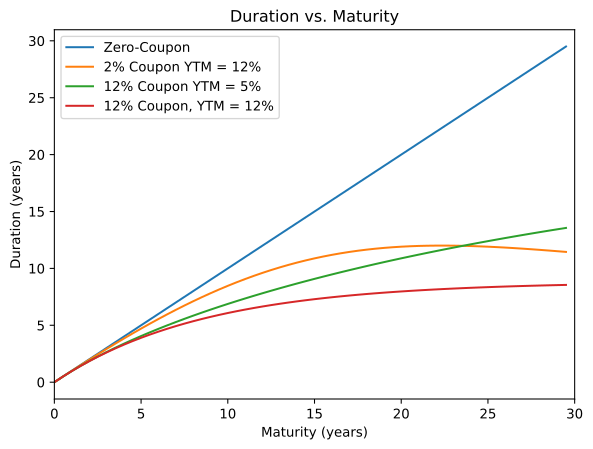
The figure displays interesting properties of the duration of a bond:
- The duration of a zero-coupon bond equals its maturity. Indeed, if there are no coupons there is only one weight that accounts for 100% of the duration at maturity.
- Holding maturity constant, a bond’s duration is higher when the coupon rate is lower. A lower coupon rate means that more weight will go to the principal, increasing its duration.
- Holding the coupon rate constant, a bond’s duration generally increases with its time to maturity. In some cases, though, especially when the YTM is very high compared to the coupon rate, the weight of the face value might decrease with maturity making the weight of the other coupons to increase.
- Holding other factors constant, the duration of a coupon bond is higher when the bond’s yield to maturity is lower. This is because a lower YTM decreases the discounting of the face value, which then contributes to increase the duration.
Example 1 (Duration of a Perpetuity) Consider a perpetuity that pays an annual coupon C when the discount rate is y expressed per year with annual compounding. The value of the perpetuity is: V = \frac{C}{y} \Rightarrow \frac{dV}{dy} = - \frac{C}{y^{2}}. Thus, \frac{dV}{V} = - \frac{1}{y} dy = - \frac{D}{1+y} dy The modified duration of the perpetuity is then 1/y and its Macaulay duration (1+y)/y.
Modified duration is usually used to approximate the change in value of a bond or portfolio for a change in yields.
Example 2 (Change in Value of a Bond) Consider a 4-year annual paying coupon bond with face value $1,000, a coupon rate of 8% and a YTM of 10% per year with annual compounding. The duration of the bond can be calculated as follows.
| Maturity | Cash flow | Discounted cash flow | Weight |
|---|---|---|---|
| 1 | 80 | 72.73 | 7.77% |
| 2 | 80 | 66.12 | 7.06% |
| 3 | 80 | 60.11 | 6.42% |
| 4 | 1080 | 737.65 | 78.76% |
| Total | 936.60 | 100.00% |
The Macaulay duration is then D = 0.0777 \times 1 + 0.0706 \times 2 + 0.0642 \times 3 + 0.7876 \times 4 = 3.56.
If the YTM changes from 10% to 10.50%, the percentage change in price will be: \begin{aligned} \frac{\Delta V}{V} & \approx - \frac{3.56}{1.10} \Delta y \\ & = - \frac{3.56}{1.10} \times 0.0050 \\ & = -1.62\%. \end{aligned}
Convexity
The sensitivity of price with respect to yield is approximated by a linear function when using duration. The relation is really non-linear; in particular, it is convex.
The convexity of a bond is the curvature of its price-yield relationship. The relative price response to a yield change can be better approximated using convexity: \frac{\Delta V}{V} \approx - \frac{D}{1+y} \Delta y + \frac{1}{2} \text{convexity} (\Delta y)^{2}. where \text{convexity} = \frac{d^{2}V}{dy^{2}} \frac{1}{V} = \sum_{t=1}^{T} \frac{t + t^{2}}{(1+y)^{2}} w_{t}, and the weight is computed as for duration.
Example 3 (Change in Value of a Bond) Using the data of Example 2, we computed w_{1} = 0.0777, w_{2} = 0.0706, w_{3} = 0.0642, w_{4} = 0.7876 and D = 3.56. The convexity of a 4-year annual paying coupon bond with face value $1,000, a coupon rate of 8% and a YTM of 10% per year with annual compounding is: \text{convexity} = \frac{1+1^{2}}{1.10^{2}} w_{1} + \frac{2+2^{2}}{1.10^{2}} w_{2} + \frac{3+3^{2}}{1.10^{2}} w_{3} + \frac{4+4^{2}}{1.10^{2}} w_{4} = 14.13.
Adjusting for convexity, if the YTM changes from 10% to 10.50%, the percentage change in price will be approximately equal to: \begin{aligned} \frac{\Delta V}{V} & \approx - \frac{3.56}{1.10} \Delta y + \frac{1}{2} \text{14.13} (\Delta y)^{2} \\ & = - \frac{3.56}{1.10} \times 0.0050 + \frac{1}{2} \text{14.13} (0.0050)^{2} \\ & = -1.60\%. \end{aligned}
When yields decline, the price increase in the bond is underestimated by the simple duration formula. A convexity term corrects the problem. The more convex a bond, the greater the expected price increase for a given decrease in yield and the smaller the expected price decrease. If interest rates are volatile, this is an attractive asymmetry. Investors will have to pay higher prices (accept lower yields) for bonds with more convexity.
Managing Interest Rate Risk Exposure
Investors and financial institutions are subject to interest-rate risk, for instance,
- homeowner: mortgage payments (ARM)
- bank: short-term deposits and long-term loans
- pension fund: owns bonds and must pay retirees
A change in the interest rate results in:
- price risk
- re-investment risk
We will try to construct a portfolio which is insensitive to interest-rate changes.
Immunization
Duration matching or immunization means to choose assets so that their value responds to interest rates exactly as the value of the liabilities does. The change in the value of assets net of liabilities is \Delta V \approx - \frac{D^{\text{assets}} V^{\text{assets}} - D^{\text{liabilities}} V^{\text{liabilities}}}{1+y} \Delta y, which is zero when the dollar durations match, D^{\text{assets}} V^{\text{assets}} = D^{\text{liabilities}} V^{\text{liabilities}}. When assets and liabilities have the same value, this means making their durations equal.
If this is the case, interest rate changes make the values of assets and liabilities change by the same amount: the portfolio is immunized.
Example 4 (The Savings & Loans Crisis) Michael Lewis in his book Liar’s Poker described Savings & Loans (S&L) members as part of the 3-6-3 club: Borrow money at 3 percent, lend it out at 6 percent, and be on the golf course every afternoon by three o’clock.
S&L’s had predominantly short-term deposits (short duration liabilities) and long-term mortgage loans (long duration assets). William Poole, former president FRB St. Louis, declared:
The decline of the savings institutions [in the 80s] was a consequence of rising nominal interest rates combined with duration mismatch.
Example 5 (Pension Fund) A company’s pension fund had liabilities with a duration of about 15 years and assets (bonds) with a duration of about 5 years. This is a duration mismatch.
- Price risk:
- When the interest rate falls, the value of the bonds increases, but the present value of the liabilities increases more.
- Reinvestment risk:
- At the new interest rate, the assets could not be reinvested to make the future payments.
To make things concrete, assume that the pension fund has to pay $100 million in 15 years, and that the current interest rate is 6% per year with annual compounding for all maturities.
Suppose that the pension fund wants to invest in 1-year and 30-year zero-coupon bonds. Remember that the duration of a zero coupon bond is equal to its maturity. If we denote by w_{1} the percentage invested in 1-year bonds and by w_{30} = 1 - w_{1} the percentage invested in 30-year bonds, it must be the case that: 1 \times w_{1} + 30 \times (1 - w_{1}) = 15. which implies that w_{1} = \frac{30 - 15}{30 - 1} = \frac{15}{29} \quad \text{and} \quad w_{30} = \frac{14}{29}.
Since the present value of the liabilities is 100 / 1.06^{15} = \$41.727 million, the fund needs to invest (15/29) \times 41.727 = \$21.583 million in 1-year bonds and 41.727 - 21.583 = \$20.144 million in 30-year bonds to immunize its portfolio.
Problems with Immunization
Immunization in general requires the strategy to be rebalanced. As was shown previously, it is an approximation that assumes:
- A flat term structure of interest rates
- Only risk of changes in the level of interest rates, but not in the slope of the term-structure or other types of shape changes
- Small interest rate changes: improve duration matching by also matching convexity
Practice Problems
These problems give you a chance to practice the concepts introduced in this chapter. Try to solve each one on your own before expanding the solution.
Problem 1 (Duration of a Short Bond) Brennan Mining (BRM) has a 3-year bond with annual coupons at 6% and a face value of $1,000. Its YTM is 5% per year with annual compounding.
- Compute the bond’s price and the weight of each cash flow in its value.
- Compute its Macaulay duration, modified duration, and convexity.
Solution
The discounted cash flows are 60/1.05 = 57.14, 60/1.05^{2} = 54.42, and 1{,}060/1.05^{3} = 915.67, so the price is $1,027.23 and the weights are 5.56%, 5.30%, and 89.14%.
The Macaulay duration is D = 1 \times 0.0556 + 2 \times 0.0530 + 3 \times 0.8914 \approx 2.84 \text{ years}, the modified duration is 2.84/1.05 \approx 2.70, and the convexity is \frac{2 \times 0.0556 + 6 \times 0.0530 + 12 \times 0.8914}{1.05^{2}} \approx 10.09.
Problem 2 (How Good Is the Duration Approximation?) Lena Fischer holds a 10-year Corbel Aerospace bond with annual coupons at 5% and a face value of $1,000, priced at a YTM of 6%. The bond has a price of $926.40, a Macaulay duration of 8.02 years, and a convexity of 72.57.
- Use modified duration to estimate the percentage price change if the YTM rises to 7%, and if it falls to 5%.
- Add the convexity term to both estimates.
- The actual price changes are -7.22\% and +7.94\%. Which approximation does better, and why is the duration estimate too pessimistic in both directions?
Solution
The modified duration is 8.02/1.06 \approx 7.57, so duration predicts -7.57\% for a rise of one percentage point and +7.57\% for a fall.
The convexity term adds \frac{1}{2} \times 72.57 \times 0.01^{2} \approx 0.36\% to both, giving -7.21\% and +7.93\%.
The convexity-adjusted estimates are within about 0.01 percentage points of the actual changes. Duration alone uses a straight line, but the price-yield curve is convex and lies above it, so duration overstates the loss when yields rise and understates the gain when they fall.
Problem 3 (Coupon Rates and Duration) Three 10-year bonds from Ellwood Chemicals all yield 6% per year with annual compounding: a zero-coupon bond, a bond with a 3% coupon, and a bond with a 9% coupon.
- Without computing, rank the three bonds by duration.
- Compute their Macaulay durations.
Solution
The zero-coupon bond has the highest duration, equal to its maturity, and the 9% bond the lowest. Higher coupons put more of the bond’s value in early cash flows.
The durations are 10 years for the zero, about 8.59 years for the 3% bond, and about 7.30 years for the 9% bond.
Problem 4 (A Perpetual Preferred Share) Kestrel Utilities has a preferred share that pays a fixed dividend forever. Investors discount it at 5% per year.
- Compute its modified and Macaulay durations.
- Estimate the percentage price change if the discount rate rises by 25 basis points.
Solution
By Example 1, the modified duration is 1/0.05 = 20 and the Macaulay duration is 1.05/0.05 = 21 years.
The price falls by about 20 \times 0.0025 = 5\%. Even a small change in rates moves the price of a perpetual security a lot.
Problem 5 (The Duration of a Bond Fund) The Halsey Short-Term Bond Fund holds $6 million in bonds with a Macaulay duration of 3.2 years and $4 million in bonds with a Macaulay duration of 8.5 years. Assume a flat yield curve.
- Compute the duration of the fund.
- The fund’s manager, Kai Morgan, wants to lower the fund’s duration to 4 years without changing its size. How much should she move from the long bonds to the short bonds?
Solution
With a flat yield curve, the duration of a portfolio is the value-weighted average of the durations: 0.6 \times 3.2 + 0.4 \times 8.5 = 5.32 years.
She needs a weight w in the long bonds such that 3.2 (1 - w) + 8.5 w = 4, or w = 0.8/5.3 \approx 15.1\%. The fund should hold about $1.51 million in long bonds, so she moves about $2.49 million into the short bonds.
Problem 6 (Immunizing an Insurance Liability) Ridgeway Life must pay $50 million in 8 years. Interest rates are 5% per year with annual compounding for all maturities, and its actuary, Ruth Okonkwo, can invest in 2-year and 12-year zero-coupon bonds.
- Compute the present value of the liability.
- Find the amounts to invest in each zero so that the assets have the same value and duration as the liability.
- What face values of the two zeros does the insurer buy?
Solution
The liability is worth 50/1.05^{8} \approx \$33.84 million.
Writing w_{2} for the weight in 2-year zeros, 2 w_{2} + 12 (1 - w_{2}) = 8 gives w_{2} = 0.4. The insurer invests 0.4 \times 33.84 \approx \$13.54 million in 2-year zeros and $20.31 million in 12-year zeros.
The face values are 13.54 \times 1.05^{2} \approx \$14.92 million for the 2-year zeros and 20.31 \times 1.05^{12} \approx \$36.47 million for the 12-year zeros.
Problem 7 (Testing the Immunized Portfolio) Right after Ridgeway Life sets up the portfolio of Exercise 6, all interest rates jump to 6%.
- Compute the new values of the assets and the liability.
- Repeat for a drop to 4%.
- Explain the results. What must the insurer do as time passes, even if rates do not move again?
Solution
At 6%, the assets are worth 14.92/1.06^{2} + 36.47/1.06^{12} \approx \$31.405 million and the liability 50/1.06^{8} \approx \$31.371 million, a small surplus of about $34,000.
At 4%, the assets are worth about $36.574 million and the liability about $36.535 million, a surplus of about $40,000.
Matching duration makes the first-order effects cancel. The remaining surplus comes from convexity: a portfolio of a short and a long zero is more convex than a single 8-year payment, so it gains on both sides. As time passes, the durations of the assets and of the liability fall at different rates, so the insurer must rebalance to keep them matched.
Problem 8 (A Bank’s Duration Gap) Harrow Bank has $500 million in loans with a duration of 6 years, funded with $450 million in deposits with a duration of 1.5 years. Its equity is the remaining $50 million, and interest rates are 4% for all maturities.
- Estimate the change in the bank’s equity if rates rise by one percentage point.
- What duration of its assets would immunize the bank’s equity?
- How does this connect to the savings and loan crisis described in this note?
Solution
The loans lose about 6/1.04 \times 500 \times 0.01 \approx \$28.85 million and the deposits about 1.5/1.04 \times 450 \times 0.01 \approx \$6.49 million, so equity falls by about $22.36 million, close to half of it.
Equity is immunized when the dollar durations match: D^{\text{assets}} \times 500 = 1.5 \times 450, or D^{\text{assets}} = 1.35 years.
Like the savings and loans of the 1980s, the bank funds long-duration loans with short-duration deposits. Rising rates cut the value of its assets far more than the value of its liabilities.
Problem 9 (What Raises Duration?) Martin Hale, a portfolio manager, compares bonds that differ in one feature at a time. For each pair, which bond has the higher duration, and why?
- Two 15-year bonds yielding 5%, one with a 4% coupon and one with an 8% coupon.
- Two 4% coupon bonds yielding 5%, one maturing in 5 years and one in 20 years.
- Two 20-year bonds with 4% coupons, one yielding 3% and one yielding 9%.
Solution
The 4% coupon bond: lower coupons put more of the value in the principal, which arrives last.
The 20-year bond: holding the coupon rate fixed, duration generally increases with maturity.
The bond yielding 3%: a lower yield discounts the distant principal less, raising its weight in the bond’s value.