"hello".encode("utf-8").hex()'68656c6c6f'Main purpose in this notebook:
Logic of the notebook:
Core mapping: 10101100_2=\mathrm{AC}_{16}=172_{10}, 256\text{ bits}=32\text{ bytes}=64\text{ hex chars}.
"hello".encode("utf-8").hex()'68656c6c6f'Interpretation:
Key properties used in the notebook:
import hashlib

def sha256_hex(s):
    return hashlib.sha256(s.encode("utf-8")).hexdigest()

(sha256_hex("hello world"), sha256_hex("Hello World"))
('b94d27b9934d3e08a52e52d7da7dabfac484efe37a5380ee9088f7ace2efcde9',
'a591a6d40bf420404a011733cfb7b190d62c65bf0bcda32b57b277d9ad9f146e')Key result:
Core block-linking logic:
So hash pointers provide integrity of history, while PoW (next section) provides the cost that enforces that integrity in practice.
PoW validity condition: \text{hash} < \text{target}.
If hash outputs are approximately uniform over a large space, each nonce attempt is a Bernoulli trial with success probability p.
Leading-zero simplification: p=16^{-N},\qquad \mathbb E[K]=\frac{1}{p}=16^N, where K is the number of tries until first success under an N-leading-zero rule.
Economic interpretation:
Pool intuition in the notebook:
Block-time state representation: X_t=(h_{t-1},m_t,\tau_t,T_t), with nonce search until first success K_t=\min\{k:r_{t,k}=1\}.
Confirmation-risk benchmark (attacker share q, honest share p): Q_z= \begin{cases} 1, & p\le q,\\ \left(\frac{q}{p}\right)^z, & p>q, \end{cases} This benchmark implies risk declines exponentially in depth z when q<p.
Interpretation:
The simulation maps theory to computation:
import random
import statistics
import time
import pandas as pd
import matplotlib.pyplot as plt


def mine_once_leading_zeros(N: int, max_tries: int = 2_000_000):
    prev_hash = "0" * 64
    merkle_root = sha256_hex(f"tx-set-{random.randint(0, 10**9)}")
    timestamp = int(time.time())
    target_prefix = "0" * N

    for nonce in range(max_tries):
        header = f"{prev_hash}|{merkle_root}|{timestamp}|{nonce}"
        if sha256_hex(header).startswith(target_prefix):
            return nonce + 1
    return None

settings = [{"N": 2, "reps": 200}, {"N": 3, "reps": 120}, {"N": 4, "reps": 40}]
rows = []
for s in settings:
    N, reps = s["N"], s["reps"]
    samples = [mine_once_leading_zeros(N) for _ in range(reps)]
    samples = [x for x in samples if x is not None]
    rows.append({
        "N": N,
        "reps": len(samples),
        "theory_E_tries": 16**N,
        "empirical_mean": round(statistics.mean(samples), 2),
        "empirical_median": round(statistics.median(samples), 2),
    })

df_summary = pd.DataFrame(rows)
df_summary| N | reps | theory_E_tries | empirical_mean | empirical_median | |
|---|---|---|---|---|---|
| 0 | 2 | 200 | 256 | 257.17 | 195.5 |
| 1 | 3 | 120 | 4096 | 4419.64 | 3656.0 |
| 2 | 4 | 40 | 65536 | 75332.45 | 40441.0 |
How to read the table:
theory_E_tries is the benchmark 16^N from the geometric-success model.empirical_mean should be close to theory with enough repetitions.empirical_median is typically lower than the mean because waiting-time distributions are right-skewed.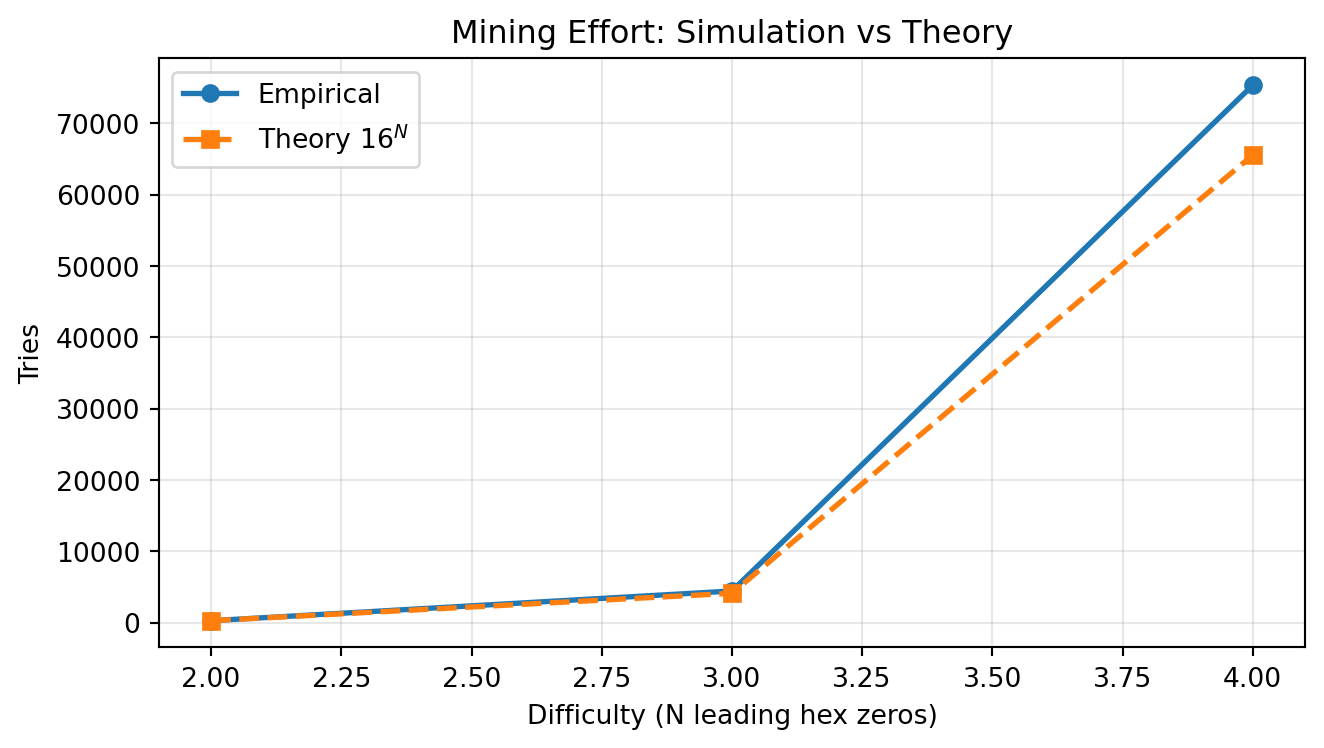
Key result: