Class 1 and 2
The Rate of Return
The total return or holding-period return (HPR) from time 0 to time 1 is defined as \text{HPR} = \frac{P_{1} - P_{0} + D_{1}}{P_{0}}.
The HPR can be decomposed as \text{HPR} = \frac{P_{1} - P_{0}}{P_{0}} + \frac{D_{1}}{P_{0}}.
The first term in the previous expression denotes the capital gain and the second term represents the income yield.
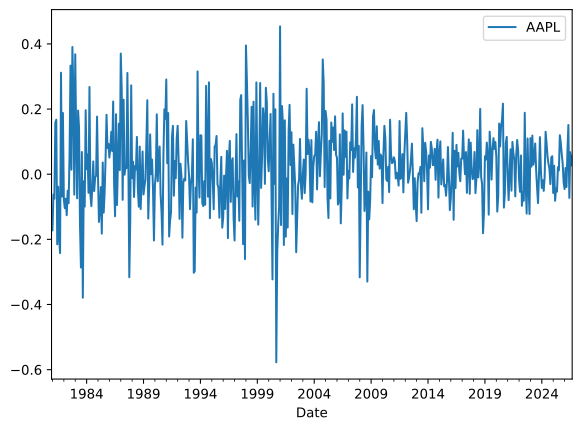
We can compute the average monthly return as \bar{r} = \frac{1}{N} \sum_{t = 1}^{N} r_{t}, and sample standard deviation as \hat{\sigma} = \sqrt{\frac{1}{N - 1} \sum_{t = 1}^{N} (r_{t} - \bar{r})^{2}}. If we assume that the monthly returns are independent and identically distributed, we can annualize the average monthly return and volatility as: \begin{aligned} \bar{r}_{\text{Annual}} & = 12 \times \bar{r}_{\text{Monthly}}, \\ \hat{\sigma}_{\text{Annual}} & = \sqrt{12} \times \hat{\sigma}_{\text{Monthly}}. \end{aligned}
Using these expressions, we get for Apple that
| Monthly Estimate (%) | Annualized Estimate (%) | |
|---|---|---|
| Mean | 2.25 | 27.04 |
| St. Dev. | 12.47 | 43.19 |
Portfolios
Consider a portfolio made up of two assets, A and B, in which you invest W_{A} and W_{B} out of total wealth W, and let r, r_{A}, and r_{B} denote the HPRs of the portfolio and of each asset. Since the portfolio’s payoff next period must equal the sum of the two assets’ payoffs, we have that (1 + r) W = (1 + r_{A}) W_{A} + (1 + r_{B}) W_{B}. Since W = W_{A} + W_{B}, the previous expression can be simplified as r = \frac{W_{A}}{W} r_{A} + \frac{W_{B}}{W} r_{B}. \tag{1} In equation (1), the fractions W_{A} / W and W_{B} / W denote the proportion of wealth allocated to each asset. In finance, we call these fractions the portfolio weights. If we denote by w_{A} and w_{B} these portfolio weights, we can write expression (1) as r = w_{A} r_{A} + w_{B} r_{B}.
Exchange Traded Funds
An ETF is a type of investment fund that is traded on stock exchanges, similar to individual stocks. ETFs hold a diversified portfolio of assets, such as stocks, bonds, or commodities, which provides investors with broad exposure to specific markets or investment strategies.
ETF arbitrage is the mechanism that helps keep the market price of an ETF in line with its Net Asset Value (NAV). Authorized Participants (APs), typically large financial institutions, have the ability to create or redeem ETF shares in large blocks called creation units.
This creation and redemption process happens continuously and helps to keep the ETF price in line with the NAV.
Practice Problems
Suppose the technology sector can rally or slump with equal probability. Solara Robotics (SOLR) returns 55% if the sector rallies and 5% if it slumps. Vantage Cloud (VNTG) returns 45% if the sector rallies and 15% if it slumps. Compute the expected return and standard deviation of returns for SOLR, VNTG, and an equally weighted portfolio composed of the two stocks.
A venture capital fund is evaluating a stake in a biotech startup whose only asset is a drug candidate awaiting an FDA decision one year from now. If the drug is approved, the stake will be worth $220,000; if it is rejected, the stake will be worth $140,000. Analysts view approval and rejection as equally likely. T-bills, the risk-free alternative, currently yield 3% per year.
- Given the uncertainty around a regulatory decision, the fund requires a risk premium of 9%, so it discounts the expected payoff at 3 + 9 = 12%. What is the price the fund should be willing to pay for the stake today?
- Suppose the fund acquires the stake at the price found in part a. What is the expected rate of return on the investment?
- Assume now that the Federal Reserve raises rates immediately and T-bills now yield 4%. Assuming the fund’s required risk premium is unchanged, what is the new price of the stake? Is the expected return on a purchase at this new price higher or lower than in part b?