Stochastic Calculus
Continuous-time finance needs two tools that ordinary calculus does not provide. The first is an integral against Brownian motion, \int_{0}^{t} b_{s} \mathop{}\!\mathrm{d}B_{s}, which measures the gains from a trading strategy when prices are driven by Brownian noise. The second is a chain rule, which tells us how a function of a random process evolves, for example the price of an option as a function of the stock price. The notes on Brownian motion showed why neither tool carries over from ordinary calculus: Brownian paths have infinite total variation and a quadratic variation equal to elapsed time.
These notes construct the Itô integral, define the class of Itô processes built from it, and derive Itô’s formula, the chain rule of stochastic calculus. They close with Girsanov’s theorem, which shows how changing the probability measure changes the drift of a Brownian motion while leaving its volatility untouched. These are the tools used in the notes on asset pricing in continuous time. These notes draw on Shreve (2004) and Steele (2001).
Throughout, \{B_{t}\} is a Brownian motion and \mathcal{F}_{t} is the information generated by observing it up to time t. A process \{b_{t}\} is adapted if the value of b_{t} is known given \mathcal{F}_{t}, that is, if it depends only on the path of the Brownian motion up to time t.
The Itô Integral
Trading Gains
Suppose the price of an asset follows a Brownian motion, and an investor rebalances a position at the dates 0 = t_{0} < t_{1} < \cdots < t_{n} = t. The investor holds b_{t_{j}} units of the asset from t_{j} to t_{j + 1}, and the position is chosen at t_{j} using only the information available then. The gains from trading up to time t are I_{t} = \sum_{j = 0}^{n - 1} b_{t_{j}} \left(B_{t_{j + 1}} - B_{t_{j}}\right). \tag{1} The holding in each period is evaluated at the left endpoint of the period, because the investor chooses it before observing the price change. An integrand of this form, constant on each period and adapted, is called a simple process, and (1) is its Itô integral.
For a general adapted integrand b_{t}, we approximate it by simple processes on finer and finer partitions and define the Itô integral as the limit of the corresponding sums, \int_{0}^{t} b_{s} \mathop{}\!\mathrm{d}B_{s} = \lim_{\lVert{\Pi}\rVert \to 0} \sum_{j = 0}^{n - 1} b_{t_{j}} \left(B_{t_{j + 1}} - B_{t_{j}}\right). \tag{2} The limit is taken in mean square, not path by path. The notes on Brownian motion explain why: Brownian paths have infinite total variation, so the sums need not converge along each path, and where we evaluate the integrand in each subinterval affects the limit. The next example shows how much it matters.
An Example: \int B \mathop{}\!\mathrm{d}B
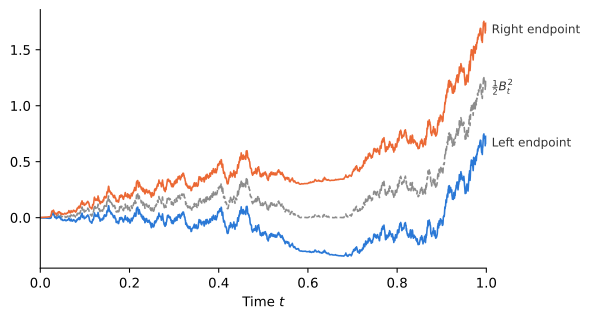
In ordinary calculus, \int_{0}^{T} x \mathop{}\!\mathrm{d}x = \frac{1}{2} T^{2}, so we might guess that \int_{0}^{T} B_{s} \mathop{}\!\mathrm{d}B_{s} = \frac{1}{2} B_{T}^{2}. To compute the Itô integral, write \Delta B_{j} = B_{t_{j + 1}} - B_{t_{j}} and use the identity B_{t_{j}} \Delta B_{j} = \frac{1}{2} \left(B_{t_{j + 1}}^{2} - B_{t_{j}}^{2}\right) - \frac{1}{2} (\Delta B_{j})^{2}. Summing over j, the first term telescopes, and the second term is half of the sum of squared increments Q_{\Pi}, which converges to T: \sum_{j = 0}^{n - 1} B_{t_{j}} \Delta B_{j} = \frac{1}{2} B_{T}^{2} - \frac{1}{2} Q_{\Pi} \xrightarrow[\lVert{\Pi}\rVert \to 0]{} \frac{1}{2} B_{T}^{2} - \frac{1}{2} T. Therefore, \int_{0}^{T} B_{s} \mathop{}\!\mathrm{d}B_{s} = \frac{1}{2} \left(B_{T}^{2} - T\right). \tag{3} The extra term -\frac{1}{2} T comes from the quadratic variation of Brownian motion. If we had evaluated B at the right endpoint instead, the same identity with a plus sign would give \frac{1}{2} (B_{T}^{2} + T). In ordinary calculus both choices give the same limit because the quadratic variation of a smooth function is zero.
The left endpoint is the economically meaningful choice. The trading gains in (3) have expected value zero, as they should when the investor cannot see the next price change. The right-endpoint sum has expected value T, which is what an investor could earn by choosing each position after seeing the price move.
Properties of the Itô Integral
The properties of the Itô integral follow from a single fact: each increment B_{t_{j + 1}} - B_{t_{j}} has mean zero and is independent of \mathcal{F}_{t_{j}}, while the holding b_{t_{j}} is known at t_{j}.
Proof for simple integrands
Let b be a simple process and I_{t} as in (1), and write \Delta B_{j} = B_{t_{j + 1}} - B_{t_{j}} and \Delta t_{j} = t_{j + 1} - t_{j}. Since b_{t_{j}} is known at t_{j} and \Delta B_{j} is independent of \mathcal{F}_{t_{j}}, \operatorname{E}\left(b_{t_{j}} \Delta B_{j} \mid \mathcal{F}_{t_{j}}\right) = b_{t_{j}} \operatorname{E}(\Delta B_{j}) = 0, \qquad \operatorname{E}\left(b_{t_{j}}^{2} \Delta B_{j}^{2} \mid \mathcal{F}_{t_{j}}\right) = b_{t_{j}}^{2} \Delta t_{j}.
Martingale. Take s = t_{k} to be one of the partition dates. Then I_{t} = I_{s} + \sum_{j \geq k} b_{t_{j}} \Delta B_{j}, and for each j \geq k the tower property gives \operatorname{E}(b_{t_{j}} \Delta B_{j} \mid \mathcal{F}_{s}) = \operatorname{E}\left(\operatorname{E}(b_{t_{j}} \Delta B_{j} \mid \mathcal{F}_{t_{j}}) \mid \mathcal{F}_{s}\right) = 0. Therefore, \operatorname{E}(I_{t} \mid \mathcal{F}_{s}) = I_{s}. Adding s to the partition handles the case where s is not a partition date.
Isometry. Expanding the square, \operatorname{E}(I_{t}^{2}) = \sum_{j} \operatorname{E}\left(b_{t_{j}}^{2} \Delta B_{j}^{2}\right) + 2 \sum_{j < k} \operatorname{E}\left(b_{t_{j}} \Delta B_{j} \, b_{t_{k}} \Delta B_{k}\right). In each cross term with j < k, everything except \Delta B_{k} is known at t_{k}, so conditioning on \mathcal{F}_{t_{k}} makes the term zero. Conditioning each diagonal term on \mathcal{F}_{t_{j}} gives \operatorname{E}(I_{t}^{2}) = \sum_{j} \operatorname{E}\left(b_{t_{j}}^{2}\right) \Delta t_{j} = \operatorname{E}\left(\int_{0}^{t} b_{s}^{2} \mathop{}\!\mathrm{d}s\right).
Quadratic variation. On a partition that refines the dates of b, the integrand is constant on each subinterval, so the squared increments of I are b_{t_{j}}^{2} \Delta B_{j}^{2}. The same argument as for the isometry, applied to the differences D_{j} = b_{t_{j}}^{2} (\Delta B_{j}^{2} - \Delta t_{j}), shows that the cross terms vanish, and using \operatorname{V}(\Delta B_{j}^{2}) = 2 \Delta t_{j}^{2} from the notes on Brownian motion, \operatorname{E}\left(\left(\sum_{j} b_{t_{j}}^{2} \Delta B_{j}^{2} - \sum_{j} b_{t_{j}}^{2} \Delta t_{j}\right)^{2}\right) = \sum_{j} \operatorname{E}\left(b_{t_{j}}^{4}\right) 2 \Delta t_{j}^{2} \leq 2 \lVert{\Pi}\rVert \sum_{j} \operatorname{E}\left(b_{t_{j}}^{4}\right) \Delta t_{j}. If each b_{t_{j}} has a finite fourth moment, the right-hand side goes to zero as \lVert{\Pi}\rVert \to 0, so the sum of squared increments of I converges in mean square to \sum_{j} b_{t_{j}}^{2} \Delta t_{j} = \int_{0}^{t} b_{s}^{2} \mathop{}\!\mathrm{d}s.The isometry is what makes the general definition (2) work. It says that the mean-square distance between the integrals of two simple processes equals the mean-square distance between the integrands. If a sequence of simple processes gets closer and closer to b, their integrals get closer and closer to each other and converge in mean square to a limit, which is the Itô integral of b. The three properties survive the limit, so they hold for every adapted integrand with \operatorname{E}\left(\int_{0}^{t} b_{s}^{2} \mathop{}\!\mathrm{d}s\right) < \infty.
The martingale property is the continuous-time version of a familiar fact: a gambler who chooses bets using only past information cannot turn a fair game into a favorable one. The isometry and the quadratic variation say that a position of b_{s} units adds b_{s}^{2} \mathop{}\!\mathrm{d}s to the variance of the gains.
Example 1 For I_{T} = \int_{0}^{T} B_{s} \mathop{}\!\mathrm{d}B_{s} = \frac{1}{2} (B_{T}^{2} - T), the isometry gives \operatorname{E}(I_{T}^{2}) = \operatorname{E}\left(\int_{0}^{T} B_{s}^{2} \mathop{}\!\mathrm{d}s\right) = \int_{0}^{T} s \mathop{}\!\mathrm{d}s = \frac{1}{2} T^{2}. We can check this directly. Since B_{T}^{2} / T has a chi-squared distribution with one degree of freedom, \operatorname{V}(B_{T}^{2}) = 2 T^{2}, and therefore \operatorname{V}(I_{T}) = \frac{1}{4} \operatorname{V}(B_{T}^{2}) = \frac{1}{2} T^{2}. The process I_{t} = \frac{1}{2} (B_{t}^{2} - t) is a martingale, which recovers the martingale B_{t}^{2} - t from the notes on Brownian motion.
Deterministic Integrands
When the integrand is a deterministic function f(s), the Itô integral is a normal random variable: \int_{0}^{t} f(s) \mathop{}\!\mathrm{d}B_{s} \sim \mathcal{N}\left(0, \int_{0}^{t} f(s)^{2} \mathop{}\!\mathrm{d}s\right). Each approximating sum \sum_{j} f(t_{j}) \Delta B_{j} is a sum of independent normal random variables and is therefore normal, with mean zero and variance \sum_{j} f(t_{j})^{2} \Delta t_{j}. A mean-square limit of normal random variables is normal, and the variance converges to \int_{0}^{t} f(s)^{2} \mathop{}\!\mathrm{d}s. Integrals of this type describe interest rate models such as the one of Vasicek (1977), in which the effect of past shocks decays exponentially.
Example 2 The integral \int_{0}^{T} (T - s) \mathop{}\!\mathrm{d}B_{s} weights early shocks more heavily than late ones. It is normal with mean zero and variance \int_{0}^{T} (T - s)^{2} \mathop{}\!\mathrm{d}s = \frac{T^{3}}{3}. This integral equals \int_{0}^{T} B_{s} \mathop{}\!\mathrm{d}s, the area under the Brownian path, as we show below with Itô’s formula.
Local Martingales
The Itô integral can be defined under the weaker condition that \int_{0}^{t} b_{s}^{2} \mathop{}\!\mathrm{d}s < \infty along almost every path, without requiring its expectation to be finite. The resulting integral still has zero drift, but it may fail to be a martingale. Such a process is called a local martingale. The distinction appears in the notes on asset pricing, where the pricing equation says that discounted gains have zero drift, which makes them local martingales, and an additional condition is needed to conclude that they are martingales. In these notes we always assume \operatorname{E}\left(\int_{0}^{t} b_{s}^{2} \mathop{}\!\mathrm{d}s\right) < \infty, so stochastic integrals are martingales.
Itô Processes
Most processes in continuous-time finance are built from a time integral and an Itô integral.
The differential notation is shorthand for the integral equation. The term a_{t} \mathop{}\!\mathrm{d}t is the drift and b_{t} \mathop{}\!\mathrm{d}B_{t} is the diffusion term, with b_{t} the volatility. Over a short interval, \operatorname{E}(\mathop{}\!\mathrm{d}X_{t} \mid \mathcal{F}_{t}) = a_{t} \mathop{}\!\mathrm{d}t and \operatorname{V}(\mathop{}\!\mathrm{d}X_{t} \mid \mathcal{F}_{t}) = b_{t}^{2} \mathop{}\!\mathrm{d}t. The drift and the volatility of an Itô process are uniquely determined by its paths. In particular, an Itô process is a martingale only if its drift is zero, and checking whether a process is a martingale amounts to checking whether its drift vanishes. Both the Brownian motion with drift X_{t} = \mu t + \sigma B_{t} and the stock price models in the next notes are Itô processes.
The drift contributes nothing to the quadratic variation of an Itô process. Using the multiplication table from the notes on Brownian motion, (\mathop{}\!\mathrm{d}X_{t})^{2} = a_{t}^{2} (\mathop{}\!\mathrm{d}t)^{2} + 2 a_{t} b_{t} (\mathop{}\!\mathrm{d}t)(\mathop{}\!\mathrm{d}B_{t}) + b_{t}^{2} (\mathop{}\!\mathrm{d}B_{t})^{2} = b_{t}^{2} \mathop{}\!\mathrm{d}t, so that [X, X]_{t} = \int_{0}^{t} b_{s}^{2} \mathop{}\!\mathrm{d}s. The drift moves the process by amounts of order \mathop{}\!\mathrm{d}t, whose squares are negligible, while the diffusion term moves it by amounts of order \sqrt{\mathop{}\!\mathrm{d}t}. A rigorous proof follows the bounds used for (\mathop{}\!\mathrm{d}B)(\mathop{}\!\mathrm{d}t) and (\mathop{}\!\mathrm{d}t)^{2} in the notes on Brownian motion, with the coefficients a and b carried along.
Itô’s Formula
The Formula
Let Y_{t} = f(X_{t}, t), where f(x, t) is a smooth function. A second-order Taylor expansion gives \mathop{}\!\mathrm{d}Y_{t} = \frac{\partial f}{\partial t} \mathop{}\!\mathrm{d}t+ \frac{\partial f}{\partial x} \mathop{}\!\mathrm{d}X_{t} + \frac{1}{2} \frac{\partial^{2} f}{\partial x^{2}} (\mathop{}\!\mathrm{d}X_{t})^{2} + \frac{\partial^{2} f}{\partial x \partial t} (\mathop{}\!\mathrm{d}X_{t})(\mathop{}\!\mathrm{d}t) + \frac{1}{2} \frac{\partial^{2} f}{\partial t^{2}} (\mathop{}\!\mathrm{d}t)^{2} + \cdots In ordinary calculus, every term after the first-order ones is negligible. Here (\mathop{}\!\mathrm{d}X_{t})^{2} = b_{t}^{2} \mathop{}\!\mathrm{d}t is of the same order as \mathop{}\!\mathrm{d}t and must be kept, while the terms with (\mathop{}\!\mathrm{d}X_{t})(\mathop{}\!\mathrm{d}t), (\mathop{}\!\mathrm{d}t)^{2}, and higher powers of \mathop{}\!\mathrm{d}X_{t} vanish.
Sketch of proof
Fix a partition of [0, t] and write \Delta X_{j} = X_{t_{j + 1}} - X_{t_{j}} and \Delta t_{j} = t_{j + 1} - t_{j}. Telescoping and expanding each increment of f around (X_{t_{j}}, t_{j}), f(X_{t}, t) - f(X_{0}, 0) = \sum_{j} \left(\frac{\partial f}{\partial t} \Delta t_{j} + \frac{\partial f}{\partial x} \Delta X_{j} + \frac{1}{2} \frac{\partial^{2} f}{\partial x^{2}} \Delta X_{j}^{2}\right) + \sum_{j} R_{j}, with the derivatives evaluated at (X_{t_{j}}, t_{j}). As \lVert{\Pi}\rVert \to 0:
- The first sum converges to \int_{0}^{t} \frac{\partial f}{\partial t} \mathop{}\!\mathrm{d}s, a Riemann sum.
- Substituting \Delta X_{j} \approx a_{t_{j}} \Delta t_{j} + b_{t_{j}} \Delta B_{j}, the second sum converges to \int_{0}^{t} \frac{\partial f}{\partial x} a_{s} \mathop{}\!\mathrm{d}s + \int_{0}^{t} \frac{\partial f}{\partial x} b_{s} \mathop{}\!\mathrm{d}B_{s}. The derivative is evaluated at the left endpoint, so the stochastic part is the Itô integral (2).
- The third sum converges to \frac{1}{2} \int_{0}^{t} \frac{\partial^{2} f}{\partial x^{2}} b_{s}^{2} \mathop{}\!\mathrm{d}s, by the same argument that gives the quadratic variation of the Itô integral, with \frac{\partial^{2} f}{\partial x^{2}} b^{2} in place of b^{2}.
- The remainder R_{j} contains terms of order \Delta t_{j}^{2}, \Delta X_{j} \Delta t_{j}, and |\Delta X_{j}|^{3}. The first two vanish for the same reasons as (\mathop{}\!\mathrm{d}t)^{2} and (\mathop{}\!\mathrm{d}B)(\mathop{}\!\mathrm{d}t). For the third, \sum_{j} |\Delta X_{j}|^{3} \leq \max_{j} |\Delta X_{j}| \sum_{j} \Delta X_{j}^{2}, where the maximum goes to zero by continuity of the paths and the sum converges to [X, X]_{t}.
The term \frac{1}{2} b_{t}^{2} \frac{\partial^{2} f}{\partial x^{2}} \mathop{}\!\mathrm{d}t is the Itô correction. It has no counterpart in ordinary calculus, and it comes entirely from the quadratic variation of Brownian motion. In practice, Itô’s formula is applied mechanically: expand f to second order in \mathop{}\!\mathrm{d}X and to first order in \mathop{}\!\mathrm{d}t, then simplify the products with the multiplication table. Some texts, including the notes on modeling stock prices, call the result Itô’s lemma.
Examples
Example 3 Let f(x) = x^{2} and X_{t} = B_{t}, so that a = 0 and b = 1. Itô’s formula gives \mathop{}\!\mathrm{d}(B_{t}^{2}) = 2 B_{t} \mathop{}\!\mathrm{d}B_{t} + \frac{1}{2} \times 2 \, (\mathop{}\!\mathrm{d}B_{t})^{2} = 2 B_{t} \mathop{}\!\mathrm{d}B_{t} + \mathop{}\!\mathrm{d}t. In integral form, B_{T}^{2} = 2 \int_{0}^{T} B_{s} \mathop{}\!\mathrm{d}B_{s} + T, which is (3). The direct calculation with telescoping sums took several steps, while Itô’s formula gives it in one line. The drift of B_{t}^{2} is one, so subtracting t produces the martingale B_{t}^{2} - t.
Example 4 Let Z_{t} = \exp\left(\theta B_{t} - \frac{1}{2} \theta^{2} t\right), the exponential martingale from the notes on Brownian motion. With f(x, t) = e^{\theta x - \frac{1}{2} \theta^{2} t}, we have \frac{\partial f}{\partial t} = -\frac{1}{2} \theta^{2} f, \frac{\partial f}{\partial x} = \theta f, and \frac{\partial^{2} f}{\partial x^{2}} = \theta^{2} f. Therefore, \mathop{}\!\mathrm{d}Z_{t} = -\frac{1}{2} \theta^{2} Z_{t} \mathop{}\!\mathrm{d}t+ \theta Z_{t} \mathop{}\!\mathrm{d}B_{t} + \frac{1}{2} \theta^{2} Z_{t} \mathop{}\!\mathrm{d}t= \theta Z_{t} \mathop{}\!\mathrm{d}B_{t}. The Itô correction exactly offsets the -\frac{1}{2} \theta^{2} t in the exponent, so the drift is zero, confirming that Z_{t} is a martingale. The process solves \mathop{}\!\mathrm{d}Z_{t} / Z_{t} = \theta \mathop{}\!\mathrm{d}B_{t}, whose percentage changes are pure noise. The notes on modeling stock prices solve \mathop{}\!\mathrm{d}S_{t} / S_{t} = \mu \mathop{}\!\mathrm{d}t+ \sigma \mathop{}\!\mathrm{d}B_{t} with the same calculation.
Example 5 Let f(x, t) = t x and X_{t} = B_{t}. Since \frac{\partial^{2} f}{\partial x^{2}} = 0, there is no Itô correction, and \mathop{}\!\mathrm{d}(t B_{t}) = B_{t} \mathop{}\!\mathrm{d}t+ t \mathop{}\!\mathrm{d}B_{t}. Integrating from 0 to T, T B_{T} = \int_{0}^{T} B_{s} \mathop{}\!\mathrm{d}s + \int_{0}^{T} s \mathop{}\!\mathrm{d}B_{s}. Writing T B_{T} = \int_{0}^{T} T \mathop{}\!\mathrm{d}B_{s} and rearranging gives \int_{0}^{T} B_{s} \mathop{}\!\mathrm{d}s = \int_{0}^{T} (T - s) \mathop{}\!\mathrm{d}B_{s}, so the area under a Brownian path is normal with variance T^{3} / 3, as claimed in Example 2.
Several Processes
Itô’s Formula for Two Processes
For a smooth function f(x, y, t) of two Itô processes, the second-order expansion now includes a cross term: \mathop{}\!\mathrm{d}f = \frac{\partial f}{\partial t} \mathop{}\!\mathrm{d}t+ \frac{\partial f}{\partial x} \mathop{}\!\mathrm{d}X + \frac{\partial f}{\partial y} \mathop{}\!\mathrm{d}Y + \frac{1}{2} \frac{\partial^{2} f}{\partial x^{2}} (\mathop{}\!\mathrm{d}X)^{2} + \frac{\partial^{2} f}{\partial x \partial y} (\mathop{}\!\mathrm{d}X)(\mathop{}\!\mathrm{d}Y) + \frac{1}{2} \frac{\partial^{2} f}{\partial y^{2}} (\mathop{}\!\mathrm{d}Y)^{2}. The most useful case is f(x, y) = x y, which gives the product rule \mathop{}\!\mathrm{d}(X_{t} Y_{t}) = X_{t} \mathop{}\!\mathrm{d}Y_{t} + Y_{t} \mathop{}\!\mathrm{d}X_{t} + (\mathop{}\!\mathrm{d}X_{t})(\mathop{}\!\mathrm{d}Y_{t}). The last term is the stochastic correction, and it vanishes when either process has no diffusion term. When both processes are positive, dividing by X_{t} Y_{t} gives the product rule in terms of percentage changes, \frac{\mathop{}\!\mathrm{d}(X_{t} Y_{t})}{X_{t} Y_{t}} = \frac{\mathop{}\!\mathrm{d}X_{t}}{X_{t}} + \frac{\mathop{}\!\mathrm{d}Y_{t}}{Y_{t}} + \left(\frac{\mathop{}\!\mathrm{d}X_{t}}{X_{t}}\right)\left(\frac{\mathop{}\!\mathrm{d}Y_{t}}{Y_{t}}\right), the form used in the notes on discount factors in continuous time.
Example 6 A stock follows \mathop{}\!\mathrm{d}S_{t} / S_{t} = \mu \mathop{}\!\mathrm{d}t+ \sigma \mathop{}\!\mathrm{d}B_{t}, and a money-market account grows as \beta_{t} = e^{r t}. The discount factor 1 / \beta_{t} = e^{-r t} is a smooth function of time, so \mathop{}\!\mathrm{d}(1 / \beta_{t}) = -r (1 / \beta_{t}) \mathop{}\!\mathrm{d}t with no diffusion term. The product rule then gives \frac{\mathop{}\!\mathrm{d}(S_{t} / \beta_{t})}{S_{t} / \beta_{t}} = \frac{\mathop{}\!\mathrm{d}S_{t}}{S_{t}} - r \mathop{}\!\mathrm{d}t= (\mu - r) \mathop{}\!\mathrm{d}t+ \sigma \mathop{}\!\mathrm{d}B_{t}. The discounted stock price has drift \mu - r, the expected excess return of the stock, and the same volatility as the stock.
Changing the Probability Measure
Girsanov’s Theorem
The drift of the discounted stock price in Example 6 is the risk premium \mu - r. In the notes on derivatives pricing we will want to work in a world where this drift is zero, so that discounted prices are martingales. Girsanov’s theorem shows that we can remove a drift by reweighting the probabilities of the paths, without changing the paths themselves.
Let \theta be a constant and T > 0, and consider the exponential martingale Z_{t} = \exp\left(-\theta B_{t} - \tfrac{1}{2} \theta^{2} t\right), \qquad 0 \leq t \leq T, which satisfies \mathop{}\!\mathrm{d}Z_{t} / Z_{t} = -\theta \mathop{}\!\mathrm{d}B_{t} by Example 4. Since Z_{T} > 0 and \operatorname{E}(Z_{T}) = Z_{0} = 1, we can define a new probability measure \operatorname{P}^{*} by \operatorname{P}^{*}(A) = \operatorname{E}\left(Z_{T} \mathbf{1}_{\{A\}}\right), \qquad \operatorname{E}^{*}(Y) = \operatorname{E}(Z_{T} Y). Under \operatorname{P}^{*}, each path is weighted by Z_{T}. When \theta > 0, paths that end high receive less weight and paths that end low receive more, which shifts the distribution of the Brownian motion down.
Proof for constant \theta
For a random variable Y known at time t \leq T, the tower property and the martingale property of Z give \operatorname{E}^{*}(Y) = \operatorname{E}(Z_{T} Y) = \operatorname{E}\left(\operatorname{E}(Z_{T} \mid \mathcal{F}_{t}) \, Y\right) = \operatorname{E}(Z_{t} Y). The paths of B^{*} are continuous and B_{0}^{*} = 0, so it remains to show that its increments are independent and normal under \operatorname{P}^{*}. Take s < t, and write \Delta B = B_{t} - B_{s} and \Delta B^{*} = B_{t}^{*} - B_{s}^{*} = \Delta B + \theta (t - s). For real u and v, \operatorname{E}^{*}\left(e^{u B_{s}^{*} + v \Delta B^{*}}\right) = \operatorname{E}\left(Z_{t} \, e^{u B_{s}^{*} + v \Delta B^{*}}\right) = \operatorname{E}\left(e^{(u - \theta) B_{s}}\right) e^{(u \theta - \frac{1}{2} \theta^{2}) s} \; \operatorname{E}\left(e^{(v - \theta) \Delta B}\right) e^{(v \theta - \frac{1}{2} \theta^{2})(t - s)}, where we split Z_{t} into a factor that depends on B_{s} and a factor that depends on \Delta B, and used the independence of B_{s} and \Delta B. Using the normal MGF \operatorname{E}(e^{c B_{s}}) = e^{\frac{1}{2} c^{2} s}, the first factor equals e^{\frac{1}{2} (u - \theta)^{2} s + u \theta s - \frac{1}{2} \theta^{2} s} = e^{\frac{1}{2} u^{2} s}, and in the same way the second factor equals e^{\frac{1}{2} v^{2} (t - s)}. The joint MGF factors into the MGF of a \mathcal{N}(0, s) random variable in u times the MGF of a \mathcal{N}(0, t - s) random variable in v. Therefore, under \operatorname{P}^{*} the increments B_{s}^{*} and B_{t}^{*} - B_{s}^{*} are independent and normal with the variances of a Brownian motion. The same calculation applies to any finite number of increments.In differential notation, Girsanov’s theorem says \mathop{}\!\mathrm{d}B_{t} = \mathop{}\!\mathrm{d}B_{t}^{*} - \theta \mathop{}\!\mathrm{d}t. Under \operatorname{P} the process B has no drift, while under \operatorname{P}^{*} it has drift -\theta. An Itô process \mathop{}\!\mathrm{d}X_{t} = a_{t} \mathop{}\!\mathrm{d}t+ b_{t} \mathop{}\!\mathrm{d}B_{t} becomes \mathop{}\!\mathrm{d}X_{t} = (a_{t} - \theta b_{t}) \mathop{}\!\mathrm{d}t+ b_{t} \mathop{}\!\mathrm{d}B_{t}^{*} under \operatorname{P}^{*}. The change of measure shifts the drift by -\theta b_{t} and leaves the volatility b_{t} unchanged. This makes sense: the volatility is determined by the quadratic variation, which is computed path by path, and \operatorname{P}^{*} reweights the paths without changing them. Since Z_{T} > 0, the two measures also agree on which events are impossible.
Example 7 For the discounted stock price in Example 6, choosing \theta = (\mu - r) / \sigma gives \frac{\mathop{}\!\mathrm{d}(S_{t} / \beta_{t})}{S_{t} / \beta_{t}} = (\mu - r - \theta \sigma) \mathop{}\!\mathrm{d}t+ \sigma \mathop{}\!\mathrm{d}B_{t}^{*} = \sigma \mathop{}\!\mathrm{d}B_{t}^{*}. Under \operatorname{P}^{*} the discounted stock price has no drift, and the stock itself satisfies \mathop{}\!\mathrm{d}S_{t} / S_{t} = r \mathop{}\!\mathrm{d}t+ \sigma \mathop{}\!\mathrm{d}B_{t}^{*}. The required \theta is the instantaneous Sharpe ratio of the stock, which the notes on derivatives pricing denote by \lambda.
This is the construction behind the risk-neutral measure. The notes on derivatives pricing build Z_{t} from the stochastic discount factor, show that \operatorname{P}^{*} makes every discounted price a martingale, and use it to price options.