Brownian Motion
Asset prices, interest rates, and exchange rates move all the time, by small amounts, in response to a constant flow of news. The Poisson process is the wrong model for this kind of noise, since it stays constant most of the time and moves only by jumps. Brownian motion is the model for cumulative noise that never stops moving. It is the building block of the stochastic differential equations used to model stock prices and the source of the Black-Scholes formula.
Brownian motion plays the same role for continuous noise that the Poisson process plays for sudden events. Both arise as limits of sums of Bernoulli random variables, both have independent and stationary increments, and both generate three martingales with the same structure. The Poisson process comes from rare events, each of size one. Brownian motion comes from coin flips that occur very often, each of a tiny size. These notes construct Brownian motion as the limit of a scaled random walk, study its martingales, and then show that its paths are far rougher than the smooth functions of ordinary calculus. That roughness is what makes stochastic calculus different from ordinary calculus.
These notes draw on Shreve (2004).
From Random Walks to Brownian Motion
The Symmetric Random Walk
Let X_{1}, X_{2}, \ldots be independent random variables that take the values +1 and -1 with probability 1/2 each, so that \operatorname{E}(X_{i}) = 0 and \operatorname{V}(X_{i}) = 1. The symmetric random walk S_{n} = X_{1} + \cdots + X_{n} records the cumulative gains from betting one dollar on each of n flips of a fair coin. We already know three of its properties:
- For m < n, the increment S_{n} - S_{m} = X_{m + 1} + \cdots + X_{n} depends only on the flips between m + 1 and n, so increments over disjoint periods are independent, and \operatorname{V}(S_{n} - S_{m}) = n - m.
- Both S_{n} and S_{n}^{2} - n are martingales, as shown in the notes on discrete-time martingales.
- Every step has size one, so the sum of squared increments along any path is n.
This last quantity, [S, S]_{n} = \sum_{i = 1}^{n} (S_{i} - S_{i - 1})^{2} = \sum_{i = 1}^{n} X_{i}^{2} = n, is the quadratic variation of the walk. Unlike the variance, which averages over all possible paths, quadratic variation is computed from a single path. For the random walk every path has the same quadratic variation, because every step has size one.
A Scaled Random Walk
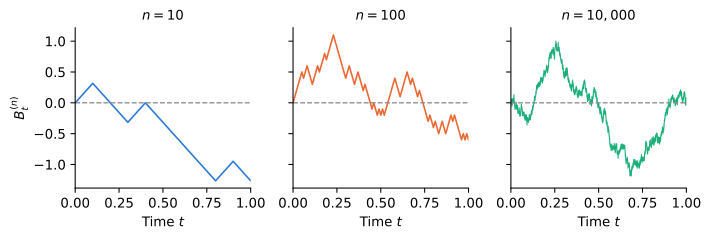
To move to continuous time, we speed up the walk and shrink its steps. Divide a time interval into slots of length \Delta t, and at the end of each slot move up or down by \sqrt{\Delta t}. After m slots, at time t = m \Delta t, the position of the scaled random walk is B_{t}^{(n)} = \sqrt{\Delta t} \, (X_{1} + X_{2} + \cdots + X_{m}), where n = 1 / \Delta t is the number of steps per unit of time. Its mean, variance, and quadratic variation are \operatorname{E}(B_{t}^{(n)}) = 0, \qquad \operatorname{V}(B_{t}^{(n)}) = m \Delta t = t, \qquad [B^{(n)}, B^{(n)}]_{t} = \sum_{j = 1}^{m} (\sqrt{\Delta t} \, X_{j})^{2} = m \Delta t = t.
The step size \sqrt{\Delta t} is the only choice that keeps the variance at time t equal to t as the slots get shorter. With steps of size \Delta t the variance would be t \Delta t and the walk would collapse to zero, while with steps of size one it would explode. Over a short interval, the scaled walk moves by an amount of order \sqrt{\Delta t}, which is much larger than \Delta t. This simple fact is behind every result in these notes.
The Limit
As \Delta t \to 0, the number of steps up to time t grows while each step shrinks, which is the setting of the central limit theorem in the notes on generating functions. Using the characteristic function \cos(u) of a fair coin flip, also from those notes, the characteristic function of B_{t}^{(n)} is \phi_{B_{t}^{(n)}}(u) = \cos\left(u \sqrt{\Delta t}\right)^{t / \Delta t} = \left(1 - \frac{u^{2} \Delta t}{2} + o(\Delta t)\right)^{t / \Delta t} \xrightarrow[\Delta t \to 0]{} e^{-\frac{1}{2} u^{2} t}, where we used \cos(x) = 1 - \frac{1}{2} x^{2} + o(x^{2}). The limit is the characteristic function of a \mathcal{N}(0, t) random variable, so by Lévy’s continuity theorem B_{t}^{(n)} converges in distribution to \mathcal{N}(0, t).
As with the Poisson process, the construction gives us more than the distribution at a single date. For s < t, the increment B_{t}^{(n)} - B_{s}^{(n)} is built from the flips between s and t, which are independent of the flips before s. The same argument shows that it converges to a \mathcal{N}(0, t - s) random variable, whose distribution depends only on the length of the interval. In addition, the paths of the scaled walk move by at most \sqrt{\Delta t} in each step, which suggests that the limit has no jumps. These properties survive the limit and define Brownian motion.
Brownian Motion
Definition
The first two properties are the same as for the Poisson process. The third replaces a Poisson increment with mean \lambda (t - s) by a normal increment with variance t - s, and the fourth rules out the jumps that are the defining feature of the Poisson process. Brownian motion is sometimes called the Wiener process, and some texts denote it by W_{t}.
Since B_{t} = B_{t} - B_{0} is normal with mean zero and variance t, we have \operatorname{E}(B_{t}) = 0 and \operatorname{V}(B_{t}) = t. For s \leq t, writing B_{t} = B_{s} + (B_{t} - B_{s}) and using the independence of the increment from B_{s}, \operatorname{Cov}(B_{s}, B_{t}) = \operatorname{Cov}(B_{s}, B_{s}) + \operatorname{Cov}(B_{s}, B_{t} - B_{s}) = s + 0 = s. Therefore, \operatorname{Cov}(B_{s}, B_{t}) = \operatorname{E}(B_{s} B_{t}) = \min(s, t) for all s, t \geq 0. The value of Brownian motion at a later date is its current value plus independent noise, so for s \leq t the correlation between B_{s} and B_{t} is \sqrt{s / t}. It depends on the ratio of the two dates rather than on the gap between them, and fades as t grows relative to s.
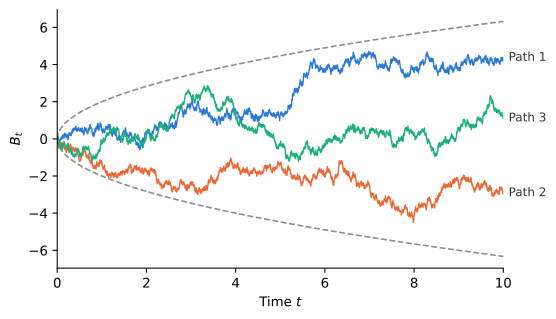
Compare Figure 2 with the Poisson paths in the previous notes. Both processes have independent and stationary increments, but a Brownian path is never flat. Over a short interval of length \mathop{}\!\mathrm{d}t, the increment \mathop{}\!\mathrm{d}B_{t} = B_{t + \mathop{}\!\mathrm{d}t} - B_{t} has mean zero and standard deviation \sqrt{\mathop{}\!\mathrm{d}t}, so the path moves by an amount far larger than \mathop{}\!\mathrm{d}t in every short interval, in one direction or the other.
Martingales of Brownian Motion
Let \mathcal{F}_{t} denote the information generated by observing \{B_{s} \colon s \leq t\} up to time t. As for the Poisson process, increments of Brownian motion are independent of the past, so conditional expectations of functions of B_{t} - B_{s} given \mathcal{F}_{s} reduce to ordinary expectations.
Proof
Fix s < t and write \Delta B = B_{t} - B_{s}, which is independent of \mathcal{F}_{s} and has a \mathcal{N}(0, t - s) distribution, so that \operatorname{E}(\Delta B) = 0 and \operatorname{E}(\Delta B^{2}) = t - s.
For the first process, \operatorname{E}(B_{t} \mid \mathcal{F}_{s}) = B_{s} + \operatorname{E}(\Delta B) = B_{s}. For the second, expanding B_{t}^{2} = B_{s}^{2} + 2 B_{s} \Delta B + \Delta B^{2} gives \operatorname{E}(B_{t}^{2} - t \mid \mathcal{F}_{s}) = B_{s}^{2} + 2 B_{s} \operatorname{E}(\Delta B) + \operatorname{E}(\Delta B^{2}) - t = B_{s}^{2} + (t - s) - t = B_{s}^{2} - s. For the third, the MGF of a \mathcal{N}(0, t - s) random variable is \operatorname{E}(e^{\theta \Delta B}) = e^{\frac{1}{2} \theta^{2} (t - s)}, so that \operatorname{E}(Z_{t} \mid \mathcal{F}_{s}) = Z_{s} \, \operatorname{E}\left(e^{\theta \Delta B}\right) e^{-\frac{1}{2} \theta^{2} (t - s)} = Z_{s}.These are the same three martingales we found for the Poisson process, and the proofs are identical line by line. The first two are the continuous-time versions of the random walk martingales S_{n} and S_{n}^{2} - n. The exponential martingale has the form e^{\theta B_{t} - t K(\theta)} found in the notes on generating functions, where K(\theta) = \frac{1}{2} \theta^{2} is the cumulant generating function of B_{1}. The exponential martingale is the tool we will later use to change probability measures, and the next section uses it to compute the probability that a process ever reaches a barrier.
Application: Hitting a Barrier
Many questions in finance ask whether a process ever reaches a given level: whether the value of a firm’s assets falls far enough to trigger default, whether a stock reaches the barrier of a knock-out option, or whether a fund loses half of its value. A simple model for the logarithm of such a value is a Brownian motion with drift, X_{t} = \mu t + \sigma B_{t}, which grows on average at the rate \mu and has volatility \sigma > 0. Let \tau be the first time X_{t} reaches either a lower barrier -a < 0 or an upper barrier b > 0. This is the gambler’s ruin problem from the notes on ruin probabilities, in continuous time and with a drift.
Proof
Applying the exponential martingale with \theta \sigma in place of \theta shows that \exp\left(\theta \sigma B_{t} - \frac{1}{2} \theta^{2} \sigma^{2} t\right) is a martingale for every \theta. Since \theta \sigma B_{t} = \theta X_{t} - \theta \mu t, this martingale equals \exp\left(\theta X_{t} - \left(\theta \mu + \tfrac{1}{2} \theta^{2} \sigma^{2}\right) t\right). Choosing \theta = -\gamma = -2 \mu / \sigma^{2} makes the coefficient of t zero, so Y_{t} = e^{-\gamma X_{t}} is a martingale.
The stopped process Y_{t \land \tau} is also a martingale, so \operatorname{E}(Y_{t \land \tau}) = Y_{0} = 1 for every t. Since X_{t \land \tau} stays between -a and b, the stopped process is bounded. The stopping time is finite with probability one, because \{\tau > t\} \subset \{-a < X_{t} < b\} and X_{t} is normal with standard deviation \sigma \sqrt{t}, so \operatorname{P}(\tau > t) \leq \operatorname{P}(-a < X_{t} < b) \to 0 as t \to \infty. Letting t \to \infty gives \operatorname{E}(Y_{\tau}) = 1, the continuous-time version of the optional stopping theorem in the notes on discrete-time martingales. Because the paths are continuous, X_{\tau} equals -a or b exactly. Writing p = \operatorname{P}(X_{\tau} = -a), p \, e^{\gamma a} + (1 - p) \, e^{-\gamma b} = 1, and solving for p gives (1). If \mu > 0, then \gamma > 0 and e^{-\gamma b} \to 0 as b \to \infty, so p \to e^{-\gamma a}, the probability of ever reaching -a.The argument is the one used for the gambler and for the insurer: find a martingale, stop it at the hitting time, and compare its value at the start with its value at the stopping time. The quantity e^{-\gamma} plays the role of q / p for the biased random walk. There is an important difference with Lundberg’s inequality in the notes on Poisson processes. The surplus of the insurer jumps below zero by a random amount, so its value at the ruin time is unknown and the argument gives only a bound. Brownian paths are continuous and hit the barrier exactly, so here the argument gives the exact probability. As \mu \to 0, (1) converges to b / (a + b), the ruin probability of the fair gambler.
Example 1 The logarithm of the value of an endowment fund, relative to its initial value, follows a Brownian motion with drift \mu = 0.04 and volatility \sigma = 0.15 per year. The fund loses half of its value when X_{t} falls by a = \ln 2 = 0.6931. With \gamma = 2 \times 0.04 / 0.15^{2} = 3.5556, the probability that the fund ever loses half of its value is e^{-\gamma a} = e^{-3.5556 \times 0.6931} = 0.085. The probability that it halves before it doubles follows from (1) with a = b = \ln 2 and equals 0.0784.
The drift \mu in this example is the growth rate of the logarithm of the fund’s value, which is lower than the expected return on the fund. The notes on modeling stock prices derive the relation between the two.
Total and Quadratic Variation
Variation of Smooth Functions
To measure how much a function moves over [0, T], take a partition \Pi = \{t_{0}, t_{1}, \ldots, t_{n}\} with 0 = t_{0} < t_{1} < \cdots < t_{n} = T, and let \lVert{\Pi}\rVert = \max_{j} (t_{j + 1} - t_{j}) be its mesh, the length of its longest subinterval. The total variation and the quadratic variation of a function f are V_{T}(f) = \lim_{\lVert{\Pi}\rVert \to 0} \sum_{j = 0}^{n - 1} |f(t_{j + 1}) - f(t_{j})|, \qquad [f, f]_{T} = \lim_{\lVert{\Pi}\rVert \to 0} \sum_{j = 0}^{n - 1} (f(t_{j + 1}) - f(t_{j}))^{2}. Total variation is the distance traveled by the function, up and down. Quadratic variation adds up squared moves instead.
Suppose f has a continuous derivative. By the mean-value theorem, each increment can be written as f(t_{j + 1}) - f(t_{j}) = f'(t_{j}^{*}) (t_{j + 1} - t_{j}) for some t_{j}^{*} in [t_{j}, t_{j + 1}]. The sum of absolute increments is then a Riemann sum, \sum_{j = 0}^{n - 1} |f'(t_{j}^{*})| (t_{j + 1} - t_{j}) \xrightarrow[\lVert{\Pi}\rVert \to 0]{} \int_{0}^{T} |f'(t)| \mathop{}\!\mathrm{d}t, so the total variation is finite. For the sum of squared increments, one factor of t_{j + 1} - t_{j} is at most \lVert{\Pi}\rVert, so \sum_{j = 0}^{n - 1} f'(t_{j}^{*})^{2} (t_{j + 1} - t_{j})^{2} \leq \lVert{\Pi}\rVert \sum_{j = 0}^{n - 1} f'(t_{j}^{*})^{2} (t_{j + 1} - t_{j}) \xrightarrow[\lVert{\Pi}\rVert \to 0]{} 0 \times \int_{0}^{T} f'(t)^{2} \mathop{}\!\mathrm{d}t= 0. A smooth function has finite total variation and zero quadratic variation. Over a short interval it moves by an amount proportional to the length of the interval, and squaring such small moves makes them negligible.
Quadratic Variation of Brownian Motion
Brownian motion moves by about \sqrt{t_{j + 1} - t_{j}} over each subinterval, so its squared moves are of the same order as t_{j + 1} - t_{j} and do not become negligible. They add up to the length of the interval.
Proof
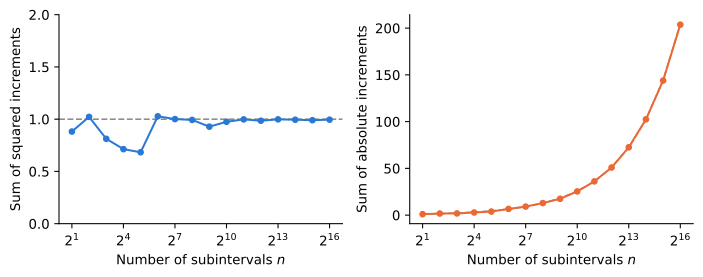
Write \Delta B_{j} = B_{t_{j + 1}} - B_{t_{j}} and \Delta t_{j} = t_{j + 1} - t_{j}. Each increment is \mathcal{N}(0, \Delta t_{j}), so \operatorname{E}(\Delta B_{j}^{2}) = \Delta t_{j} and \operatorname{E}(Q_{\Pi}) = \sum_{j = 0}^{n - 1} \Delta t_{j} = T. A standard normal random variable Z has \operatorname{E}(Z^{4}) = 3, and \Delta B_{j} has the same distribution as \sqrt{\Delta t_{j}} \, Z, so \operatorname{E}(\Delta B_{j}^{4}) = 3 \Delta t_{j}^{2} and \operatorname{V}(\Delta B_{j}^{2}) = \operatorname{E}(\Delta B_{j}^{4}) - \operatorname{E}(\Delta B_{j}^{2})^{2} = 3 \Delta t_{j}^{2} - \Delta t_{j}^{2} = 2 \Delta t_{j}^{2}. The increments are independent, so the variance of their sum is the sum of their variances, \operatorname{V}(Q_{\Pi}) = 2 \sum_{j = 0}^{n - 1} \Delta t_{j}^{2} \leq 2 \lVert{\Pi}\rVert \sum_{j = 0}^{n - 1} \Delta t_{j} = 2 \lVert{\Pi}\rVert T. Therefore, \operatorname{E}\left((Q_{\Pi} - T)^{2}\right) = \operatorname{V}(Q_{\Pi}) \to 0 as \lVert{\Pi}\rVert \to 0. By Chebyshev’s inequality, \operatorname{P}(|Q_{\Pi} - T| > \varepsilon) \leq \operatorname{V}(Q_{\Pi}) / \varepsilon^{2} \to 0 for every \varepsilon > 0, so Q_{\Pi} also converges to T in probability.The scaled random walk has quadratic variation t on every path, and Brownian motion inherits this property in the limit. Each squared increment (B_{t_{j + 1}} - B_{t_{j}})^{2} is random, but on a fine partition there are many of them, they are independent, and their sum has a vanishing variance. Quadratic variation is computed from a single path, and the result is essentially the same on every path. This is the main contrast with the Poisson process, whose quadratic variation [N, N]_{t} = N_{t} is random.
The Multiplication Table
In differential notation, [B, B]_{t} = t reads (\mathop{}\!\mathrm{d}B)^{2} = \mathop{}\!\mathrm{d}t. Two more limits complete the picture. Let M_{\Pi} = \max_{j} |B_{t_{j + 1}} - B_{t_{j}}| be the largest move of the path over the partition. Brownian paths are continuous, so M_{\Pi} \to 0 as \lVert{\Pi}\rVert \to 0, and \left|\sum_{j = 0}^{n - 1} (B_{t_{j + 1}} - B_{t_{j}}) (t_{j + 1} - t_{j})\right| \leq M_{\Pi} T \to 0, \qquad \sum_{j = 0}^{n - 1} (t_{j + 1} - t_{j})^{2} \leq \lVert{\Pi}\rVert T \to 0. Together these results give the multiplication table of Brownian motion, (\mathop{}\!\mathrm{d}B)^{2} = \mathop{}\!\mathrm{d}t, \qquad (\mathop{}\!\mathrm{d}B)(\mathop{}\!\mathrm{d}t) = 0, \qquad (\mathop{}\!\mathrm{d}t)^{2} = 0, sometimes called box calculus. The table does not say that each squared increment equals the length of its interval. It says that sums of squared increments behave like sums of time increments, and the next notes use it in exactly that way to derive Itô’s formula. For the Poisson process the first entry is (\mathop{}\!\mathrm{d}N)^{2} = \mathop{}\!\mathrm{d}N instead.
Infinite Total Variation
The quadratic variation result implies that Brownian paths travel an infinite distance over any interval. For each subinterval, (B_{t_{j + 1}} - B_{t_{j}})^{2} \leq M_{\Pi} \, |B_{t_{j + 1}} - B_{t_{j}}|, and summing over j gives \sum_{j = 0}^{n - 1} |B_{t_{j + 1}} - B_{t_{j}}| \geq \frac{Q_{\Pi}}{M_{\Pi}}. As the mesh goes to zero, the numerator approaches T > 0 while the denominator goes to zero, so the sum of absolute increments grows without bound. The total variation of Brownian motion over [0, T] is infinite. The right panel of Figure 3 shows the sum growing like \sqrt{n}, since each of the n increments has an expected absolute value proportional to \sqrt{T / n}.
A path with a continuous derivative on some interval would have finite total variation there, so Brownian paths are not smooth on any interval, however short. In fact a stronger result holds: with probability one, a Brownian path does not have a derivative at any point. The proof of this result requires a separate argument, but Figure 1 and Figure 2 already show why: a Brownian path wiggles at every scale, and zooming in never makes it look straight.
Infinite total variation is the reason we need a new calculus. An integral \int_{0}^{T} f(t) \mathop{}\!\mathrm{d}g(t) can be defined path by path as a limit of sums \sum f(t_{j}) (g(t_{j + 1}) - g(t_{j})) whenever f is continuous and g has finite total variation, and the point in each subinterval at which f is evaluated does not matter in the limit. With g = B it does matter. For f = B, evaluating at the right endpoint instead of the left changes the sum by \sum (B_{t_{j + 1}} - B_{t_{j}})^{2} = Q_{\Pi}, which converges to T rather than to zero. The Itô integral in the notes on stochastic calculus evaluates the integrand at the left endpoint and is defined as a limit in mean square, relying on the same independence of increments that made \operatorname{V}(Q_{\Pi}) vanish. The nonzero quadratic variation then adds the extra term in Itô’s formula that has no counterpart in ordinary calculus.