Options Spreads
An option spread is a strategy that combines two or more options of the same type — either all calls or all puts — on the same underlying asset. By simultaneously buying and selling options at different strike prices, spreads let investors express a directional or range-bound view on the stock while capping both potential gains and losses.
Bull Spread
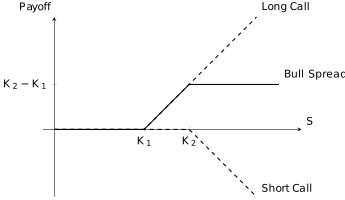
A bull spread is a two-leg option strategy that consists of a long position in a call with strike K_{1} and a short position in a call with strike K_{2}, where K_{1} < K_{2}.
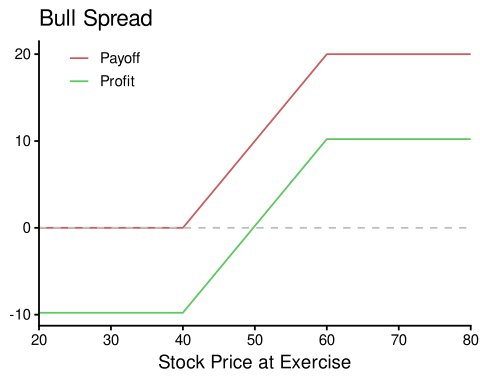
Example 1 A non-dividend paying stock currently trades at $50. Call options with strikes $40 and $60 trade for $13.23 and $3.45, respectively. A bull spread that goes long the call with strike $40 and shorts the call with strike $60 costs 13.23 - 3.45 = $9.78. Below are some possible bull spread payoffs and profits for different stock prices at maturity:
| Stock Price | 30 | 40 | 50 | 60 | 70 |
|---|---|---|---|---|---|
| Payoff | 0 | 0 | 10 | 20 | 20 |
| Profit | -9.78 | -9.78 | 0.22 | 10.22 | 10.22 |
The bull spread caps the maximum gains and losses at 20 - 9.78 = $10.22 and 0 - 9.78 = -$9.78, respectively.
We can derive the payoff table of the bull spread by combining the payoffs of the long call with strike price K_{1} and the short call with strike price K_{2} > K_{1}.
| S \leq K_{1} | K_{1} < S \leq K_{2} | K_{2} < S | |
|---|---|---|---|
| Long Call | 0 | S - K_{1} | S - K_{1} |
| Short Call | 0 | 0 | -(S - K_{2}) |
| Bull Spread | 0 | S - K_{1} | K_{2} - K_{1} |
The previous analysis shows that the payoff of the bull spread is either zero or positive. Thus, no-arbitrage implies that the cost of a bull spread cannot be negative, that is, C_{1} - C_{2} \geq 0. If this were not the case, you could build a bull spread with a negative cost! This proves that a call with a lower strike cannot cost less than an otherwise equivalent call with a higher strike price, so that C_{1} \geq C_{2}. In other words, if we keep everything else constant, the call premium is a decreasing function of the strike price. 1
1 In mathematics, we use partial derivatives to analyze changes in a variable while keeping everything else constant. Therefore, assuming that the call premium C(K) is a differentiable function of the strike K, we could write the previous statement as \frac{\partial C(K)}{\partial K} < 0, which is equivalent to say that the function is decreasing in the strike price.
When K_{2} - K_{1} is small, the bull spread is like an all-or-nothing bet on the stock finishing above K_{2}: the payoff is either zero or approximately K_{2} - K_{1}.
Bear Spread
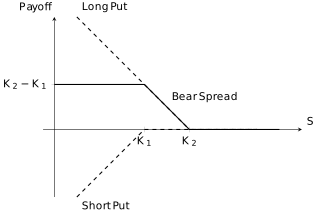
A bear spread is a two-leg option strategy that consists of a long position in a put with strike K_{2} and a short position in a put with strike K_{1}, where K_{1} < K_{2}.
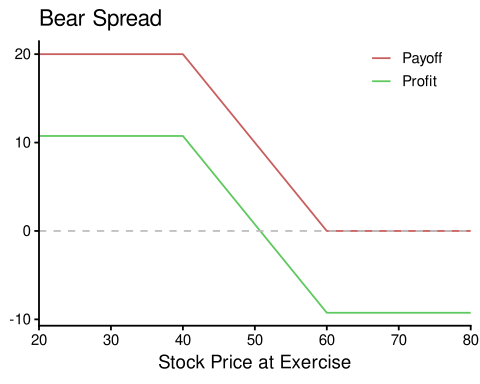
Example 2 A non-dividend paying stock currently trades at $50. Put options with strikes K_{1} = \$40 and K_{2} = \$60 trade for $1.28 and $10.53, respectively. A bear spread that goes long the put with strike K_{2} and shorts the put with strike K_{1} costs 10.53 - 1.28 = $9.25. Below are some possible bear spread payoffs and profits for different stock prices at maturity:
| Stock Price | 30 | 40 | 50 | 60 | 70 |
|---|---|---|---|---|---|
| Payoff | 20 | 20 | 10 | 0 | 0 |
| Profit | 10.75 | 10.75 | 0.75 | -9.25 | -9.25 |
The bear spread caps the maximum gains and losses at 20 - 9.25 = $10.75 and 0 - 9.25 = -$9.25, respectively.
As we did with the bull spread, we can derive the payoff table of the bear spread by writing down the payoffs of the long and short puts.
| S \leq K_{1} | K_{1} < S \leq K_{2} | S > K_{2} | |
|---|---|---|---|
| Long Put | K_{2} - S | K_{2} - S | 0 |
| Short Put | -(K_{1} - S) | 0 | 0 |
| Bear Spread | K_{2} - K_{1} | K_{2} - S | 0 |
The payoff table of the bear spread shows that the strategy can either pay nothing, or a positive amount. Thus, no-arbitrage implies that the cost of a bear spread cannot be negative, that is, P_{2} - P_{1} \geq 0. If not, you could build a bear spread with a negative cost! This implies that a put with a higher strike must cost more than an otherwise equivalent put with a lower strike price: P_{2} \geq P_{1}. In words, keeping everything else constant, the put premium is an increasing function of the strike price.
When K_{2} - K_{1} is small, the bear spread is like an all-or-nothing bet on the stock finishing below K_{1}: the payoff is either zero or approximately K_{2} - K_{1}.
Butterfly
A butterfly is a three-leg option strategy that consists of a long call with strike K_{1}, short two calls with strike K_{2} and a long call with strike K_{3} where K_{1} < K_{2} < K_{3} and K_{2} = (K_{1} + K_{3}) / 2. The figure below shows the payoff of the different long and short calls, as well as the resulting butterfly.
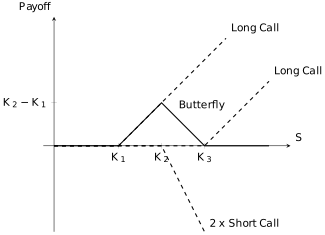
The figure shows that the butterfly pays off if the stock price stays around K_{2}. In that sense the butterfly looks similar to a short straddle. The butterfly, though, unlike a short straddle, is a debit position, meaning that you must pay something to establish it. This allows traders to take on similar exposure to a short straddle while limiting their downside to whatever the butterfly costs.
Example 3 A non-dividend paying stock currently trades at $50. Call options with strikes $45, $50 and $55 trade for $9.85, $7.12 and $5.01, respectively. A butterfly with strikes $45, $50 and $55 then costs 9.85 - 2(7.12) + 5.01 = $0.63. Below are some possible butterfly payoffs and profits for different stock prices at maturity:
| Stock Price | 35 | 40 | 45 | 50 | 55 | 60 | 65 |
|---|---|---|---|---|---|---|---|
| Payoff | 0 | 0 | 0 | 5 | 0 | 0 | 0 |
| Profit | -0.62 | -0.62 | -0.62 | 4.38 | -0.62 | -0.62 | -0.62 |
The butterfly makes a profit if the stock stays very close to $50. The return of getting the bet right is big. If the stock price ends up at $50 at maturity then you would make 4.38/0.62 = 706% on your investment!
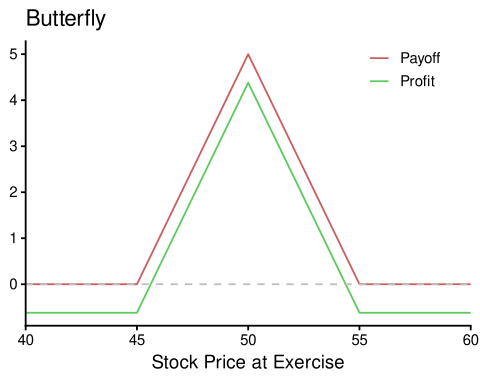
The payoff of a butterfly can then be described as follows. The first long call pays off whenever S > K_{1}, whereas the two short calls lose if S > K_{2}. Finally, the third long call pays off whenever S > K_{3}.
| S \leq K_{1} | K_{1} < S \leq K_{2} | K_{2} < S \leq K_{3} | S > K_{3} | |
|---|---|---|---|---|
| Long Call | 0 | S - K_{1} | S - K_{1} | S - K_{1} |
| 2 x Short Call | 0 | 0 | 2 (K_{2} - S) | 2 (K_{2} - S) |
| Long Call | 0 | 0 | 0 | S - K_{3} |
| Butterfly | 0 | S - K_{1} | K_{3} - S | 0 |
Note that the butterfly can also be obtained by buying puts with strikes K_{1} and K_{3}, and shorting two puts with strikes K_{2} = (K_{1} + K_{3})/2.
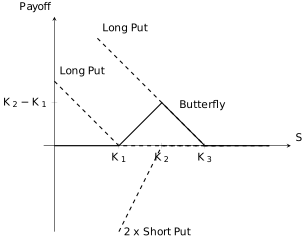
The figure shows that the payoff obtained using puts is the same as the one obtained when using call options. Also, the payoff of the butterfly is non-negative, which implies that the cost of the butterfly must be positive. Combining these two observations, no-arbitrage then implies that: P_{1} - 2 P_{2} + P_{3} = C_{1} - 2 C_{2} + C_{3} \geq 0, which in turn implies that P_{2} \leq \dfrac{P_{1} + P_{3}}{2} and C_{2} \leq \dfrac{C_{1} + C_{3}}{2}. In words, this means that both the call and the put are convex functions in the strike price. This is because the average of the option prices at the two outer strikes is higher than the option price at the middle strike K_{2}.
Condor
Similar to the butterfly, a condor is a four-leg option strategy that consists of a long call with strike K_{1}, a short call with strike K_{2}, a short call with strike K_{3} and a long call with strike K_{4} where K_{1} < K_{2} < K_{3} < K_{4} with K_{2} - K_{1} = K_{4} - K_{3}. The condor pays off when the stock price stays within the range [K_{2}, K_{3}] and is cheaper than the butterfly because it is willing to accept any price in that range rather than requiring the stock to finish near a single point.
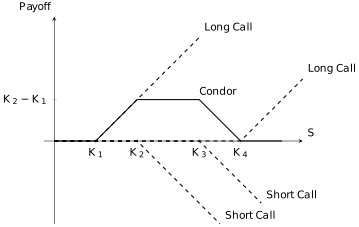
Example 4 A non-dividend paying stock currently trades at $50. Call options with strikes $40, $45, $55 and $60 trade for $13.23, $9.85, $5.01 and $3.45, respectively. A condor built using those strikes then costs 13.23 - 9.85 - 5.01 + 3.45 = $1.82. Below are some possible condor payoffs and profits for different stock prices at maturity:
| S | 35 | 40 | 45 | 50 | 55 | 60 | 65 |
|---|---|---|---|---|---|---|---|
| Payoff | 0 | 0 | 5 | 5 | 5 | 0 | 0 |
| Profit | -1.82 | -1.82 | 3.18 | 3.18 | 3.18 | -1.82 | -1.82 |
The condor makes a profit if the stock stays between $41.82 and $58.18.
The payoff table of the condor follows the same logic as the butterfly.
| S \leq K_{1} | K_{1} < S \leq K_{2} | K_{2} < S \leq K_{3} | K_{3} < S \leq K_{4} | S > K_{4} | |
|---|---|---|---|---|---|
| Long Call 1 | 0 | S - K_{1} | S - K_{1} | S - K_{1} | S - K_{1} |
| Short Call 2 | 0 | 0 | -(S - K_{2}) | -(S - K_{2}) | -(S - K_{2}) |
| Short Call 3 | 0 | 0 | 0 | -(S - K_{3}) | -(S - K_{3}) |
| Long Call 4 | 0 | 0 | 0 | 0 | S - K_{4} |
| Condor | 0 | S - K_{1} | K_{2} - K_{1} | K_{4} - S | 0 |
Since the condor payoff is never negative, no-arbitrage implies that the cost of a condor must be non-negative: C_{1} - C_{2} - C_{3} + C_{4} \geq 0.
Practice Problems
Problem 1 Suppose that put options on a stock with strike prices $30 and $35 cost $4 and $7, respectively. How can the options be used to create a bull spread and a bear spread? Construct a table that shows the profit and payoff for both spreads as a function of S when S \leq 30, 30 < S \leq 35 and S > 35.
Solution
The bull spread is synthesized by going long the put with strike $30 and short the put with strike $35. The cost of the strategy is 4 - 7 = -$3. The payoff and profit as a function of S is:
| S \leq 30 | 30 < S \leq 35 | S > 35 | |
|---|---|---|---|
| Payoff | -5 | S - 35 | 0 |
| Profit | -2 | S - 32 | 3 |
The bear spread is synthesized by going short the put with strike $30 and long the put with strike $35. The cost of the strategy is -4 + 7 = $3. The payoff and profit as a function of S is:
| S \leq 30 | 30 < S \leq 35 | S > 35 | |
|---|---|---|---|
| Payoff | 5 | 35 - S | 0 |
| Profit | 2 | 32 - S | -3 |
Problem 2 Three put options on a stock have the same expiration date and strike prices of $55, $60, and $65. The market prices are $3, $5, and $8, respectively. Explain how a butterfly spread can be created. Construct a table showing the profit from the strategy as a function of S. For what range of stock prices would the butterfly spread lead to a loss?
Solution
The butterfly spread is synthesized by going long the put with strike $55, short two puts with strike $60 and long the put with strike $65. The cost of the strategy is 3 - 2 \cdot 5 + 8 = \$1.
| S \leq 55 | 55 < S \leq 60 | 60 < S \leq 65 | S > 65 | |
|---|---|---|---|---|
| Payoff | 0 | S - 55 | 65 - S | 0 |
| Profit | -1 | S - 56 | 64 - S | -1 |
Problem 3 Suppose you purchase one call option written on stock WFM, expiring in May, with strike price $100, for $5. At the same time, you write one call on WFM, expiring in May, with strike $105, for $2. If at expiration the price of a share of WFM stock is $103, compute the profit per share.