Modeling Stock Prices in Continuous-Time
To price a derivative, we need a model for how the underlying asset price evolves over time. This note develops that model from first principles. We begin with the discrete-time random walk, build intuition about how randomness accumulates, and then pass to the continuous-time limit to arrive at geometric Brownian motion (GBM) — the standard model for stock prices. We then introduce the tools of stochastic calculus, most importantly Ito’s Lemma, which tells us how smooth functions of a stochastic process evolve. Together, these results yield the exact distribution of future stock prices under GBM and lay the groundwork for the Black-Scholes pricing formula.
Stochastic Processes
A stochastic process is a collection of random variables indexed by time, used to model the evolution of an uncertain quantity. Unlike a single random variable — which captures uncertainty at one point in time — a stochastic process describes how that uncertainty unfolds dynamically: how a quantity moves, fluctuates, and accumulates randomness as time passes. In finance, stochastic processes are used to model stock prices, interest rates, volatility, and exchange rates, among others.
A central concept is the sample path: a single possible trajectory of the process over time. A stochastic process can be thought of as generating a whole family of such paths, each occurring with some probability. When we simulate a stock price model, each simulated trajectory is a sample path.
Time can be modeled as discrete or continuous depending on the application:
- Discrete-time: the process \left\{ S_{n} \right\} is defined at a countable set of dates, n \in \{ 0, 1, 2, \ldots, N \}. This is natural for data observed at fixed intervals and makes the mathematics particularly transparent.
- Continuous-time: the process \left\{ S_{t} \right\} is defined at every instant t \in [0, T]. This is the right framework for pricing derivatives, since no-arbitrage arguments require the ability to trade continuously.
We start with the discrete-time random walk to build intuition, then take the continuous-time limit to arrive at the geometric Brownian motion — the workhorse model for stock prices.
Random Walks
We will now study one of the simplest yet most intriguing stochastic processes defined in discrete time. A one-dimensional random walk \left\{ X_{n} \right\} is a stochastic process defined as \begin{aligned} X_{0} & = x_{0}, \\ X_{n + 1} & = X_{n} + e_{n + 1}, \end{aligned} where \left\{ e_{n} \right\} are independent and identically distributed (i.i.d.) random variables such that \operatorname{E}(e_{n}) = 0 for all n \geq 1. Note that e_{n} need not be normally distributed. For example, for each n, the variable e_{n} could take the values 1 and -1 with equal probability. A random walk only requires that the shocks e_{n} are independent.
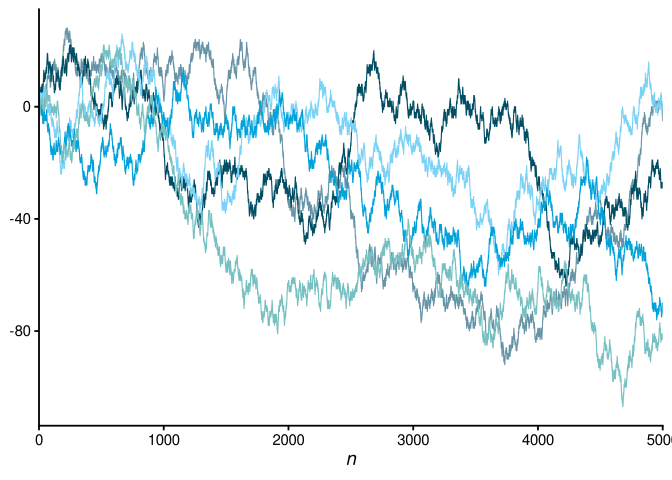
An essential property of a random walk is that its sample paths diverge as n grows. Indeed, we have \begin{aligned} X_{n} & = X_{n-1} + e_{n} \\ & = X_{n-2} + e_{n-1} + e_{n} \\ & \hphantom{xxxxxx} \vdots \\ & = X_{0} + e_{1} + \cdots + e_{n-1} + e_{n} \\ & = X_{0} + \sum_{i=1}^{n} e_{i}. \end{aligned} Denoting \operatorname{V}(e_{n}) = \sigma^{2}, and since we have that \{e_{n}\} are independent, we have \operatorname{V}(X_{n}) = n \sigma^{2}. Therefore, the variance of X_{n} increases linearly with n as n \rightarrow \infty.
Intuitively, this is saying that if we simulate many different sample paths for n = 0, \ldots, N where N is very large, we should expect to see some values of X_{N} to be very high and positive whereas others will be significantly negative.
Brownian Motion
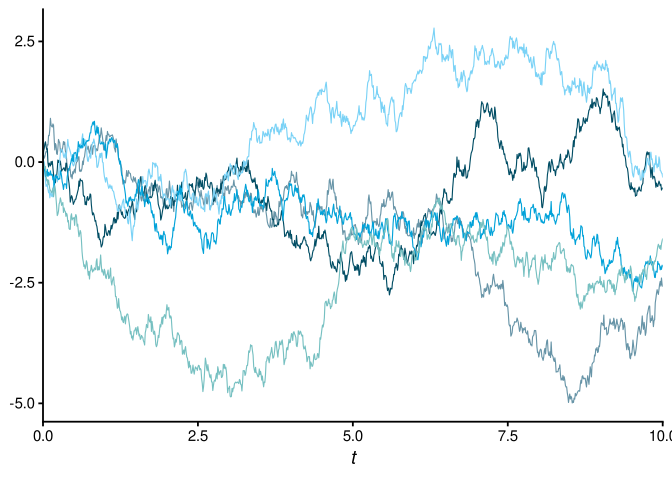
A very useful random walk can be defined as follows: W_{t + \Delta t} = W_{t} + \sqrt{\Delta t} e_{t + \Delta t}, where W_{0} = 0 and \left\{ e_{t} \right\} are i.i.d. such that e_{t} \sim N(0, 1). Note that here time increases each step by \Delta t. Letting \Delta t \rightarrow 0, the resulting process \left\{ W_{t} \right\} for t \in [0, T] is called a Brownian motion or Wiener process.
The Brownian motion has the following properties:
- The sample paths are continuous.
- For s < t, the increment W_{t} - W_{s} \sim N(0, t - s), i.e. is normally distributed with mean 0 and variance t - s.
- Increments are independent of each other.
- In particular, note that W_{t} \sim N(0, t) for 0 < t \leq T.
Geometric Brownian Motion
Now we turn our attention to modeling stock prices \left\{ S_{t} \right\}. We need to be careful, though, as stock prices cannot be negative. We also would like to allow the model to display a certain drift \mu and volatility \sigma.
To achieve this, we model the percentage change of a stock price between t and t + \Delta t as follows. As we will see, the solution in continuous time takes the form of an exponential, which ensures S_t > 0 for all t. \frac{\Delta S_{t}}{S_{t}} = \mu \Delta t + \sigma \Delta W_{t}. Note that the percentage change in price over an interval \Delta t is normally distributed with mean \mu \Delta t and variance \sigma^{2} \Delta t. Letting \Delta t \rightarrow 0, the resulting process \left\{ S_{t} \right\} for t \in [0, T] is called a geometric Brownian motion (GBM).
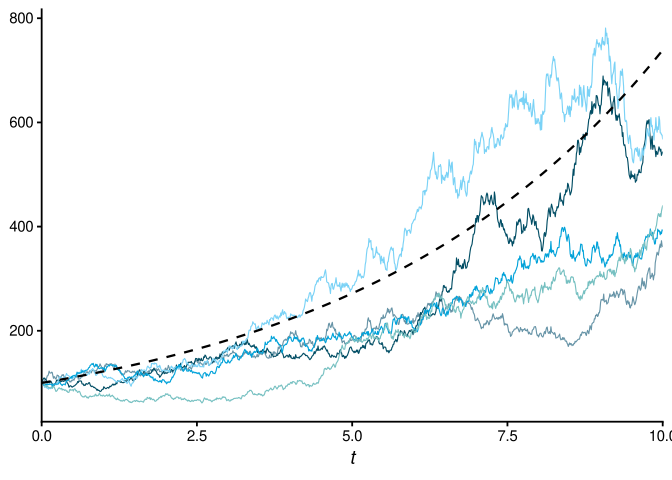
The figure illustrates two key features of GBM. First, individual paths are highly dispersed — some drift far above the starting price while others fall substantially below it. Second, the dashed line shows that the expected price \operatorname{E}(S_t) = S_0 e^{\mu t} grows smoothly at the rate \mu, even though no single path follows it closely. This tension between the behavior of the average and the behavior of typical paths will play a central role when we solve for the exact distribution of S_T below.
Stochastic Calculus
Knowing how S_t evolves is only the first step. To price derivatives, we need to understand how a function of S_t evolves — since the payoff of a call option, for instance, is a function of the stock price at expiration. We start with functions of S alone and then extend to functions of both S and t, which is the case for options with a fixed expiration date.
Ito’s Lemma
In ordinary calculus, when x changes by a small amount \Delta x, a smooth function F changes by approximately F'(x)\,\Delta x. The second-order term \frac{1}{2}F''(x)(\Delta x)^2 can be ignored because (\Delta x)^2 is negligible compared to \Delta x for small \Delta x.
For stochastic processes driven by Brownian motion, this logic breaks down. Because \Delta W_t = \sqrt{\Delta t}\,e_{t+\Delta t}, we have (\Delta W_t)^2 \approx \Delta t (see appendix), which is the same order as \Delta t itself. The second-order term therefore contributes at leading order and cannot be dropped.
To see this concretely, expand (\Delta S_t)^2 for a GBM: \begin{aligned} (\Delta S_{t})^{2} & = (\mu S_{t} \Delta t + \sigma S_{t} \Delta W_{t})^{2} \\ & = (\mu S_{t})^{2} \underbrace{(\Delta t)^{2}}_{\approx 0} + 2 \mu \sigma S_{t}^{2} \underbrace{(\Delta t)(\Delta W_{t})}_{\approx 0} + (\sigma S_{t})^{2} \underbrace{(\Delta W_{t})^{2}}_{\approx \Delta t} \\ & \approx \sigma^{2} S_{t}^{2}\, \Delta t. \end{aligned} Applying a second-order Taylor expansion of F around S_t and substituting: \Delta F(S_{t}) \approx \left( \mu S_{t} F'(S_{t}) + \frac{1}{2} \sigma^{2} S_{t}^{2} F''(S_{t}) \right) \Delta t + \sigma S_{t} F'(S_{t})\, \Delta W_{t}. The first term is the deterministic drift of F, which includes the correction \frac{1}{2}\sigma^2 S^2 F'' that has no analog in ordinary calculus. The second term is the random component inherited from \Delta W_t. Taking \Delta t \to 0 gives Ito’s Lemma.
Box Calculus
Rather than expanding (\Delta S)^2 every time, the box calculus encodes the same approximations as a set of algebraic rules that can be applied mechanically:
Generalized Ito’s Lemma
Since derivative prices depend on both the stock price and the time remaining to expiration, we need Ito’s Lemma for a function F(S, t). The only change is an additional term from the time derivative, which enters exactly as in the ordinary chain rule — no stochastic correction is needed because dt \cdot dW = 0.
Solving for GBM
We can use Ito’s Lemma to find the exact distribution of S_T. The key step is to apply F(S) = \ln(S), which transforms the multiplicative dynamics of S into an additive process that can be integrated directly. With F'(S) = 1/S and F''(S) = -1/S^{2}: \begin{aligned} d\ln(S) & = F'(S)\, dS + \frac{1}{2} F''(S)\, (dS)^{2} \\ & = \frac{1}{S} \left( \mu S\, dt + \sigma S\, dW \right) + \frac{1}{2} \left( -\frac{1}{S^{2}} \right) \sigma^{2} S^{2}\, dt \\ & = \left( \mu - \frac{1}{2} \sigma^{2} \right) dt + \sigma\, dW. \end{aligned} Since the right-hand side has constant coefficients, we can integrate both sides from 0 to T: \begin{aligned} \ln(S_{T}) - \ln(S_{0}) & = \int_{0}^{T} \left( \mu - \frac{1}{2} \sigma^{2} \right) dt + \int_{0}^{T} \sigma\, dW \\ & = \left( \mu - \frac{1}{2} \sigma^{2} \right) T + \sigma W_{T}, \end{aligned} and conclude that S_{T} = S_{0} \exp\left( \left( \mu - \frac{1}{2} \sigma^{2} \right) T + \sigma W_{T} \right). \tag{2}
Properties of Stock Prices Following a GBM
Equation (2) can be rewritten as: \ln(S_{T}) = \ln(S_{0}) + \left( \mu - \frac{1}{2} \sigma^{2} \right) T + \sigma W_{T}.
We can conclude that \ln(S_{T}) \sim N(m, s^{2}), where \begin{aligned} m & = \ln(S_{0}) + \left( \mu - \frac{1}{2} \sigma^{2} \right) T, \\ s & = \sigma \sqrt{T}. \end{aligned} In other words, \ln(S_{T}) is normally distributed with mean m and variance s^{2}, i.e., S_{T} follows a log-normal distribution.
Example 1 Consider a stock whose price at time t is given by S_{t} and that follows a GBM. The expected return is 12% per year and the volatility is 25% per year. The current spot price is $25. If we denote X_{T} = \ln(S_{T}) and take T = 0.5, we have that: \begin{aligned} \operatorname{E}(X_{T}) & = \ln(25) + \left(0.12 - 0.5(0.25)^{2}\right)(0.5) = 3.2633, \\ \operatorname{SD}(X_{T}) & = 0.25 \sqrt{0.5} = 0.1768. \end{aligned} Hence, the 95% confidence interval for S_{T} is given by: [e^{3.2633 - 1.96(0.1768)}, e^{3.2633 + 1.96(0.1768)}] = [18.48, 36.96].
Therefore, there is a 95% probability that the stock price in 6 months will lie between $18.48 and $36.96.
Moments of the Stock Price
The fact that the stock price at time T is log-normally distributed allows us to compute the mean and standard deviation of S_{T}.
Proof
Since \ln(S_{T}) \sim \mathcal{N}(m, s^{2}), we can compute its moments using the results derived earlier so that \begin{aligned} \operatorname{E}(S_{T}) & = e^{m + \frac{1}{2} s^{2}} = e^{\ln(S_{0}) + \left(\mu - \frac{1}{2} \sigma^{2}\right) T + \frac{1}{2} \sigma^{2} T} = e^{\ln(S_{0})} e^{\mu T} = S_{0} e^{\mu T}. \end{aligned} In this model, the expected stock price at any point in the future is just the current stock price growing at the rate \mu for T years. The standard deviation formula follows analogously from the log-normal variance formula derived earlier.Therefore, the expected stock price grows at a rate \mu. The variance of S_{T}, however, is large and increases exponentially with time.
Example 2 Consider a stock whose price at time t is given by S_{t} and that follows a GBM. The expected return is 12% per year and the volatility is 25% per year. The current spot price is $25. The expected price and standard deviation 6 months from now are: \begin{aligned} \operatorname{E}(S_{T}) & = 25 e^{0.12 (0.5)} = \$26.55, \\ \operatorname{SD}(S_{T}) & = 26.55 \sqrt{e^{0.25^{2} (0.5)} - 1} = \$4.73. \end{aligned}
Appendix
Some Intuition on Brownian Motion
Remember that we defined the Brownian motion or Wiener process as a random walk driven by normally distributed shocks: W_{t + \Delta t} = W_{t} + \sqrt{\Delta t} e_{t + \Delta t}, where \{e_{t}\} is an i.i.d. sequence of random variables distributed \mathcal{N}(0, 1).
Let’s start by splitting the interval [0, T] into n intervals of length \Delta t = t_{i+1} - t_{i}.

Note that t_{i} = i \Delta t and T = t_{n} = n \Delta t. The Brownian motion increments are then defined as \Delta W_{t_{i}} = W_{t_{i+1}} - W_{t_{i}}.
The first question one might have is why using normally distributed increments. There are two answers for that. First, a sum of normally distributed random variables is also normal and in this case we have: W_{T} - W_{0} = \sum_{i=0}^{n-1} \Delta W_{t_{i}} = \sum_{i=0}^{n-1} \sqrt{\Delta t} e_{t_{i} + \Delta t}.
The variance of \sum_{i=0}^{n-1} \sqrt{\Delta t} e_{t_{i} + \Delta t} is given by \sum_{i=0}^{n-1} \Delta t = n \Delta t = T, which implies that W_{T} \sim \mathcal{N}(0, T). So by using normally distributed increments we guarantee that the resulting process for Brownian motion is also normal.
Second, imagine that we use a different distribution for the i.i.d. increments while still requiring \operatorname{E}(e_{t}) = 0 and \operatorname{V}(e_{t}) = 1. For example, e_{t} could take the values 1 and -1 with equal probability. Nevertheless, the central limit theorem guarantees that: \frac{1}{\sqrt{n}} \sum_{i=0}^{n-1} \sqrt{\Delta t} e_{t_{i} + \Delta t} \xrightarrow[]{d} \mathcal{N}(0, T).
In other words, even if we use a different distribution for the increments, as n \rightarrow \infty we have that W_{T} \sim \mathcal{N}(0, T). Therefore, there is no loss in generality in assuming normally distributed increments for the Brownian motion.
A second question, and one of the most puzzling facts in stochastic calculus, is why we can treat (dW_{t})^{2} = dt as if it were a deterministic quantity. Since \Delta W_{t} is random, (\Delta W_{t})^{2} is also random, yet we replace it with \Delta t. The key insight is that (\Delta W_{t})^{2} = \Delta t \, e_{t}^{2} has mean \Delta t and variance 2(\Delta t)^{2}. As \Delta t \rightarrow 0, the variance vanishes much faster than the mean, so (\Delta W_{t})^{2} concentrates tightly around \Delta t. By a similar argument, (\Delta t)(\Delta W_{t}) has mean zero and variance of order (\Delta t)^{3}, which vanishes even faster, so (\Delta t)(\Delta W_{t}) \approx 0. These two facts together justify the box calculus rules.
Computing Partial Expectations
Since \ln(S_{T}) \sim \mathcal{N}(m, s^{2}), we can use the result introduced earlier about partial expectations to show the following property.
Proof
\begin{aligned} \operatorname{E}\left(S_{T} 1\kern-0.25em\text{l}_{\{S_{T} > K\}}\right) & = e^{m + \frac{1}{2}s^{2}} \operatorname{\Phi}\left(\frac{m + s^{2} - \ln(K)}{s}\right) \\ & = S_{0} e^{\mu T} \operatorname{\Phi}\left( \frac{\ln(S_{0}/K) +(\mu + \frac{1}{2} \sigma^{2})T}{\sigma \sqrt{T}} \right), \\ \operatorname{E}\left(K 1\kern-0.25em\text{l}_{\{S_{T} > K\}}\right) & = K \operatorname{\Phi}\left(\frac{m - \ln(K)}{s}\right) \\ & = K \operatorname{\Phi}\left( \frac{\ln(S_{0}/K) + (\mu - \frac{1}{2} \sigma^{2})T}{\sigma \sqrt{T}} \right). \end{aligned}It turns out that these results are everything we need in order to derive the Black-Scholes pricing formulas!
Practice Problems
Problem 1 Consider a stock whose price at time t is given by S_{t} and that follows a geometric Brownian motion (GBM). The expected return is 18% per year and the volatility is 32% per year. The current spot price is $60.
- Compute the expected price 9 months from now.
- Compute the mean and standard deviation of the log-spot price 9 months from now.
- Compute the 95% confidence interval of \ln(S_{T}) 9-months from now, and report the corresponding values for S_{T}.
Solution
- \operatorname{E}(S_{T}) = 60 e^{0.18(9/12)} = \$68.67.
- The mean and standard deviation can be computed as follows: \begin{aligned} m & = \ln(60) + (0.18 - 0.5(0.32^{2}))(9/12) \\ & = 4.1909 \\ s & = 0.32 \sqrt{9/12} \\ & = 0.2771 \end{aligned}
- The confidence interval of \ln(S_{T}) 9-months from now satisfies: \begin{aligned} \operatorname{P}\left( -1.96 < \frac{\ln(S_{T}) - m}{s} \leq 1.96 \right) & = \operatorname{P}\left(m - 1.96 s < \ln(S_{T}) \leq m + 1.96 s \right) \\ & = \operatorname{P}(3.6478 < \ln(S_{T}) \leq 4.7341) \\ & = \operatorname{P}\left(e^{3.6478} < S_{T} \leq e^{4.7341}\right) \\ & = \operatorname{P}(38.39 < S_{T} \leq 113.76) \end{aligned} Therefore, the 95% confidence interval for \ln(S_{T}) is [3.6478, 4.7341] and the corresponding values for S_{T} are [38.39, 113.76].
Problem 2 Consider a stock whose price at time t is given by S_{t} and that follows a GBM. The expected return is 11% per year and the volatility is 27% per year. The current spot price is $60.
- Compute the expected price of S_{t} 1 year from now.
- Compute the expected price of 1 / S_{t} 1 year from now.
Solution
- \operatorname{E}(S_{T}) = 60 e^{0.11(1)} = \$66.98
- We have that \ln(S_{T}) \sim \mathcal{N}(m, s^{2}), where: \begin{aligned} m & = \ln(60) + (0.11 - 0.5(0.27^{2}))(1) \\ & = 4.1679 \\ s & = 0.27 \sqrt{1} \\ & = 0.27 \end{aligned} Using the fact that if X \sim \mathcal{N}(\mu, \sigma^{2}), then \alpha X \sim \mathcal{N}(\alpha\mu, \alpha^{2}\sigma^{2}) and \operatorname{E}(Y^{\alpha}) = \operatorname{E}(e^{\alpha X}) = e^{\alpha\mu+\frac{1}{2} \alpha^{2}\sigma^{2}}, we can take \alpha=-1 to conclude: \begin{aligned} \operatorname{E}(1/S_{T}) & = e^{(-1)4.1679 + 0.5(-1)^{2}(0.27)^{2}} \\ & = 0.0161 \end{aligned}
Problem 3 Consider a stock whose price at time t is given by S_{t} and that follows a GBM. The expected return is 12% per year and the volatility is 35% per year. The current spot price is $55. Let T=18 months.
- Compute \operatorname{E}(S_{T}).
- Compute the mean and standard deviation of the log-spot price at T.
- Find C such that \operatorname{P}(S_{T} \leq C)=0.01.
Solution
- \operatorname{E}(S_{T}) = 55 e^{0.12(18/12)} = \$65.85
- We have that \ln(S_{T}) \sim \mathcal{N}(m, s^{2}), where: \begin{aligned} m & = \ln(55) + (0.12 - 0.5(0.35^{2}))(18/12) \\ & = 4.0955 \\ s & = 0.35 \sqrt{18/12} \\ & = 0.4287 \end{aligned}
- We want to find C such that: \begin{aligned} \operatorname{P}(S_{T} \leq C) & = \operatorname{P}\left(Z \leq \tfrac{\ln(C) - m}{s}\right) \\ & = 0.01 \end{aligned} Hence, \dfrac{\ln(C) - 4.0955}{0.4287} = -2.326, which implies that: \begin{aligned} \ln(C) & = 4.0955 - 2.326(0.4287) \\ & = 3.0982 \end{aligned} Therefore, C = e^{3.0982} = \$22.16.
Problem 4 Consider a stock whose price at time T is given by S_{T} and that follows a GBM, i.e., \ln(S_{T}) \sim \mathcal{N}(\ln(S_{0})+(\mu-0.5\sigma^{2})T, \sigma^{2} T).
The expected return is 12% per year and the volatility is 35% per year. The current spot price is $100.
- Compute the expected price in 2 years from now.
- Compute the mean and standard deviation of the log-spot price in 2 years from now.
- Compute the probability that the spot price is less than $100 in 2 years from now.
- Compute the probability that the spot price is greater than $120 in 2 years from now.
Solution
- \operatorname{E}(S_{T}) = 100 e^{0.12(2)} = \$127.12
- We have that \ln(S_{T}) \sim \mathcal{N}(m, s^{2}), where: \begin{aligned} m & = \ln(100) + (0.12 - 0.5(0.35^{2}))(2) = 4.7227 \\ s & = 0.35 \sqrt{2} = 0.4950 \end{aligned}
- The probability that S_{T} \leq 100 is: \begin{aligned} \operatorname{P}(S_{T} \leq 100) & = \operatorname{P}(\ln(S_{T}) \leq \ln(100)) \\ & = \operatorname{P}\left(Z \leq \frac{\ln(100) - 4.7227}{0.4950}\right) \\ & = \operatorname{P}(Z \leq -0.24) \\ & = 0.4052 \end{aligned}
- The probability that S_{T} > 120 is: \begin{aligned} \operatorname{P}(S_{T} > 120) & = 1 - \operatorname{P}(S_{T} \leq 120) \\ \operatorname{P}(S_{T} \leq 120) & = \operatorname{P}(\ln(S_{T}) \leq \ln(120)) \\ & = \operatorname{P}\left(Z \leq \frac{\ln(120) - 4.7227}{0.4950}\right) \\ & = \operatorname{P}(Z \leq 0.13) \\ & = 0.5518 \end{aligned} Hence, \operatorname{P}(S_{T} > 120) = 1 - 0.5518 = 0.4482.
Problem 5 Suppose that the stock price follows a geometric Brownian motion (GBM) with drift \mu and instantaneous volatility \sigma, i.e., dS = \mu S dt + \sigma S dW. Show that Y = S^{\alpha} also follow a GBM and determine the drift and volatility as a function of \mu, \sigma, and \alpha.
Solution
We have that Y'(S) = \alpha S^{\alpha - 1} and Y''(S) = \alpha (\alpha - 1) S^{\alpha - 2}. Therefore, \begin{aligned} dY & = Y'(S)\, (dS) + \frac{1}{2} Y''(S)\, (dS)^{2} \\ & =\alpha S^{\alpha - 1} (\mu S dt + \sigma S dW) + \frac{1}{2} \alpha (\alpha - 1) S^{\alpha - 2} (\sigma^{2} S^{2} dt) \\ & = \left(\alpha \mu S^{\alpha} + \frac{1}{2} \alpha (\alpha - 1) \sigma^{2} S^{\alpha}\right) dt + \alpha \sigma S^{\alpha} dW \\ & = \left(\alpha \mu + \frac{1}{2} \alpha (\alpha - 1) \sigma^{2} \right) Y dt + \alpha \sigma Y dW \\ \end{aligned} Hence, Y follows a GBM with drift \alpha \mu + \frac{1}{2} \alpha (\alpha - 1) \sigma^{2} and volatility \alpha \sigma.Problem 6 Let S be the price of TESLA stock that follows a geometric Brownian motion such that dS = \mu S dt + \sigma S dW. Your sales team would like to launch a new product called TESLA Quadro that tracks the price of TESLA to the power 4. In other words, the value of this instrument is given by Y = S^{4}. What is the process followed by Y?
Solution
We saw in class that dY = Y'(S)\, dS + \frac{1}{2} Y''(S)\, (dS)^{2}, where (dS)^{2} = \sigma^{2} S^{2} dt. If Y = S^{4} then Y'(S) = 4 S^{3} and Y''(S) = 12 S^{2}. We can then write the previous expression as \begin{aligned} dY & = 4 S^{3} (\mu S dt + \sigma S dW) + \frac{1}{2} (12 S^{2}) (\sigma^{2} S^{2} dt) \\ & = 4 \mu S^{3} dt + 4 \sigma S^{4} dW + 6 \sigma^{2} S^{4} dt \\ & = (4 \mu + 6 \sigma^{2}) Y dt + 4 \sigma Y dW \end{aligned} The new product then follows a geometric Brownian motion with drift 4 \mu + 6 \sigma^{2} and instantaneous volatility 4 \sigma.Problem 7 GoingUp Corp. has been gaining a lot of attention in the media for its upside potential. Financial experts agree that the stock price follows a geometric Brownian motion with drift (\mu) equal to 20% per year and volatility of price returns (\sigma) of 73% per year. The current stock price is $220. Compute the probability that the stock price is greater than $233 in 10 months from now.
Solution
We know that \ln(S_{T}) \sim N(m, s^{2}) where \begin{aligned} m & = \ln(S_{0}) + (\mu - 0.5 \sigma^{2}) T \\ & = \ln(220) + (0.20 - 0.5 \times 0.73^{2}) \times (10/12) \\ & = 5.3383 \\ s & = \sigma \sqrt{T} \\ & = 0.73 \sqrt{10/12} \\ & = 0.6664 \end{aligned} Therefore, \begin{aligned} \operatorname{P}(S_{T} \leq 233) & = \operatorname{P}(\ln(S_{T}) \leq \ln(233)) \\ & = \operatorname{P}\left( Z \leq \frac{\ln(233) - 5.3383}{0.6664} \right) \\ & = \Phi(0.1692) \\ & = 0.5672 \end{aligned} Therefore, \operatorname{P}(S_{T} > 233) = 1 - 0.5672 = 0.4328.Problem 8 You would like to invest in ZigZag Inc. but you are concerned that the stock price might go down. You have been studying the dynamics of the stock price and concluded that the stock follows a geometric Brownian motion with drift (\mu) equal to 13% per year and volatility of price returns (\sigma) of 58% per year. The current stock price is $118. Compute the probability that the stock price is less than $98 in 12 months from now.
Solution
We know that \ln(S_{T}) \sim N(m, s^{2}) where \begin{aligned} m & = \ln(S_{0}) + (\mu - 0.5 \sigma^{2}) T \\ & = \ln(118) + (0.13 - 0.5 \times 0.58^{2}) \\ & = 4.7325 \\ s & = \sigma \sqrt{T} \\ & = 0.58 \end{aligned} Therefore, \begin{aligned} \operatorname{P}(S_{T} \leq 98) & = \operatorname{P}(\ln(S_{T}) \leq \ln(98)) \\ & = \operatorname{P}\left( Z \leq \frac{\ln(98) - 4.7325}{0.58} \right) \\ & = \Phi(-0.2543) \\ & = 0.3996 \end{aligned}Problem 9 You are analyzing BMX stock. You believe that it is accurate to model the price evolution of the stock as a geometric Brownian motion. Using historical data, you estimate that the drift (\mu) is 12.0% per year and the volatility of stock returns (\sigma) is 39% per year. The stock price just closed at $331. Compute the expected stock price in 9 months from now.
Solution
We saw in class that \operatorname{E}(S_{T}) = 331 e^{0.12 \times 9/12} = 362.17.Optional Practice Problems
These problems are not required to study for the exam.
Problem 10 Suppose that the stock price follows a geometric Brownian motion (GBM) with drift \mu = 10\% and instantaneous volatility \sigma = 25\%. Compute \operatorname{E}(S_{T} 1\kern-0.25em\text{l}_{\{S_{T} > K\}}) and \operatorname{E}(1\kern-0.25em\text{l}_{\{S_{T} > K\}}) = \operatorname{P}(S_{T} > K) if S_{0} = 100, K = 95 and T = 2.