Multiple Periods
In the one-period model, a stock can move to one of two possible prices, and we price derivatives by replication or, equivalently, by computing expected payoffs under the risk-neutral probability and discounting at the risk-free rate. This document extends that framework to multiple periods by chaining one-period trees together. We first study the structure of multi-period trees and the recombination property that keeps them tractable. We then derive the backward-induction pricing formula, show how to calibrate the tree to observed volatility, and develop a closed-form shortcut for European options.
Binomial Trees with Multiple Periods
The power of binomial trees becomes apparent when we chain one-period trees together to build larger ones, as the following example illustrates.
Example 1 (Two-Period Binomial Tree) The current stock price is $100. Each period, the asset can go up or down by 5% with probability p and 1 - p, respectively.
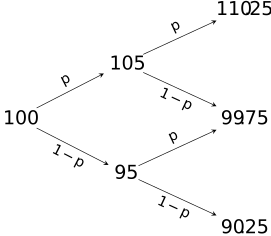
There are three possible values for the stock at the end of the tree, but four possible histories. Indeed, the price $99.75 can be reached by going up first and then down, or by going down first and then up.
Sometimes we will omit the probabilities from the diagram to keep the notation clean.
Example 2 (Four-Period Binomial Tree) The current stock price is $100. Each period the asset can go up or down by 2.5%.
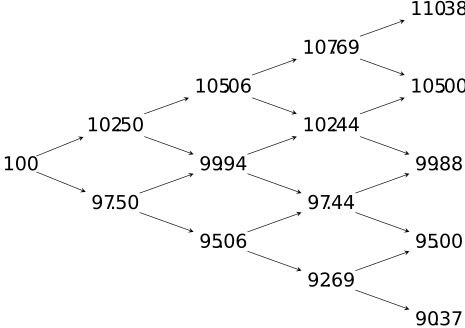
After four periods there are five possible values for the stock — one for each number of up-moves from zero to four — confirming that the tree recombines.
A key feature of the previous examples is that going up and then down yields the same price as going down and then up. When this happens we say that the tree recombines.
Recombining trees are very useful for modeling financial assets because the number of nodes grows linearly with the number of periods: after n periods there are only n + 1 possible nodes, even though the number of possible histories grows exponentially. In a non-recombining tree, by contrast, the number of nodes at period n is 2^{n}, which quickly becomes computationally prohibitive.
A sufficient condition for the tree to recombine is that the percentage increase and decrease of the stock price at each node are kept constant throughout the tree. As the following example shows, in a recombinant tree u need not be equal to d.
Example 3 (Recombining Trees) Is it the same for an asset to go up by 80% and then down by 30%, compared to first go down by 30% and then go up by 80%? Consider an asset whose current price is $100.
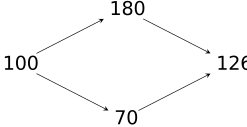
The tree recombines because of the associative property of multiplication: S_{ud} = 100 \times 1.80 \times 0.70 = 100 \times 0.70 \times 1.80 = S_{du} In words, gaining 80% and then losing 30% is the same as first losing 30% and then gaining 80%.
The Two Period Binomial Model
We now extend the model to two periods. We would like to price a European call option with strike price K, expiring at time T and written on a non-dividend paying stock. The figure below shows the different values that we need to compute for both the stock1 and the call option.
1 Each period, the stock price goes up or down by u or d, respectively. Therefore, at the end of the first period we have that S_{u} = S \times u, \, S_{d} = S \times d. At the end of the second period the possible values are given by S_{uu} = S_{u} \times u, \, S_{ud} = S_{u} \times d, \, S_{dd} = S_{d} \times d. Finally, because the tree recombines, we must have that S_{ud} = S_{u} \times d = S_{d} \times u = S_{du}.
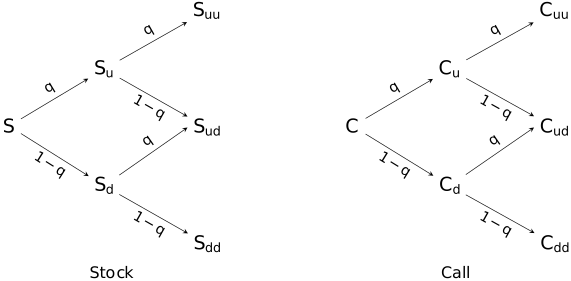
We assume that each period has equal length \Delta t = T / 2. This is not required, but it ensures that the volatility of stock returns is the same in every period. The risk-neutral probability of an up-move is then q = \frac{S e^{r \Delta t} - S d}{S u - S d} = \frac{e^{r \Delta t} - d}{u - d}. Note that the risk-neutral probability of the stock going up is the same in all nodes of the tree.
We now work backwards from expiration to the beginning of the tree. The call’s value at expiration is simply its intrinsic value: \begin{aligned} C_{uu} & = \max(S_{uu} - K, 0), \\ C_{ud} & = \max(S_{ud} - K, 0), \\ C_{dd} & = \max(S_{dd} - K, 0). \end{aligned} If the stock price goes up during the first period, the call price at that point must be equal to: C_{u} = \left( q C_{uu} + (1 - q) C_{ud} \right) e^{-r \Delta t}. Similarly, if the stock price goes down during the first period we have that: C_{d} = \left( q C_{du} + (1 - q) C_{dd} \right) e^{-r \Delta t}. Finally, the value of the option at the beginning of the tree must be equal to the expected price under the risk-neutral probabilities, discounted at the risk-free rate. Indeed, an investor that buys the call today could sell it a period later at the price observed at that point. Thus, C = \left( q C_{u} + (1 - q) C_{d} \right) e^{-r \Delta t}.
Example 4 (Pricing a European Call Option) The current stock price is $100 and it can go up or down by 5% each period. Each period represents three months, so \Delta t = 3/12 = 0.25. The risk-free rate is 6% per year with continuous compounding. We price a European call with maturity 6 months and strike $100.
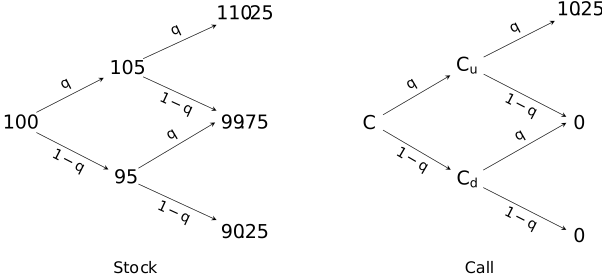
The risk-neutral probability of an up-move is then: q = \frac{e^{r \Delta t} - d}{u - d} = \frac{e^{0.06 \times 0.25} - 0.95}{1.05 - 0.95} = 0.6511.
The risk-neutral probability of a down-move is 1 - q = 0.3489. We can then compute: \begin{aligned} C_{u} & = \left( 10.25 \times q + 0 \times (1 - q) \right) e^{-0.06 \times 0.25} = \$6.57 \\ C_{d} & = \left( 0 \times q + 0 \times (1 - q) \right) e^{-0.06 \times 0.25} = \$0 \\ C & = \left( 6.57 \times q + 0 \times (1 - q) \right) e^{-0.06 \times 0.25} = \$4.22 \end{aligned} Therefore, the value of the European call is $4.22.
Example 5 (Pricing a European Put Option) We can use the risk-neutral probabilities in Example 4 to price a European put with the same characteristics. The put payoffs at expiration are \max(K - S_{T}, 0), which gives the following tree:
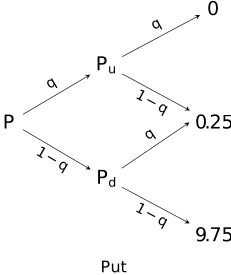
Working backwards: \begin{aligned} P_{u} & = \left( 0 \times q + 0.25 \times (1 - q) \right) e^{-0.06 \times 0.25} = \$0.08 \\ P_{d} & = \left( 0.25 \times q + 9.75 \times (1 - q) \right) e^{-0.06 \times 0.25} = \$3.51 \\ P & = \left( 0.08 \times q + 3.51 \times (1 - q) \right) e^{-0.06 \times 0.25} = \$1.26 \end{aligned}
The value of the European put can also be obtained using put-call parity. Indeed, the put is equal to a call plus a short forward: \begin{aligned} P & = C - S + K e^{-r T} \\ & = 4.22 + 100 - 100 e^{-0.06 \times 0.5} \\ & = \$1.26. \\ \end{aligned} Note that we discount the strike price using the maturity of the option which is 6 months.
Making the Tree Consistent with Observed Volatility
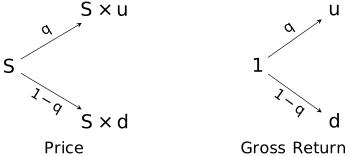
So far we have used arbitrary values for u and d. A great advantage of the binomial model is that it is possible to relate these movements to the volatility of the stock observed in the market. Over a small interval \Delta t, the choice u = e^{\sigma \sqrt{\Delta t}} and d = 1 / u produces a binomial model consistent with the Black-Scholes model of a Geometric Brownian Motion (GBM).2
2 Note that in this case u \times d = 1, so the tree on average does not have a drift. The risk-neutral drift, however, is incorporated into the risk-neutral probabilities.
In other words, for small \Delta t the variance of stock returns satisfies V \approx \sigma^{2} \Delta t. Therefore, at each node the percentage change in the stock price has mean r \Delta t and variance \sigma^{2} \Delta t.
Proof
Let’s see how this modification works in a 1-period tree.
A Shortcut for European Options
In the case of European options it is possible to price a European call or put without having to work the intermediate steps. In the case of American options, however, it is necessary to check whether it is worth to exercise the option at each node of the tree. We will learn later how to handle the American option case.
Take a two-period tree. Instead of working backwards step by step, we can use the terminal payoffs directly to compute: C = \left( \Pi_{uu} C_{uu} + \Pi_{ud} C_{ud} + \Pi_{dd} C_{dd} \right) e^{-r T}, where \Pi_{uu} = q^{2}, \Pi_{ud} = 2 q (1 - q), and \Pi_{dd} = (1 - q)^{2}. The \Pi’s represent the total risk-neutral probabilities of each final node.
We can generalize the method for an arbitrary number of periods n, which means that \Delta t = T / n. Since at each node the stock S can go up or down to S_{u} = S \times u and S_{d} = S \times d, we have that the stock price at time T can take on n + 1 different values: S_{T} = \left( \begin{array}{c} S_{T}(0) \\ S_{T}(1) \\ S_{T}(2) \\ \vdots \\ S_{T}(n - 2) \\ S_{T}(n - 1) \\ S_{T}(n) \end{array} \right) = \left( \begin{array}{c} S u ^ {n} \\ S u ^ {n - 1} d \\ S u ^ {n - 2} d ^ {2} \\ \vdots \\ S u ^ {2} d ^ {n - 2} \\ S u d ^ {n - 1} \\ S d ^ {n} \end{array} \right) The risk-neutral probability of an up-move is given by: q = \frac{e^{r \Delta t} - d}{u - d}. The total risk-neutral probability at node i = 0, \ldots, n is: Q(i) = \binom{n}{i} q^{i} (1 - q)^{n - i}, where \binom{n}{i} = \frac{n!}{(n - i)! i!} is a binomial coefficient. The price of European call and put options are given by: \begin{aligned} C & = e^{-r T} \sum_{i = 0}^{n}{Q(i) \max(S_{T}(i) - K, 0)} \\ P & = e^{-r T} \sum_{i = 0}^{n}{Q(i) \max(K - S_{T}(i), 0)} \end{aligned}
An Arbitrary Number of Periods
The following example illustrates how to price a European call using a multi-period binomial tree calibrated to observed volatility.
Example 6 (Pricing a European Call Option Using Five Periods) In this example we price a 6-month European call option with strike price $135 written on a non-dividend paying stock that currently trades at $132 and whose volatility of stock returns is 35% per year. We use an interest rate of 3% per year with continuous compounding.
We will use a 5-period binomial tree. Therefore, we have that T = 6/12 = 0.5 and \Delta t = T / 5 = 0.1, so that u = e^{0.35 \sqrt{0.1}} = 1.1170 and d = 1/1.1170 = 0.8952. The table below describes the binomial tree for the stock. Note that for convenience I wrote the tree as a lower triangle. The horizontal line describes the path where the stock price increases every period whereas the lower diagonal describes the path where the stock price goes down every period.
| Time | 0 | 0.1 | 0.2 | 0.3 | 0.4 | 0.5 |
|---|---|---|---|---|---|---|
| Stock | 132 | 147.45 | 164.71 | 183.98 | 205.52 | 229.57 |
| 118.17 | 132.00 | 147.45 | 164.71 | 183.98 | ||
| 105.79 | 118.17 | 132.00 | 147.45 | |||
| 94.70 | 105.79 | 118.17 | ||||
| 84.78 | 94.70 | |||||
| 75.90 |
The risk-neutral probability of an up-move is given by: \begin{aligned} q = \frac{e^{0.03 \times 0.1} - 0.8952}{1.1170 - 0.8952} = 0.4859. \end{aligned} We can now price the call as follows.
| Time | 0 | 0.1 | 0.2 | 0.3 | 0.4 | 0.5 |
|---|---|---|---|---|---|---|
| Call | 13.16 | 21.23 | 33.18 | 49.79 | 70.92 | 94.57 |
| 5.60 | 10.06 | 17.68 | 30.11 | 48.98 | ||
| 1.42 | 2.92 | 6.03 | 12.45 | |||
| 0.00 | 0.00 | 0.00 | ||||
| 0.00 | 0.00 | |||||
| 0.00 |
In the table above, the last column contains the payoffs of the call at maturity. For example, if the stock price at maturity is 229.57, then the payoff of the call is 229.57 - 135 = 94.57 which is the first number on the last column. On the other hand, if the stock price at maturity 94.70, then the call is out-of-the-money and the payoff is 0.
We work backwards on the tree by computing expected payoffs using the risk-neutral probabilities and discounting at the risk-free rate for 0.1 years. For example, the first number in the before last column is computed as 70.92 = (94.57 p + 48.98 (1 - p)) e^{- 0.03 \times 0.1} where p is the risk-neutral probability computed above. We keep doing this for all nodes until we reach the beginning of the tree. The price of the call is then $13.16.
A spreadsheet that shows the computations can be found here.
Practice Problems
Problem 1 A non-dividend stock trades for $100. Over each of the next two 6-month periods it is expected to go up or down by 10%. The risk-free interest rate is 8% per annum with continuous compounding.
- What is the value of a 1-year European call option with a strike price of $100?
- What is the value of a 1-year European put option with a strike price of $100?
Solution
The binomial trees for the stock and the European call are as follows:
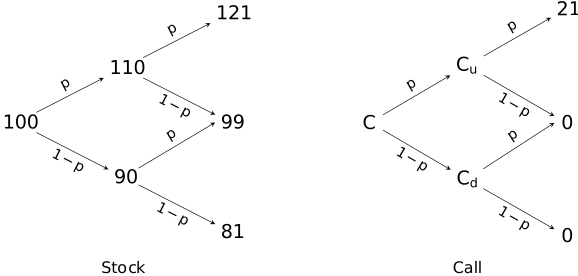
The risk-neutral probability of an up move is: q = \frac{e^{0.08 \times 6/12} - 0.90}{1.10 - 0.90} = 0.7041. We can then compute: \begin{aligned} C_{u} & = (21 q + 0 (1 - q)) e^{-0.08 \times 6/12} = 14.21 \\ C_{d} & = (0 q + 0 (1 - q)) e^{-0.08 \times 6/12} = 0 \\ C & = (14.21 q + 0 (1 - q)) e^{-0.08 \times 6/12} = 9.61 \end{aligned}
The binomial tree for the European put is:
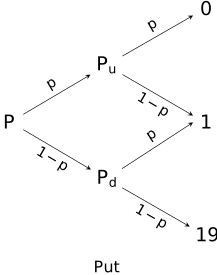
Therefore: \begin{aligned} P_{u} & = (0 q + 1 (1 - q)) e^{-0.08 \times 6/12} = 0.28 \\ P_{d} & = (1 q + 19 (1 - q)) e^{-0.08 \times 6/12} = 6.08 \\ P & = (0.28 q + 6.08 (1 - q)) e^{-0.08 \times 6/12} = 1.92 \end{aligned}
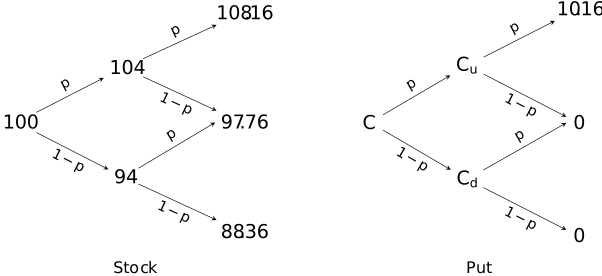
Problem 2 The current price of a non-dividend paying stock is $100. Every three months, it is expected to go up or down by 4% or 6%, respectively. The risk-free rate is 8% per year with continuous compounding. Compute the price of a European call option with strike price $98 and maturity six months written on the stock.
Solution
We have that \Delta t = 3/12, u = 1.04 and d = 0.94. The binomial trees for the stock and the European call are as follows:
Problem 3 A non-dividend paying stock costs $50. Analysts estimate that there is a 50% chance that the stock trades for $60 next year if the company succeeds in developing an important vaccine. Otherwise, the stock could fall to $40. The risk-free rate is 5% per year with continuous compounding. What should be the price of a security that pays $100 next year if the stock goes up, and $0 otherwise?
Solution
The risk-neutral probability of the stock going up is: q = \frac{50 e^{0.05} - 40}{60 - 40} The price of the security then is (100 q + 0 (1 - q)) e^{-0.05} = \$59.75.Problem 4 Consider a non-dividend paying asset for which you have the following information: S_{0} = 100, r = 4\% per year with continuous compounding, and\sigma = 20\% per year. Using a standard binomial model with four periods in which u = e^{\sigma \sqrt{\Delta t}} and d = 1/u, compute the price of an at-the-money European call option expiring in 6 months.
Solution
We start by noting that \Delta t = 0.5 / 4 = 0.125, so that u = e^{0.20 \sqrt{0.125}} = 1.0733 and d = 1 / 1.0733 = 0.9317.
The tree for the stock is:
| Period | 0 | 1 | 2 | 3 | 4 |
|---|---|---|---|---|---|
| 100.00 | 107.33 | 115.19 | 123.63 | 132.69 | |
| 93.17 | 100.00 | 107.33 | 115.19 | ||
| 86.81 | 93.17 | 100.00 | |||
| 80.89 | 86.81 | ||||
| 75.36 |
The risk-neutral probability of an up-move is q = \frac{e^{0.04 \times 0.125} - 0.9317}{1.0733 - 0.9317} = 0.5177
Therefore, the tree for the call is:
| Period | 0 | 1 | 2 | 3 | 4 |
|---|---|---|---|---|---|
| 6.29 | 10.27 | 16.19 | 24.13 | 32.69 | |
| 2.08 | 4.03 | 7.83 | 15.19 | ||
| 0.00 | 0.00 | 0.00 | |||
| 0.00 | 0.00 | ||||
| 0.00 |