Modeling Stock Prices
Geometric Brownian Motion
Now we turn our attention to modeling stock prices \left\{ S_{t} \right\}. We need to be careful, though, as stock prices cannot be negative. We also would like to allow the model to display a certain drift \mu and volatility \sigma.
To achieve this, we model the percentage change of a stock price between t and t + \Delta t as \frac{\Delta S_{t}}{S_{t}} = \mu \Delta t + \sigma \Delta B_{t}. Note that the percentage change in price over an interval \Delta t is normally distributed with mean \mu \Delta t and variance \sigma^{2} \Delta t. Letting \Delta t \rightarrow 0, the resulting process \left\{ S_{t} \right\} is called a geometric Brownian motion (GBM) and is written as \frac{\mathop{}\!\mathrm{d}S}{S} = \mu \mathop{}\!\mathrm{d}t + \sigma \mathop{}\!\mathrm{d}B.
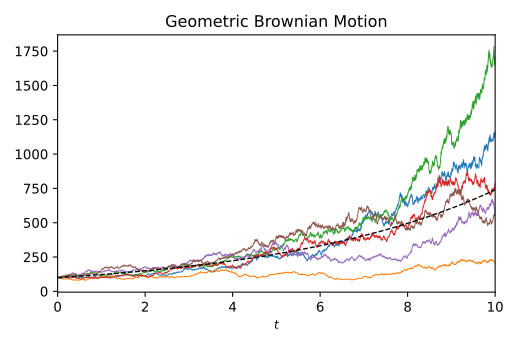
With the dynamics of \{S_{t}\} specified, we now turn to processes of the form X_{t} = f(S_{t}). This is important because derivative prices depend on underlying state variables. When a stock follows a GBM driven by a single Brownian motion, the no-arbitrage value of a European option at time t depends only on the current stock price S and the remaining time to maturity T. Thus, option prices can be written as f(S,T), and we use Itô’s lemma to determine how such functions evolve.
We begin by studying how X_{t} = f(S_{t}) behaves over time, assuming f(\cdot) is smooth with well-defined first and second derivatives. Later, we extend this to include time dependence.
It is usually more convenient to use the box calculus when working with stochastic processes defined through Brownian motions.
Solving for GBM
Define X = \ln(S), which implies S = e^{X}. We have that X_{S} = 1 / S and X_{SS} = -1 / S^{2}, which implies \begin{aligned} \mathop{}\!\mathrm{d}X & = X_{S} \mathop{}\!\mathrm{d}S + \frac{1}{2} X_{SS} (\mathop{}\!\mathrm{d}S)^{2} \\ & = \frac{1}{S} \left( \mu S \mathop{}\!\mathrm{d}t + \sigma S \mathop{}\!\mathrm{d}B \right) + \frac{1}{2} \left( -\frac{1}{S^{2}} \right) \sigma^{2} S^{2} \mathop{}\!\mathrm{d}t \\ & = \left( \mu \mathop{}\!\mathrm{d}t + \sigma \mathop{}\!\mathrm{d}B \right) - \frac{1}{2} \sigma^{2} \mathop{}\!\mathrm{d}t \\ & = \left( \mu - \frac{1}{2} \sigma^{2} \right) \mathop{}\!\mathrm{d}t + \sigma \mathop{}\!\mathrm{d}B. \end{aligned} We can then solve for X_{T}: \begin{aligned} X_{T} - X_{0} & = \int_{0}^{T} \mathop{}\!\mathrm{d}X = \int_{0}^{T} \left( \mu - \frac{1}{2} \sigma^{2} \right) \mathop{}\!\mathrm{d}t + \int_{0}^{T} \sigma \mathop{}\!\mathrm{d}B \\ & = \left( \mu - \frac{1}{2} \sigma^{2} \right) T + \sigma B_{T}, \end{aligned} and conclude that S_{T} = S_{0} \exp\left( \left( \mu - \frac{1}{2} \sigma^{2} \right) T + \sigma B_{T} \right). \tag{2}
Properties of Stock Prices Following a GBM
Equation (2) can be rewritten as: \ln(S_{T}) = \ln(S_{0}) + \left( \mu - \frac{1}{2} \sigma^{2} \right) T + \sigma B_{T}.
We can conclude that \ln(S_{T}) \sim N(\operatorname{E}(\ln(S_{T})), \operatorname{V}(\ln(S_{T}))), where \begin{aligned} \operatorname{E}(\ln(S_{T})) & = \ln(S_{0}) + \left( \mu - \frac{1}{2} \sigma^{2} \right) T, \\ \sigma(\ln(S_{T})) & = \sigma \sqrt{T}. \end{aligned} In other words, S_{T} is lognormally distributed with mean and variance as described above.
Example 1 Consider a stock whose price at time t is given by S_{t} and that follows a GBM. The expected return is 12% per year and the volatility is 25% per year. The current spot price is $25. If we denote X_{T} = \ln(S_{T}) and take T = 0.5, we have that: \begin{aligned} \operatorname{E}(X_{T}) & = \ln(25) + \left(0.12 - 0.5(0.25)^{2}\right)(0.5) = 3.2633, \\ \operatorname{SD}(X_{T}) & = 0.25 \sqrt{0.5} = 0.1768. \end{aligned} Hence, the 95% confidence interval for S_{T} is given by: [e^{3.2633 - 1.96(0.1768)}, e^{3.2633 + 1.96(0.1768)}] = [18.48, 36.96].
Therefore, there is a 95% probability that the stock price in 6 months will lie between $18.48 and $36.96.
Moments of the Stock Price
The fact that the stock price at time T is log-normally distributed allows us to compute the mean and standard deviation of S_{T}. Since \ln(S_{T}) \sim \mathcal{N}(m, s^{2}), we have that \begin{aligned} \operatorname{E}(S_{T}) & = e^{m + \frac{1}{2} s^{2}} = e^{\ln(S_{0}) + \left(\mu - \frac{1}{2} \sigma^{2}\right) T + \frac{1}{2} \sigma^{2} T} = e^{\ln(S_{0})} e^{\mu T} = S_{0} e^{\mu T}. \end{aligned} In this model, the expected stock price at any point in the future is just the current stock price growing at the rate \mu for T years.
Therefore, the expected stock price grows at a rate \mu. The variance of S_{T}, however, is large and increases exponentially with time.
Example 2 Consider a stock whose price at time t is given by S_{t} and that follows a GBM. The expected return is 12% per year and the volatility is 25% per year. The current spot price is $25. The expected price and standard deviation 6 months from now are: \begin{aligned} \operatorname{E}(S_{T}) & = 25 e^{0.12 (0.5)} = \$26.55, \\ \operatorname{SD}(S_{T}) & = 26.55 \sqrt{e^{0.25^{2} (0.5)} - 1} = \$4.73. \end{aligned}
A Generalized Form of Itô’s Lemma
Most derivatives not only depend on the underlying asset but also depend on time since they have fixed expiration dates. The analysis we did before for Itô’s Lemma generalizes easily to handle this case. Consider a non-dividend paying stock that follows a GBM: \begin{aligned} dS = \mu S dt + \sigma S dW, \end{aligned} and a new process defined by X = f(S, t) where f is twice continuously differentiable in S and once continuously differentiable in t. Itô’s formula states that \mathop{}\!\mathrm{d}X = \frac{\partial f}{\partial S} \mathop{}\!\mathrm{d}S + \frac{1}{2} \frac{\partial^{2} f}{\partial S^{2}} (\mathop{}\!\mathrm{d}S)^{2} + \frac{\partial f}{\partial t} \mathop{}\!\mathrm{d}t. In many financial applications, X represents a financial asset that expires at time T. It is often more convenient to express f as a function of time-to-maturity T rather than calendar time t. In this case, as calendar time t moves forward by \mathop{}\!\mathrm{d}t, the time-to-maturity T decreases by \mathop{}\!\mathrm{d}t, so that \frac{\partial f}{\partial t} = - \frac{\partial f}{\partial T}. For notational simplicity, I like to write X_{S} = \frac{\partial f}{\partial S}, X_{SS} = \frac{\partial^{2} f}{\partial S^{2}}, and X_{T} = \frac{\partial f}{\partial T}. Using this notation, Itô’s formula becomes \mathop{}\!\mathrm{d}X = X_{S} \mathop{}\!\mathrm{d}S + \frac{1}{2} X_{SS} (\mathop{}\!\mathrm{d}S)^{2} - X_{T} \mathop{}\!\mathrm{d}t.