Interest Rate Risk
Investment Theory
Fall 2026
Bond Price Sensitivity
- The term structure of interest rates changes over time, and this of course affects the prices of fixed-income securities.
- We call interest rate sensitivity how much bond prices change when interest rates change.
- We say that a bond is more price sensitive than another if the percentage price change is larger for an equal change in YTM.
Four Bonds Compared

Figure 1: The figure shows the price sensitivity of different bonds vs. changes in YTM.
What Determines Bond Price Sensitivity
- We already saw that bond prices and yields are inversely related, although not in a linear fashion.
- Indeed, an increase in a bond’s yield-to-maturity results in a smaller change in price than a decrease in the yield of equal magnitude.
- Comparing bonds A and B that have the same coupon rate and the same initial YTM, we can see that long-term bonds are more price sensitive than short-term bonds.
- Comparing bonds B and C, we can see that for the same maturity the price sensitivity is inversely related to the bond’s coupon rate.
- Finally, comparing bonds C and D we can see that the price sensitivity of a bond is inversely related to the YTM at which the bond is selling.
Bond Prices Are a Function of YTM
- Consider a series of cash flows C_{t} paid at the end of each year t = 1, 2, \ldots, T.
- Assume that the yield curve is flat for all maturities so that all cash flows are discounted at the same rate y expressed per year with annual compounding. V(y) = \frac{C_{1}}{(1+y)^{1}} + \frac{C_{2}}{(1+y)^{2}} + \cdots + \frac{C_{T}}{(1+y)^{T}}
- In the analysis that follows we will keep the maturity T of the cash flows constant.
- That is, we are trying to measure the sensitivity of V with respect to an unforeseen and instantaneous change in y.
Sensitivity to Interest Rate Changes
- We then have that: \frac{dV}{dy} = -1 \times \frac{C_{1}}{(1+y)^{2}} - 2 \times \frac{C_{2}}{(1+y)^{3}} - \cdots - T \times \frac{C_{T}}{(1+y)^{T+1}}.
- The previous expression can be rewritten as: \frac{dV}{V} = - \frac{D}{1+y} dy, where D = 1 \times w_{1} + 2 \times w_{2} + \cdots + T \times w_{T}, and w_{t} = \frac{C_{t}/(1+y)^{t}}{V}.
Duration
- The term D is usually called the Macaulay duration of the cash flows.
- The effective price sensitivity of the cash flows is given by: D_{\text{mod}} = \frac{D}{1+y} and is usually called the modified duration of the cash flows.
Duration vs. Maturity

Figure 2: The figure shows the duration of different bonds vs. their time to maturity.
What Determines Duration
- The duration of a zero-coupon bond equals its maturity.
- If there are no coupons there is only one weight that accounts for 100% of the duration at maturity.
- Holding maturity constant, a bond’s duration is higher when the coupon rate is lower.
- A lower coupon rate means that more weight will go to the principal, increasing its duration.
What Determines Duration (cont’d)
- Holding the coupon rate constant, a bond’s duration generally increases with its time to maturity.
- When the YTM is very high compared to the coupon rate, the weight of the face value might decrease with maturity making the weight of the other coupons to increase.
- Holding other factors constant, the duration of a coupon bond is higher when the bond’s yield to maturity is lower.
- This is because a lower YTM decreases the discounting of the face value, which then contributes to increase the duration.
Example 1 (Duration of a Perpetuity) Consider a perpetuity that pays an annual coupon C when the discount rate is y expressed per year with annual compounding. The value of the perpetuity is: V = \frac{C}{y} \Rightarrow \frac{dV}{dy} = - \frac{C}{y^{2}}. Thus, \frac{dV}{V} = - \frac{1}{y} dy = - \frac{D}{1+y} dy The modified duration of the perpetuity is then 1/y and its Macaulay duration (1+y)/y.
Example 2 (Change in Value of a Bond) Consider a 4-year annual paying coupon bond with face value $1,000, a coupon rate of 8% and a YTM of 10% per year with annual compounding. The duration of the bond can be calculated as follows.
| Maturity | Cash flow | Discounted cash flow | Weight |
|---|---|---|---|
| 1 | 80 | 72.73 | 7.77% |
| 2 | 80 | 66.12 | 7.06% |
| 3 | 80 | 60.11 | 6.42% |
| 4 | 1080 | 737.65 | 78.76% |
| Total | 936.60 | 100.00% |
The Macaulay duration is then D = 0.0777 \times 1 + 0.0706 \times 2 + 0.0642 \times 3 + 0.7876 \times 4 = 3.56.
If the YTM changes from 10% to 10.50%, the percentage change in price will be: \frac{\Delta V}{V} \approx - \frac{3.56}{1.10} \Delta y = - \frac{3.56}{1.10} \times 0.0050 = -1.62\%.
Convexity
- The sensitivity of price with respect to yield is approximated by a linear function when using duration.
- The relation is really non-linear; in particular, it is convex.
- The convexity of a bond is the curvature of its price-yield relationship. \frac{\Delta V}{V} \approx - \frac{D}{1+y} \Delta y + \frac{1}{2} \text{convexity} (\Delta y)^{2}. where \text{convexity} = \frac{d^{2}V}{dy^{2}} \frac{1}{V} = \sum_{t=1}^{T} \frac{t + t^{2}}{(1+y)^{2}} w_{t}, and the weight is computed as for duration.
Example 3 (Change in Value of a Bond) Using the data of Example 2, we computed w_{1} = 0.0777, w_{2} = 0.0706, w_{3} = 0.0642, w_{4} = 0.7876 and D = 3.56. The convexity of a 4-year annual paying coupon bond with face value $1,000, a coupon rate of 8% and a YTM of 10% per year with annual compounding is: \text{convexity} = \frac{1+1^{2}}{1.10^{2}} w_{1} + \frac{2+2^{2}}{1.10^{2}} w_{2} + \frac{3+3^{2}}{1.10^{2}} w_{3} + \frac{4+4^{2}}{1.10^{2}} w_{4} = 14.13.
Adjusting for convexity, if the YTM changes from 10% to 10.50%, the percentage change in price will be approximately equal to: \begin{aligned} \frac{\Delta V}{V} & \approx - \frac{3.56}{1.10} \Delta y + \frac{1}{2} \text{14.13} (\Delta y)^{2} \\ & = - \frac{3.56}{1.10} \times 0.0050 + \frac{1}{2} \text{14.13} (0.0050)^{2} = -1.60\%. \end{aligned}
Convexity Is Good If Interest Rates Are Volatile
- When yields decline, the price increase in the bond is underestimated by the simple duration formula.
- A convexity term corrects the problem. The more convex a bond, the greater the expected price increase for a given decrease in yield and the smaller the expected price decrease.
- If interest rates are volatile, this is an attractive asymmetry.
- Investors will have to pay higher prices (accept lower yields) for bonds with more convexity.
Managing Interest Rate Risk Exposure
- Investors and financial institutions are subject to interest-rate risk, for instance,
- homeowner: mortgage payments (ARM)
- bank: short-term deposits and long-term loans
- pension fund: owns bonds and must pay retirees
- A change in the interest rate results in:
- price risk
- re-investment risk
- We will try to construct a portfolio which is insensitive to interest-rate changes.
Immunization
- Duration matching or immunization means choosing assets whose value responds to interest rates exactly as the liabilities do. The change in assets net of liabilities is \Delta V \approx - \frac{D^{\text{assets}} V^{\text{assets}} - D^{\text{liabilities}} V^{\text{liabilities}}}{1+y} \Delta y.
- It is zero when the dollar durations match, D^{\text{assets}} V^{\text{assets}} = D^{\text{liabilities}} V^{\text{liabilities}}; with equal values, when the durations are equal.
- If this is the case, interest rate changes make the values of assets and liabilities change by the same amount.
- The portfolio is immunized.
Example 4 (The Savings & Loans Crisis) Michael Lewis in his book Liar’s Poker described Savings & Loans (S&L) members as part of the 3-6-3 club: Borrow money at 3 percent, lend it out at 6 percent, and be on the golf course every afternoon by three o’clock.
S&L’s had predominantly short-term deposits (short duration liabilities) and long-term mortgage loans (long duration assets). William Poole, former president FRB St. Louis, declared:
The decline of the savings institutions [in the 80s] was a consequence of rising nominal interest rates combined with duration mismatch.
A Pension Fund
- A company’s pension fund had liabilities with a duration of about 15 years and assets (bonds) with a duration of about 5 years.
- This is a duration mismatch.
- Price risk:
- When the interest rate falls, the value of the bonds increases, but the present value of the liabilities increases more.
- Reinvestment risk:
- At the new interest rate, the assets could not be reinvested to make the future payments.
The Problem
- To make things concrete, assume that the pension fund has to pay $100 million in 15 years, and that the current interest rate is 6% per year with annual compounding for all maturities.
- Suppose that the pension fund wants to invest in 1-year and 30-year zero-coupon bonds.
- Remember that the duration of a zero coupon bond is equal to its maturity.
The Solution
- If we denote by w_{1} the percentage invested in 1-year bonds and by w_{30} = 1 - w_{1} the percentage invested in 30-year bonds, it must be the case that: 1 \times w_{1} + 30 \times (1 - w_{1}) = 15. which implies that w_{1} = \frac{30 - 15}{30 - 1} = \frac{15}{29} \quad \text{and} \quad w_{30} = \frac{14}{29}.
- Since the present value of the liabilities is 100 / 1.06^{15} = \$41.727 million, the fund needs to invest (15/29) \times 41.727 = \$21.583 million in 1-year bonds and 41.727 - 21.583 = \$20.144 million in 30-year bonds to immunize its portfolio.
Problems with Immunization
- Immunization in general requires the strategy to be rebalanced.
- As was shown previously, it is an approximation that assumes:
- A flat term structure of interest rates
- Only risk of changes in the level of interest rates, but not in the slope of the term-structure or other types of shape changes
- Small interest rate changes: improve duration matching by also matching convexity
- Duration hedges a parallel shift. How far is the yield curve from moving in parallel?
How the Yield Curve Moves
Level, Slope and Curvature
- Litterman and Scheinkman (1991): three common factors explain at least 96% of the variance of the returns of Treasury zeros.
- They called them level, steepness and curvature, after their effect on the yield curve.
- We repeat the analysis with the Treasury curve of Bond Pricing:
- monthly changes in zero yields at 8 maturities from 1 to 30 years, December 1985 to December 2025,
- and their principal components: uncorrelated combinations that capture as much of the variance as possible.
Three Factors Move the Curve
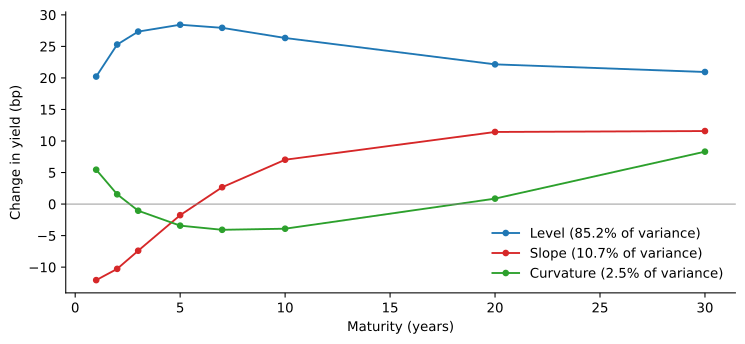
Change in the zero yield at each maturity from a one-standard-deviation move in each of the first three principal components of monthly yield changes, 1985 to 2025, in basis points.
- Together the three explain 98.5% of the variance; the 1-year and 30-year changes correlate only 0.50.
Why Duration Works, and Where It Fails
- Duration hedges a parallel shift, and a parallel shift is close to the level factor, the source of most of the risk.
- A duration-matched portfolio is still exposed to slope and curvature.
- A barbell (short and long bonds) matched to a bullet liability is exposed to a change in slope.
- Practitioners measure the sensitivity to each factor, or to yields at several key maturities, and hedge them separately.
Example 5 (Immunization and a Twist) The pension fund owes $100 million in 15 years and holds $21.583 million in 1-year zeros and $20.144 million in 30-year zeros, with all yields at 6%. If all yields rise to 7%, assets are worth $36.58 million and the liability $36.24 million: still funded. If instead the 1-year yield falls to 5% and the 30-year rises to 7%, with the 15-year unchanged, assets are worth $36.99 million against a liability of $41.73 million: a $4.74 million shortfall.