Mean-Variance Analysis with N Risky Assets
Introduction
This notebook develops the mathematics of portfolio choice for an economy with n risky assets and no risk-free asset. The analysis follows Chapter 3 in Huang and Litzenberger (1988).
Markowitz (1952) was the first to establish a solid foundation for this problem. His key insight is that combining risky assets allows investors to diversify away idiosyncratic risk, but some risk—known as systematic risk—cannot be eliminated. As a result, for any target expected return there is a portfolio that achieves the lowest possible variance, and the collection of all such portfolios traces out the minimum variance frontier (MVF).
Without short-selling constraints, the MVF is a hyperbola in (\mu, \sigma) space. We derive its equation explicitly, show that any two frontier portfolios span the entire frontier, and characterize the global minimum variance portfolio (MVP). Beta pricing and the extension to economies with a risk-free asset are covered in separate notebooks.
N-Risky Assets
Portfolio Statistics
We use lowercase boldface for vectors and uppercase boldface for matrices; \mathbf{A}' denotes the transpose of \mathbf{A}. The n asset returns and portfolio weights are collected in column vectors \mathbf{r} = (r_{1}, r_{2}, \ldots, r_{n})', \qquad \mathbf{w} = (w_{1}, w_{2}, \ldots, w_{n})'.
Investors allocate wealth across the n assets by choosing weights \mathbf{w}. Weights may be positive (long) or negative (short), subject only to the budget constraint \mathbf{w}'\pmb{\iota} = 1, where \pmb{\iota} = (1, 1, \ldots, 1)'. The portfolio return is therefore r = \mathbf{w}' \mathbf{r}. \tag{1}
For portfolio optimization we need the first two moments of \mathbf{r}. The vector of expected returns is \mathbf{e} = (\operatorname{E}(r_{1}), \operatorname{E}(r_{2}), \ldots, \operatorname{E}(r_{n}))', where \operatorname{E}(\cdot) denotes the expectation operator. The covariance matrix \mathbf{V}, with (i,j) entry \operatorname{Cov}(r_{i}, r_{j}), is symmetric by definition and positive semidefinite since for any \mathbf{y} \in \mathbb{R}^{n}, \begin{aligned} \mathbf{y}' \mathbf{V} \mathbf{y} & = \mathbf{y}' \operatorname{E}\left[ (\mathbf{r} - \mathbf{e})(\mathbf{r} - \mathbf{e})' \right] \mathbf{y} \\ & = \operatorname{E}\left[ \left((\mathbf{r} - \mathbf{e})' \mathbf{y}\right)^{2} \right] \geq 0. \end{aligned}
Definition 1 (Economy) An economy consists of n risky assets. Each asset i has an arbitrage-free payoff x_i, a strictly positive price p_i > 0, and a net return r_i = x_i/p_i - 1. The vector \mathbf{r} = (r_1, \ldots, r_n)' has an invertible covariance matrix \mathbf{V}. The return of any portfolio is r = \mathbf{w}' \mathbf{r}.
For the returns \mathbf{r} to be well-defined, each price p_{i} must be strictly positive. This is guaranteed by requiring the underlying payoff market to be arbitrage-free: if any asset had a non-positive price while delivering a non-negative payoff in every state (and strictly positive in some), investors could earn a risk-free profit by holding it. Thus, even though we work entirely with returns from this point on, no-arbitrage on payoffs is the silent prerequisite that makes every r_{i} = x_{i} / p_{i} a proper return (see Chamberlain and Rothschild 1983).
We will assume that \mathbf{V} is invertible to guarantee that the n-risky basis assets are linearly independent, i.e. that no combination of them generates a risk-free asset. Intuitively, this implies that it is not possible to combine the risky assets to build a portfolio that has zero variance.
Since \mathbf{V} is symmetric, all its eigenvalues are real. Being positive semidefinite further requires all eigenvalues to be non-negative, while being invertible rules out zero eigenvalues. Together, these three properties imply that all eigenvalues of \mathbf{V} are strictly positive, so \mathbf{V} is positive definite: \mathbf{y}' \mathbf{V} \mathbf{y} > 0 for all \mathbf{y} \neq \mathbf{0}.
Property 1 (Portfolio Statistics) For portfolios of risky assets we have the following relations \begin{aligned} \operatorname{E}(r_{p}) & = \mathbf{w}_{p}' \mathbf{e}, \\ \sigma^{2}(r_{p}) & = \mathbf{w}_{p}' \mathbf{V} \mathbf{w}_{p}, \\ \operatorname{Cov}(r_{p}, r_{q}) & = \mathbf{w}_{q}' \mathbf{V} \mathbf{w}_{p}. \end{aligned}
Taking expectations in (1), the expected return of portfolio p is computed as \operatorname{E}(r_{p}) = \sum_{i = 1}^{n} w_{i, p} \operatorname{E}(r_{i}) = \mathbf{w}_{p}' \mathbf{e}. Applying (1) to portfolios p and q, the covariance between these two portfolios is \operatorname{Cov}(r_{p}, r_{q}) = \sum_{i = 1}^{n} \sum_{j = 1}^{n} w_{i, p} w_{j, q} \operatorname{Cov}(r_{i}, r_{j}) = \mathbf{w}_{q}' \mathbf{V} \mathbf{w}_{p} Finally, the variance of portfolio p is just \sigma^{2}(r_{p}) = \operatorname{Cov}(r_{p}, r_{p}) = \mathbf{w}_{p}' \mathbf{V} \mathbf{w}_{p}
The Minimum-Variance Frontier
Property 2 (The Minimum Variance Frontier) The minimum variance frontier contains all the portfolios that achieve the minimum possible variance for a given expected return. It determines the frontier of the investment opportunity set. It is an hyperbola characterized in (\mu, \sigma) space by \frac{\sigma^{2}}{1/C} - \frac{(\mu - A/C)^{2}}{D/C^{2}} = 1.
We want to solve the following problem: \begin{aligned} \min_{\mathbf{w}} \quad & \dfrac{1}{2} \mathbf{w}' \mathbf{V} \mathbf{w} \\ \textrm{s.t.} \quad & \begin{aligned} \mathbf{w}' \mathbf{e} & = \mu \\ \mathbf{w}' \pmb{\iota} & = 1 \end{aligned} \end{aligned}
For this we form the Lagrangian \mathcal{L} = \dfrac{1}{2} \mathbf{w}' \mathbf{V} \mathbf{w} + \lambda_{1} (\mu - \mathbf{w}' \mathbf{e}) + \lambda_{2} (1 - \mathbf{w}' \pmb{\iota})
The first order conditions for this problem are \begin{aligned} \dfrac{\partial \mathcal{L}}{\partial \mathbf{w}} & = \mathbf{V} \mathbf{w} - \lambda_{1} \mathbf{e} - \lambda_{2} \pmb{\iota} = 0 \\ \dfrac{\partial \mathcal{L}}{\partial \lambda_{1}} & = \mu - \mathbf{w}' \mathbf{e} = 0 \\ \dfrac{\partial \mathcal{L}}{\partial \lambda_{2}} & = 1 - \mathbf{w}' \pmb{\iota} = 0 \end{aligned} \tag{2} From the first FOC in (2), the frontier weights must lie in the span of \mathbf{V}^{-1}\mathbf{e} and \mathbf{V}^{-1}\pmb{\iota}: \mathbf{w} = \lambda_{1}\mathbf{V}^{-1}\mathbf{e} + \lambda_{2}\mathbf{V}^{-1}\pmb{\iota}. \tag{3}
Define A = \pmb{\iota}' \mathbf{V}^{-1} \mathbf{e}, \qquad B = \mathbf{e}' \mathbf{V}^{-1} \mathbf{e}, \qquad C = \pmb{\iota}' \mathbf{V}^{-1} \pmb{\iota}, and let D = BC - A^{2}. Substituting (3) into the two constraints gives B\lambda_{1} + A\lambda_{2} = \mu, \qquad A\lambda_{1} + C\lambda_{2} = 1. Solving, \lambda_{1} = \frac{C\mu - A}{D}, \qquad \lambda_{2} = \frac{B - A\mu}{D}. Therefore the frontier portfolio is affine in its target mean: \mathbf{w} = \mathbf{a} + \mu \mathbf{b}, where \mathbf{a} = \frac{1}{D}\mathbf{V}^{-1}(B\pmb{\iota} - A\mathbf{e}), \qquad \mathbf{b} = \frac{1}{D}\mathbf{V}^{-1}(C\mathbf{e} - A\pmb{\iota}). \tag{4} Hence, \begin{aligned} \sigma^{2} & = (\mathbf{a} + \mu \mathbf{b})' \mathbf{V} (\mathbf{a} + \mu \mathbf{b}) \\ & = \dfrac{1}{D} (B - 2 A \mu + C \mu^{2}). \end{aligned} \tag{5} This can be written as \frac{\sigma^{2}}{1/C} - \frac{(\mu - A/C)^{2}}{D/C^{2}} = 1. \tag{6} Equation (6) describes an hyperbola in (\mu, \sigma) space with vertex \left( 1/\sqrt{C}, A/C \right) and asymptotes \mu = A/C \pm \sigma \sqrt{D/C}.
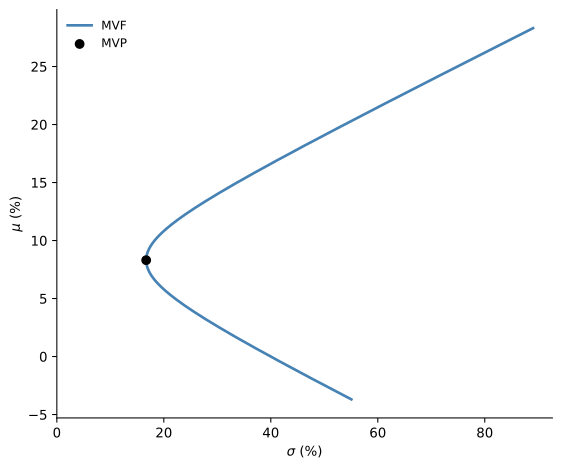
The investment opportunity set is the region on and to the right of the hyperbola in Figure 1. To see this, write any portfolio with mean \mu as \mathbf{w} = \mathbf{w}_{p} + \mathbf{z}, where \mathbf{w}_{p} is the frontier portfolio with the same mean and \mathbf{z} satisfies \mathbf{z}'\mathbf{e} = \mathbf{z}'\pmb{\iota} = 0. Then \sigma^{2} = \mathbf{w}_{p}'\mathbf{V}\mathbf{w}_{p} + 2\mathbf{w}_{p}'\mathbf{V}\mathbf{z} + \mathbf{z}'\mathbf{V}\mathbf{z}. The cross term vanishes because, by (3), \mathbf{V}\mathbf{w}_{p} = \lambda_{1}\mathbf{e} + \lambda_{2}\pmb{\iota} for some scalars \lambda_{1},\lambda_{2}. Hence \mathbf{w}_{p}'\mathbf{V}\mathbf{z} = \lambda_{1}\mathbf{e}'\mathbf{z} + \lambda_{2}\pmb{\iota}'\mathbf{z} = 0. Since \mathbf{V} is positive definite, \mathbf{z}'\mathbf{V}\mathbf{z} \geq 0, and therefore \sigma^{2} \geq \sigma^{2}_{\min}(\mu) for every portfolio with mean \mu.
Property 3 (Spanning) The investment opportunity set has dimension n and is spanned by n risky assets such that their covariance matrix is invertible. The minimum variance frontier has dimension 2 and is spanned by any two different frontier portfolios.
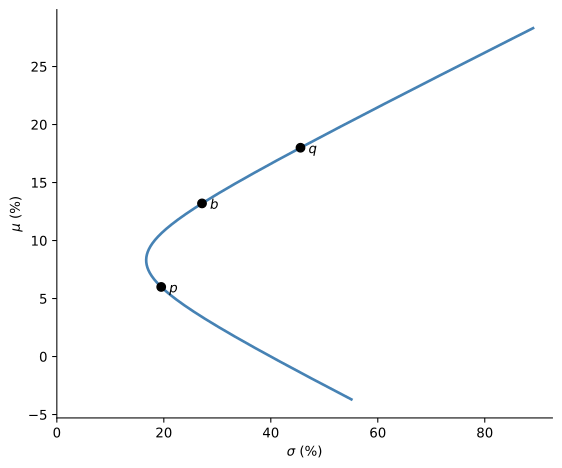
Consider two frontier portfolios, p and q with expected returns \mu_{p} and \mu_{q}. By (4), their weights are \begin{aligned} \mathbf{w}_{p} & = \mathbf{a} + \mu_{p}\mathbf{b} \\ \mathbf{w}_{q} & = \mathbf{a} + \mu_{q}\mathbf{b}. \end{aligned} Consider now forming a portfolio b consisting of 1 - \beta of p and \beta of q. Its expected return is \mu_{b} = (1 - \beta) \mu_{p} + \beta \mu_{q}, and its portfolio weights are given by \begin{aligned} \mathbf{w}_{b} & = (1 - \beta)(\mathbf{a} + \mu_{p}\mathbf{b}) + \beta(\mathbf{a} + \mu_{q}\mathbf{b}) \\ & = \mathbf{a} + \left[(1 - \beta)\mu_{p} + \beta\mu_{q}\right]\mathbf{b} \\ & = \mathbf{a} + \mu_{b}\mathbf{b}, \end{aligned} which shows that b is also a frontier portfolio. Figure 2 illustrates this with b = 0.4\, p + 0.6\, q.
Property 4 (Minimum Variance Portfolio) There is a unique portfolio that minimizes variance across all portfolios, called the minimum variance portfolio (MVP), denoted by g. The covariance of the MVP with any other portfolio is always equal to the variance of the MVP.
We solve the problem: \begin{aligned} \min_{\mathbf{w}} \quad & \dfrac{1}{2} \mathbf{w}' \mathbf{V} \mathbf{w} \\ \textrm{s.t.} \quad & \mathbf{w}' \pmb{\iota} = 1 \end{aligned}
For this we form the Lagrangian \mathcal{L} = \dfrac{1}{2} \mathbf{w}' \mathbf{V} \mathbf{w} + \lambda (1 - \mathbf{w}' \pmb{\iota})
The first order conditions for this problem are \begin{aligned} \dfrac{\partial \mathcal{L}}{\partial \mathbf{w}} & = \mathbf{V} \mathbf{w} - \lambda \pmb{\iota} = 0, \\ \dfrac{\partial \mathcal{L}}{\partial \lambda} & = 1 - \mathbf{w}' \pmb{\iota} = 0. \end{aligned} Hence, \begin{aligned} \mathbf{w}_{g} & = \lambda \mathbf{V}^{-1} \pmb{\iota}, \\ 1 = \mathbf{w}_{g}' \pmb{\iota} & = \lambda \pmb{\iota}' \mathbf{V}^{-1} \pmb{\iota} = \lambda C, \\ \mathbf{w}_{g} & = \dfrac{1}{C} \mathbf{V}^{-1} \pmb{\iota}. \end{aligned} The covariance of the MVP with any other portfolio i is given by \begin{aligned} \operatorname{Cov}(r_{i}, r_{g}) & = \mathbf{w}_{i}' \mathbf{V} \mathbf{w}_{g} \\ & = \mathbf{w}_{i}' \mathbf{V} \left( \frac{1}{C} \mathbf{V}^{-1} \pmb{\iota} \right) \\ & = \frac{1}{C}. \end{aligned} Since \operatorname{V}(r_{g}) = \operatorname{Cov}(r_{g}, r_{g}) = 1 / C, we have that \operatorname{Cov}(r_{i}, r_{g}) = \operatorname{V}(r_{g}) for any portfolio i.
Note that the standard deviation of the MVP corresponds to the \sigma-coordinate of the vertex of the hyperbola described by (6).