import hashlib
import matplotlib.pyplot as plt
import pandas as pd
import random
import statistics
import time

def sha256_hex(s: str) -> str:
    return hashlib.sha256(s.encode("utf-8")).hexdigest()

def mine_once_leading_zeros(N: int, max_tries: int = 2_000_000):
    prev_hash = "0" * 64
    merkle_root = sha256_hex(f"tx-set-{random.randint(0, 10**9)}")
    timestamp = int(time.time())
    target_prefix = "0" * N

    for nonce in range(max_tries):
        header = f"{prev_hash}|{merkle_root}|{timestamp}|{nonce}"
        h = sha256_hex(header)
        if h.startswith(target_prefix):
            return nonce + 1
return NoneBlockchain Basics
FIN 4506
Lorenzo Naranjo
Spring 2026
Digital Foundations
- Before blockchain mechanics, we need four building blocks:
- bits
- bytes
- hexadecimal notation
- cryptographic hash functions
Bits and Bytes
- A bit is a binary digit: 0 or 1
- A byte is 8 bits
- Example: \begin{aligned} 10101100_2 & = 1\cdot 2^7 + 0\cdot 2^6 + 1\cdot 2^5 + 0\cdot 2^4 + 1\cdot 2^3 + 1\cdot 2^2 + 0\cdot 2^1 + 0\cdot 2^0 \\ & = 172_{10} \end{aligned}
Hexadecimal (Base 16)
- Hex uses symbols
0-9andA-F - One hex digit = 4 bits
- Therefore:
- 1 byte (8 bits) = 2 hex digits
- 256 bits = 32 bytes = 64 hex characters
- Example: 10101100_2 = \mathrm{AC}_{16} = 172_{10}
Text to Bytes Example
- Computers hash bytes, not abstract text
- UTF-8 encoding maps characters to bytes
- Example string:
"hello"- bytes in hex:
68 65 6C 6C 6F - so changing case/punctuation changes bytes before hashing
- bytes in hex:
What Is a Hash?
- A hash function maps arbitrary input to fixed-length output
- SHA-256 output length is always 256 bits (64 hex chars)
- Example interpretation:
- input: a transaction or block header
- output: a 256-bit digest used as a compact fingerprint
Why Hashes Are Useful
- Deterministic: same input, same output
- Avalanche effect: tiny input change, very different output
- Pre-image resistance: hard to reverse digest back to original input
- Collision resistance: hard to find two inputs with same digest
- These properties enable tamper-evidence in blockchain data structures
Why Blockchain?
- Core coordination problem: no central ledger manager
- Nodes must agree on one transaction history
- Agreement must hold under:
- network delays
- strategic behavior
- potentially malicious participants
Encoding and Hashes
- Data are bytes (8 bits), usually shown in hex
- SHA-256 maps arbitrary input to a fixed 256-bit digest
- Security-relevant properties:
- deterministic
- pre-image resistance
- collision resistance
- avalanche effect
Block Composition
- A block has two parts:
- Header: compact metadata used for PoW/identification
- Body: full transaction list
- In this simplified setup, header includes:
- previous block hash
- transaction summary hash (Merkle root)
- timestamp
- nonce
Merkle Root (Intuition)
- Start by hashing each transaction (leaf hashes)
- Hash leaves in pairs, then hash resulting parents in pairs
- Continue until one top hash remains: the Merkle root
- One transaction change alters its leaf, then propagates upward and changes the root
Why Merkle Roots Matter
- Compact commitment: one fixed-size hash summarizes all block transactions
- Fast verification of inclusion:
- a node can verify one transaction with a short Merkle proof
- only sibling hashes along one tree path are needed
- Full transactions are still in the block body; the root is a summary, not a replacement
Proof of Work (PoW)
- Miners search for a nonce such that: \text{hash(header)} < \text{target}
- Smaller target means higher difficulty
- “More leading zeros” is shorthand for a lower target in hex representation
First-Passage View of Mining
- Each nonce trial is one Bernoulli attempt
- Under leading-N-hex-zero rule: p = 16^{-N}
- If K is tries to first success, then K\sim\text{Geometric}(p) and \mathbb{E}[K]=\frac{1}{p}=16^N
Economic Security Logic
- Producing valid blocks is expensive (hardware + energy)
- Verifying blocks is cheap for all nodes
- Rewards are paid only to accepted blocks
- For most miners, honest participation is profit-maximizing
Confirmation Security
- To reverse a confirmed payment, attacker must catch up from deficit z
- If honest share is p, attacker share is q, with p+q=1:
- if q \ge p, eventual catch-up probability is 1
- if q < p, benchmark catch-up probability: Q_z = \left(\frac{q}{p}\right)^z
- Reversal risk declines exponentially with confirmation depth when q<p
State-Process Representation
At block t, define state: X_t=(h_{t-1}, m_t, \tau_t, T_t)
- h_{t-1}: previous hash
- m_t: Merkle-root transaction summary
- \tau_t: timestamp
- T_t: difficulty target
Recursion: current state \rightarrow nonce search \rightarrow accepted hash \rightarrow next state.
Mining Pools
- Solo mining has high payout variance
- Pools smooth payouts by sharing reward flow
- Common contracts:
- PPS: miners get smoother pay, pool bears more variance
- PPLNS: miners bear more variance, pool bears less
- Pool concentration can increase coordination/security risk
Simulation Setup (Notebook Link)
- Fix
prev_hash,merkle_root,timestamp - Vary
noncesequentially - Stop when hash satisfies leading-zero difficulty rule
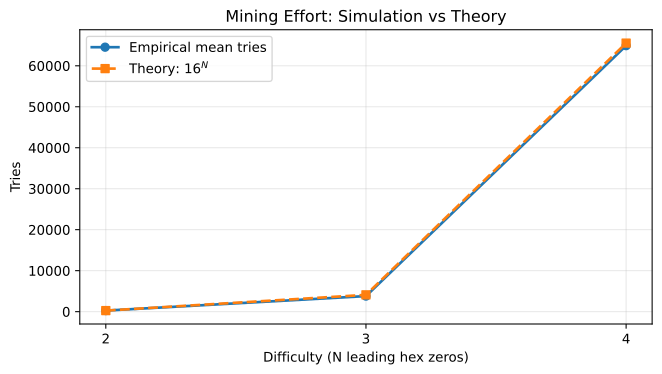
- Compare empirical average tries with theoretical (16^N)
Simulation Code
Simulation Results: Summary Table
settings = [
    {"N": 2, "reps": 200},
    {"N": 3, "reps": 120},
    {"N": 4, "reps": 40},
]

rows = []
for s in settings:
    N, reps = s["N"], s["reps"]
    samples = [mine_once_leading_zeros(N) for _ in range(reps)]
    samples = [x for x in samples if x is not None]

    rows.append({
        "N": N,
        "reps": len(samples),
        "theory_E_tries": 16**N,
        "empirical_mean": round(statistics.mean(samples), 2),
        "empirical_median": round(statistics.median(samples), 2),
    })

df_summary = pd.DataFrame(rows)
df_summary
Simulation Results: Summary Table
| N | reps | theory_E_tries | empirical_mean | empirical_median | |
|---|---|---|---|---|---|
| 0 | 2 | 200 | 256 | 264.36 | 199.0 |
| 1 | 3 | 120 | 4096 | 3797.62 | 2706.5 |
| 2 | 4 | 40 | 65536 | 64913.88 | 43075.5 |
Simulation Results: Theory vs Empirical
Ns = df_summary["N"].tolist()
empirical = df_summary["empirical_mean"].tolist()
theory = df_summary["theory_E_tries"].tolist()

plt.figure(figsize=(7, 4))
plt.plot(Ns, empirical, marker="o", linewidth=2, label="Empirical mean tries")
plt.plot(Ns, theory, marker="s", linestyle="--", linewidth=2, label="Theory: $16^N$")
plt.xlabel("Difficulty (N leading hex zeros)")
plt.ylabel("Tries")
plt.title("Mining Effort: Simulation vs Theory")
plt.xticks(Ns)
plt.grid(alpha=0.3)
plt.legend()
plt.tight_layout()
plt.show()
Simulation Results: Theory vs Empirical
Simulation Results: Dispersion at Fixed Difficulty
| N | min | median | mean | max | |
|---|---|---|---|---|---|
| 0 | 3 | 7 | 2938.5 | 4081.05 | 27347 |
Takeaways
- Blockchain combines cryptographic commitment and incentive design
- Merkle roots make transaction commitment compact and verifiable
- PoW makes production costly but verification cheap
- Confirmation depth converts elapsed work into security