Options Spreads
Options, Futures and Derivative Securities
Spring 2026
What Is an Option Spread?
- An option spread combines options of the same type, all calls or all puts, on the same underlying asset with different strikes.
- Option spreads can be directional, such as bull or bear spreads, or pay the spread if the stock price is within a certain range.
Bull Spread
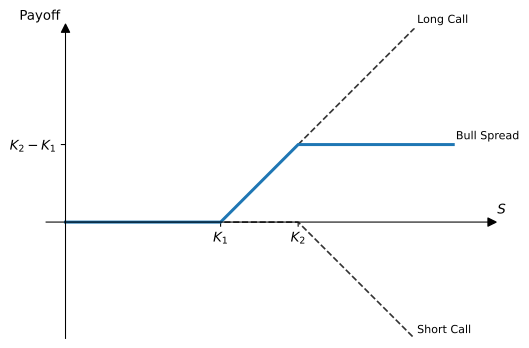
- A bull spread is a two-leg option strategy that consists in a long position in a call with strike K_{1} and a short position in a call with strike K_{2}, where K_{1} < K_{2}.
Example 1: Bull Spread
- A non-dividend paying stock currently trades at $50.
- Call options with strikes K_{1} = \$40 and K_{2} = \$60 trade for $13.23 and $3.45, respectively.
- The cost of the bull spread is 13.23 - 3.45 = $9.78.
- The payoff and profit for different stock prices at maturity is:
| Long Call |
0 |
10 |
30 |
| Short Call |
0 |
0 |
-10 |
| Payoff |
0 |
10 |
20 |
| Profit |
-9.78 |
0.22 |
10.22 |
Bull Spread
- The payoff of a bull spread can then be described as follows:
| Long Call |
0 |
S - K_{1} |
S - K_{1} |
| Short Call |
0 |
0 |
-(S - K_{2}) |
| Bull Spread |
0 |
S - K_{1} |
K_{2} - K_{1} |
- If K_{2} - K_{1} is small, the bull spread is like an all-or-nothing bet on the stock going above K_{2}.
Call Premium and the Strike Price
- The previous analysis shows that the payoff of the bull spread is either zero or positive.
- Thus, no-arbitrage implies that the cost of a bull spread cannot be negative, that is,
C_{1} - C_{2} \geq 0
- If not, you could build a bull spread with a negative cost!
- This implies that a call with a lower strike cannot cost less than an otherwise equivalent call with a higher strike price:
C_{1} \geq C_{2}
Bear Spread
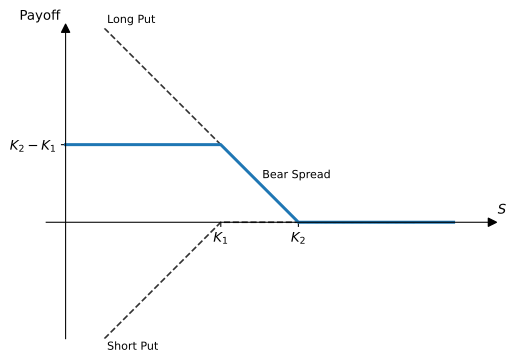
- A bear spread is a two-leg option strategy that consists in a long position in a put with strike K_{2} and a short position in a put with strike K_{1}, where K_{1} < K_{2}.
Example 2: Bear Spread
- A non-dividend paying stock currently trades at $50.
- Put options with strikes K_{1} = \$40 and K_{2} = \$60 trade for $1.28 and $10.53, respectively.
- The cost of the bear spread is 10.53 - 1.28 = $9.25.
- The payoff and profit for different stock prices at maturity is:
| Long Put |
30 |
10 |
0 |
| Short Put |
-10 |
0 |
0 |
| Payoff |
20 |
10 |
0 |
| Profit |
10.75 |
0.75 |
-9.25 |
Bear Spread
- The payoff of a bear spread can then be described as follows:
| Long Put |
K_{2} - S |
K_{2} - S |
0 |
| Short Put |
-(K_{1} - S) |
0 |
0 |
| Bear Spread |
K_{2} - K_{1} |
K_{2} - S |
0 |
- If K_{2} - K_{1} is small, the bear spread is like an all-or-nothing bet on the stock going below K_{1}.
Put Premium and the Strike Price
- The payoff diagram of the bear spread shows that the strategy can either pay nothing, or a positive amount.
- Thus, no-arbitrage implies that the cost of a bear spread cannot be negative, that is,
P_{2} - P_{1} \geq 0
- If not, you could build a bear spread with a negative cost!
- This implies that a put with a higher strike cannot cost less than an otherwise equivalent put with a lower strike price:
P_{2} \geq P_{1}
Butterfly
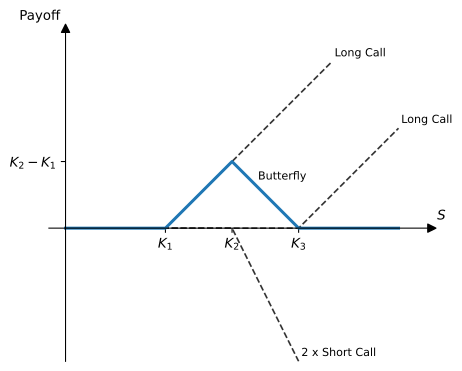
- A butterfly is a three-leg option strategy that consists in a long call with strike K_{1}, short two calls with strike K_{2} and a long call with strike K_{3} where K_{1} < K_{2} < K_{3} and K_{2} = (K_{1} + K_{3}) / 2.
Example 3: Butterfly
- A non-dividend paying stock currently trades at $50.
- Call options with strikes K_{1} = \$45, K_{2} = \$50 and K_{3} = \$55 trade for $9.85, $7.12 and $5.01, respectively.
- A butterfly with strikes K_{1}, K_{2} and K_{3} then costs 9.85 - 2(7.12) + 5.01 = $0.62.
- Below are some possible butterfly payoffs and profits for different stock prices at maturity:
| Payoff |
0 |
5 |
0 |
| Profit |
-0.62 |
4.38 |
-0.62 |
Building a Butterfly with Put Options
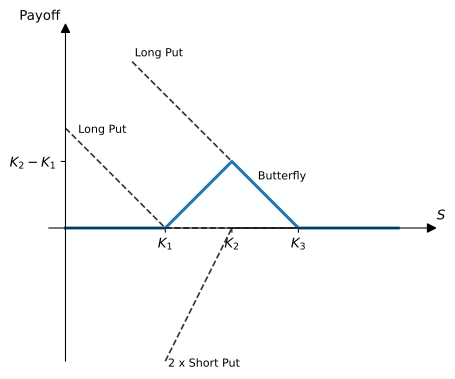
- The butterfly can also be obtained by buying puts with strikes K_{1} and K_{3}, and shorting two puts with strikes K_{2} = (K_{1} + K_{3})/2.
Option Premium Convexity with Respect to the Strike Price
- No-arbitrage implies that the price of a butterfly cannot be negative, that is,
P_{1} - 2 P_{2} + P_{3} = C_{1} - 2 C_{2} + C_{3} \geq 0,
which in turn implies that
P_{2} \leq \dfrac{P_{1} + P_{3}}{2} \quad \text{and} \quad C_{2} \leq \dfrac{C_{1} + C_{3}}{2}.
- If this was not the case, you could make a butterfly out of calls or puts with a negative price!
Condor
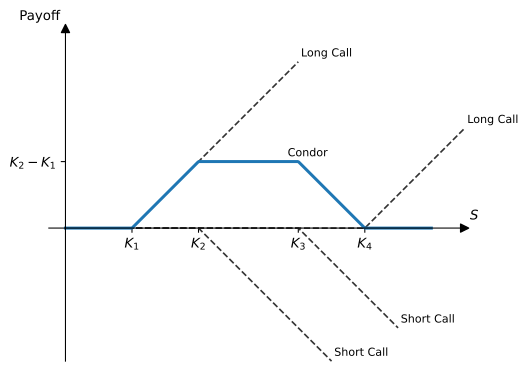
- A condor consists in a long call with strike K_{1}, a short call with strike K_{2}, a short call with strike K_{3} and a long call with strike K_{4} where K_{1} < K_{2} < K_{3} < K_{4} and K_{2} - K_{1} = K_{4} - K_{3}.
Example 4: Condor
- A non-dividend paying stock currently trades at $50.
- Call options with strikes K_{1} = \$40, K_{2} = \$45, K_{3} = \$55 and K_{4} = \$60 trade for $13.23, $9.85, $5.01 and $3.45, respectively.
- A condor with strikes K_{1}, K_{2}, K_{3} and K_{4} then costs 13.23 - 9.85 - 5.01 + 3.45 = $1.82.
- Below are some possible condor payoffs and profits for different stock prices at maturity:
| Payoff |
0 |
5 |
0 |
| Profit |
-1.82 |
3.18 |
-1.82 |