Forward and Futures Markets
Options, Futures and Derivative Securities
Lorenzo Naranjo
Spring 2026
Forward Contracts
Forward Positions
- A forward contract is an agreement to buy or sell an asset at a future date for a price fixed today, the delivery price K.
- The party that agrees to buy has a long position, and the party that agrees to sell has a short position.
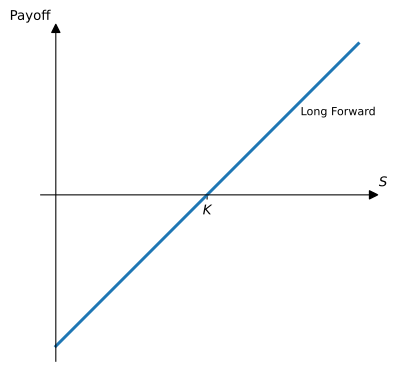
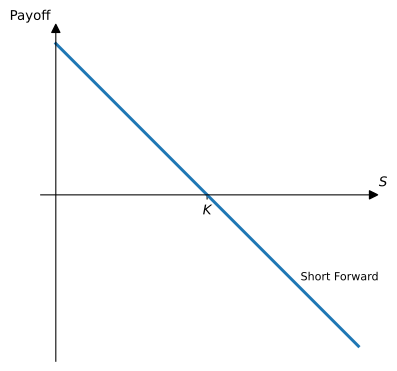
- If the asset price at maturity is S_{T}, the payoff of the long position is S_{T} - K, and the payoff of the short position is K - S_{T}.
Payoffs
Example: Currency Forward
- On May 24, 2010, the treasurer of a corporation enters into a long forward contract to buy £1 million in six months at an exchange rate of $1.4422 per British pound.
- This obligates the corporation to pay $1,442,200 for £1 million on November 24, 2010.
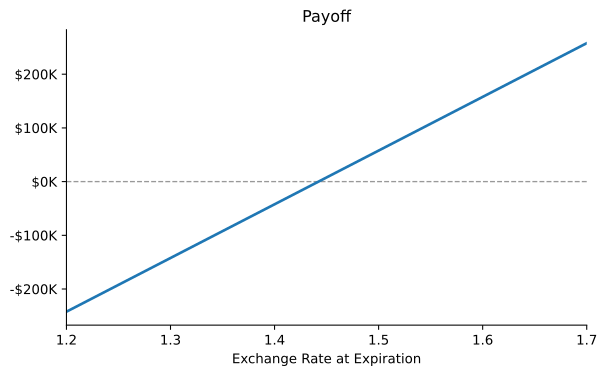
- The payoff of this contract is 1{,}000{,}000 \times (S_{T} - 1.4422).
- The table below shows the payoff for different values of the exchange rate in six months.
| S_{T} | 1.2000 | 1.3000 | 1.4000 | 1.5000 | 1.6000 |
|---|---|---|---|---|---|
| Payoff | -242,200 | -142,200 | -42,200 | 57,800 | 157,800 |
Forward Contract Payoff
- The figure shows the payoff of a long forward written on £1,000,000 with delivery price $1.4422 per £.
The Forward Price
- Nobody pays anything to enter a forward, so the delivery price must make the contract worth zero to both parties.
- That delivery price is the forward price F, so at inception K = F.
- Later, the forward price for the same date moves while K stays fixed, and the contract gains value for one side and loses it for the other.
- Forwards trade over-the-counter (OTC): terms are negotiated, settlement is at maturity, and each party bears the risk that the other defaults.
Futures Contracts
Futures Contracts
- A futures contract is a forward traded on an exchange such as the CME or the CBOE.
- Written on commodities, equity indices, currencies, interest rates, even volatility.
- The exchange standardizes size, expiration dates, delivery method, and quality, so all contracts with the same expiration are interchangeable.
- Examples:
- Buy 100 oz. of gold at $1,400 per oz. in December
- Sell £62,500 at $1.2620 per £ in June
- Sell 1,000 barrels of oil at $70 per barrel in July
Trading
- Futures used to trade by open-outcry in the pits of physical trading floors.
- Today almost all trading is electronic, through a limit-order book:
- Limit orders that cannot execute immediately wait in the book and can be cancelled at no cost.
- Market orders execute immediately at the best bid or offer.
- Futures trade for longer hours than stocks: the E-mini S&P 500 trades Sunday through Friday, 5 p.m. to 4 p.m. CT.
Margin and Daily Settlement
Marking to Market
- Each day the exchange sets a settlement price for every contract.
- Every position is marked to market: the change in the settlement price, times the contract size, is paid from the losing side to the winning side.
- The contract is effectively rewritten every day at the new settlement price.
- Buying at a futures price F_{0}, the gains and losses add up to S_{T} - F_{0}, the payoff of a forward with delivery price F_{0}, paid in daily installments.
Margin Account
- Traders deposit cash or marketable securities in a margin account with a broker.
- The account must stay above a maintenance margin; below it, the trader gets a margin call.
- Margins are set from the risk of the position, so they rise with the contract size and the volatility of the price.
- The clearinghouse is the buyer to every seller and the seller to every buyer. With losses collected daily, a default costs at most about one day’s price move.
Example: Margin on the E-mini S&P 500
- The contract value is $50 \times the futures price. You deposit $12,000 and buy one contract at 4,645.00.
| Day | Futures Price | Gain/Loss | Margin Account |
|---|---|---|---|
| 0 | 4,645.00 | 12,000.00 | |
| 1 | 4,656.75 | 587.50 | 12,587.50 |
| 2 | 4,652.25 | -225.00 | 12,362.50 |
| 3 | 4,658.50 | 312.50 | 12,675.00 |
- Over three days the account gains 50 \times 13.50 = \$675, the same as a forward entered at 4,645.00 and closed at 4,658.50.
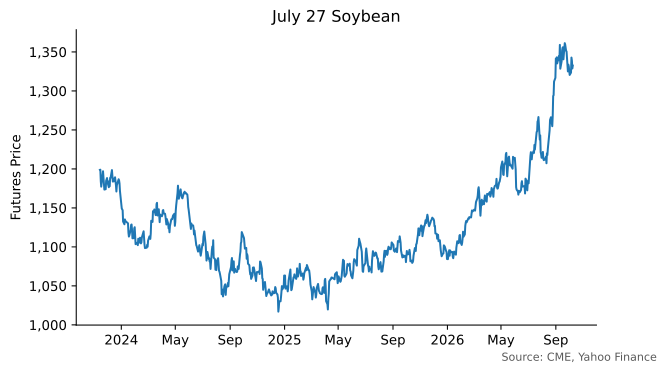
Evolution of July 27 Soybean Futures Price
Settlement and Delivery
Final Settlement
- Physical delivery: many commodity contracts, which specify the size, quality, and delivery locations of the good.
- Soybeans: 5,000 bushels of No. 2 yellow soybeans at par, No. 1 at 6 cents over, No. 3 at 6 cents under.
- Cash settlement: equity index futures and SOFR futures pay the contract size times a reference index.
- Treasury note and bond futures are settled by delivering Treasury securities.
- Several expirations trade at once: E-mini S&P 500 futures list 9 consecutive quarters plus 3 additional Decembers.
Rolling
- Almost nobody who trades futures intends to make or take delivery.
- Traders close positions before expiration, or roll them by selling the expiring contract and buying a later one.
- For them, a physically settled contract works like a cash-settled one.
- Delivery matters only to commercial firms with storage and transport, and only in the last days of a contract.
- A long position held into delivery with no place to store the good is serious trouble, as negative oil prices showed in April 2020.
Open Interest
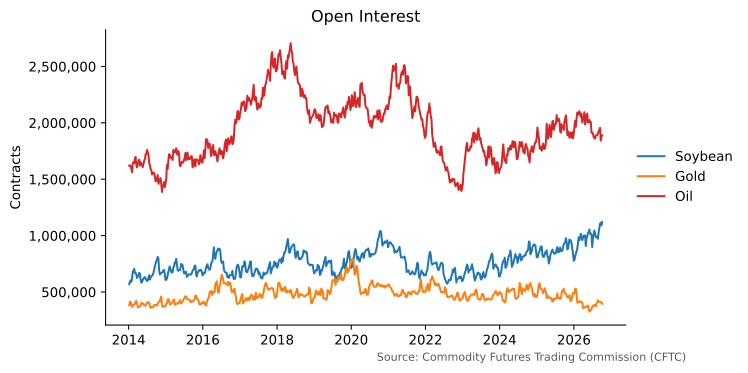
- Open interest is the number of contracts outstanding: the number of long positions, or equivalently of short positions.
SOFR Futures
From LIBOR to SOFR
- LIBOR USD was for half a century the reference rate for corporate loans in dollars.
- After the manipulation cases of 2012, and with unsecured interbank borrowing too thin to anchor the rate, regulators set out to replace it.
- In 2017, the ARRC selected the Secured Overnight Financing Rate (SOFR).
- SOFR is the rate on overnight Treasury repos: secured, deep, and close to risk-free.
SOFR Futures
- Loans and swaps need rates over months, so traders hedge and lock in the average of SOFR over future periods with SOFR futures.
- Cash settled against realized SOFR:
- 3-month: $2,500 \times IMM index, where the index is 100 minus the compounded SOFR over the reference quarter.
- 1-month: the index uses the arithmetic average of SOFR over the delivery month.
The Spot Price
Cash Price and Spot Price
- Futures of different maturities trade on one exchange under the same terms, and holding them needs no storage: no-arbitrage always applies among them.
- Whether it also ties futures to the cash market depends on the basis, the cash price minus the futures price.
- Stock index: traders can buy or short the S&P 500 basket at a known cost, so index arbitrage keeps the E-mini close to the cash index.
- The same holds for stocks and convertible currencies: the cash price is the spot price.
Why Commodities Are Different
- Physical commodities come in different grades and locations, and moving or storing them takes time and money.
- Brent and WTI are both crude oil, but different oils in different places at different prices.
- Gold in London and gold in New York are different assets. What trades around the clock in London is unallocated gold, a claim on a bank rather than bars in a vault.
- Delivering a particular lot against a futures contract carries risk, so arbitrage does not hold the basis in place.
- What can be bought and sold at a known cost is the futures contract, standardized in grade, size, and location.
The Spot Price of a Commodity
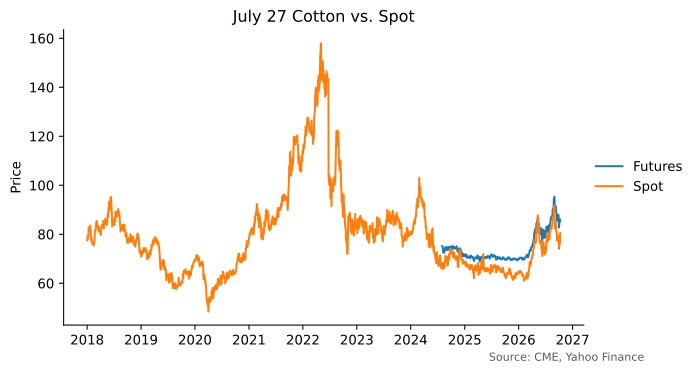
- The spot price is the price of the closest-to-maturity futures contract, the nearby contract.
- It is the price traders hedge against and the price other maturities are quoted against.
- It can be far from the cash price of the physical good, and that gap is not a pricing error.
- If F(t, T) is the futures price at t of a contract expiring at T, S_{t} = F(t, T_{1}), where T_{1} is the nearest expiration after t.
Spot vs. Futures Prices
- The gap is the spread between the July contract and the nearby; the spot series switches contracts at each expiration, so it can jump on roll dates.
Hedging the Basis
Hedging the Basis
- If arbitrage does not hold the basis in place, the merchants and processors who buy, store, and sell the physical good bear its risk.
- Selling futures against stored wheat removes most of the price risk. What is left is the basis B_{t} = P_{t} - F_{t}: (P_{1} - P_{0}) - (F_{1} - F_{0}) = B_{1} - B_{0}.
- Working (1953): the merchant buys because the cash price is low relative to futures and expects the basis to move in their favor. Hedging “is not properly comparable with insurance. It is a sort of arbitrage.”
Example: Hedging Wheat in Storage
- Kansas City, 1951: buy wheat on September 4, sell December futures, unwind both on December 1.
| Sep 4 | Dec 1 | Gain | |
|---|---|---|---|
| Cash wheat (long) | 232.50 | 252.00 | 19.50 |
| December futures (short) | 238.25 | 252.00 | -13.75 |
| Basis | -5.75 | 0.00 | 5.75 |
- The merchant earns 5.75 cents per bushel for storage, exactly what the basis promised on September 4: the wheat was the deliverable grade, so cash and futures converged at expiration.
- On May 1, 1952, an 18-cent premium over July futures signaled scarce old-crop wheat: carrying hedged wheat to July 1 lost 24.50 cents. The basis also tells the merchant when not to store.
How Many Futures?
- With h futures sold per unit, the variance of the gain is smallest at (Johnson 1960) h^{*} = \frac{\operatorname{Cov}(P_{1} - P_{0}, F_{1} - F_{0})}{\operatorname{V}(F_{1} - F_{0})}, which removes a fraction \rho^{2} of the unhedged variance.
- Ederington (1979): h^{*} is usually below one, and longer hedges remove more risk.
- Anderson and Danthine (1981): a mean-variance merchant holding q units sells N_{F} = h^{*} q + \frac{F_{0} - \operatorname{E}[F_{1}]}{\lambda \operatorname{V}(F_{1} - F_{0})}, a pure hedge plus a pure speculation. Working’s merchant has no view on the price level, sets N_{F} = q, and chooses q from the expected change in the basis.
References
Anderson, Ronald W., and Jean-Pierre Danthine. 1981. “Cross Hedging.” Journal of Political Economy 89 (6): 1182–96.
Ederington, Louis H. 1979. “The Hedging Performance of the New Futures Markets.” Journal of Finance 34 (1): 157–70.
Johnson, Leland L. 1960. “The Theory of Hedging and Speculation in Commodity Futures.” Review of Economic Studies 27 (3): 139–51.
Working, Holbrook. 1953. “Futures Trading and Hedging.” American Economic Review 43 (3): 314–43.