Exotic Options
Options, Futures and Derivative Securities
Spring 2026
Packages
Packages
- A package is a portfolio of standard options sold to a client as a single contract.
- Spreads, straddles and collars become packages when a dealer sells them as one product, usually designed to cost nothing up front.
Range Forward Contracts
- A forward fixes the price; a range forward lets it float within a band [K_{1}, K_{2}]. Common in currencies.
- A long range forward, for a buyer of the asset: long a call with strike K_{2}, short a put with strike K_{1}. The net price paid is
S_{T} - \max(S_{T} - K_{2}, 0) + \max(K_{1} - S_{T}, 0) = \min(\max(S_{T}, K_{1}), K_{2})
- Protection above K_{2}, paid for by giving up the savings below K_{1}.
- A short range forward, for a seller: long a put with strike K_{1}, short a call with strike K_{2}.
- The strikes are chosen so that the put pays for the call: zero cost. A narrow band around the forward price is a plain forward.
Range Forward Payoff
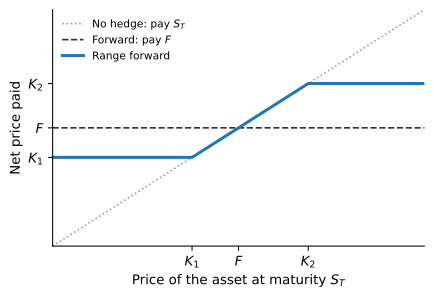
Net price paid at maturity by a buyer under a long range forward with strikes K_{1} < F < K_{2}, compared with no hedge and with a forward at F.
Valuing a Range Forward
- A long range forward is worth C(K_{2}) - P(K_{1}), both priced with Black-Scholes.
- Positive: the client pays the dealer up front. Negative: the dealer pays the client.
- Zero cost: fix one strike and solve for the other so that C(K_{2}) = P(K_{1}), by trial and error.
- Since C(F) = P(F), a zero-cost band always contains the forward price: K_{1} < F < K_{2}.
Example 1
- An asset at $100 pays a dividend yield of 2%, with volatility 25%. The risk-free rate is 5%, so the one-year forward price is F = 100 e^{0.03} = \$103.05.
- A one-year range forward with K_{1} = \$90 and K_{2} = \$115: \begin{aligned} C(115) & = 100 e^{-0.02} \operatorname{Φ}(-0.3140) - 115 e^{-0.05} \operatorname{Φ}(-0.5640) = \$5.60 \\ P(90) & = 90 e^{-0.05} \operatorname{Φ}(-0.4164) - 100 e^{-0.02} \operatorname{Φ}(-0.6664) = \$4.23 \end{aligned}
- The client pays 5.603 - 4.227 = \$1.38 up front.
- Keeping K_{1} = \$90, the range forward costs nothing when K_{2} = \$120.68.
Variations of the Black-Scholes Framework
Binary Options
- A call pays Q if S_{T} > K; the put pays Q if S_{T} < K.
- An call pays one share if S_{T} > K; the put pays one share if S_{T} < K.
| Type | Call | Put |
|---|---|---|
| Asset-or-nothing | S e^{-\delta T} \operatorname{Φ}(d_{1}) | S e^{-\delta T} \operatorname{Φ}(-d_{1}) |
| Cash-or-nothing | Q e^{-r T} \operatorname{Φ}(d_{2}) | Q e^{-r T} \operatorname{Φ}(-d_{2}) |
- A European call is a long asset-or-nothing call and a short position in K cash-or-nothing calls paying $1: C = \underbrace{S e^{-\delta T} \operatorname{Φ}(d_{1})}_{\text{asset-or-nothing}} - \underbrace{K e^{-r T} \operatorname{Φ}(d_{2})}_{\text{cash-or-nothing}}
Binary Payoffs
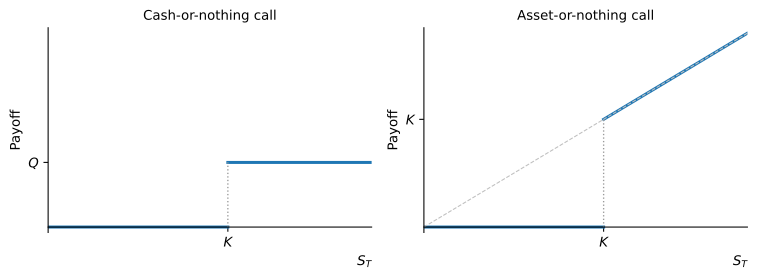
Payoffs at maturity of a cash-or-nothing call paying Q and an asset-or-nothing call paying one share, both with strike K.
Example 2
- A stock pays a dividend yield of 3%, has a volatility of 35%, and trades at $150. The risk-free rate is 8%.
- For binaries with strike $150 and maturity 6 months, \begin{aligned} d_{1} & = \frac{(0.08 - 0.03 + 0.5 \times 0.35^{2}) \times 0.5}{0.35 \sqrt{0.5}} = 0.2248 \\ d_{2} & = 0.2248 - 0.35 \sqrt{0.5} = -0.0227 \end{aligned}
- An asset-or-nothing call costs 150 e^{-0.03 \times 0.5} \operatorname{Φ}(0.2248) = \$87.02, and the put \$60.74.
- A cash-or-nothing call paying $100 costs 100 e^{-0.08 \times 0.5} \operatorname{Φ}(-0.0227) = \$47.17, and the put \$48.91.
Gap Options
- A gap call pays S_{T} - \textcolor{blue}{K_{1}} when S_{T} > \textcolor{red}{K_{2}}, and zero otherwise.
- It delivers one share and takes K_{1} in cash, so it is a long asset-or-nothing call and a short position in K_{1} cash-or-nothing calls, both triggered at K_{2}: \begin{aligned} \text{Gap Call} & = S e^{-\delta T} \operatorname{Φ}(d_{1}) - \textcolor{blue}{K_{1}} e^{-r T} \operatorname{Φ}(d_{2}) \\ \text{Gap Put} & = \textcolor{blue}{K_{1}} e^{-r T} \operatorname{Φ}(-d_{2}) - S e^{-\delta T} \operatorname{Φ}(-d_{1}) \end{aligned} where d_{1} = \frac{\ln(S/\textcolor{red}{K_{2}}) + (r - \delta + 0.5 \sigma^{2}) T}{\sigma \sqrt{T}}, \quad d_{2} = d_{1} - \sigma \sqrt{T}
- K_{2} enters d_{1} and d_{2} because it decides when the binaries pay; K_{1} only scales the cash leg.
Example 3
- An option pays S_{T} - 180 if S_{T} > 220 in 10 months, on a non-dividend paying asset worth $200 with volatility 40%. The risk-free rate is 6%.
- It is a gap call with K_{1} = 180 and K_{2} = 220: \begin{aligned} d_{1} & = \frac{\ln(200/220) + (0.06 + 0.5 (0.40)^{2}) (10/12)}{0.40 \sqrt{10/12}} = 0.0585 \\ d_{2} & = 0.0585 - 0.40 \sqrt{10/12} = -0.3067 \end{aligned}
- Hence, \begin{aligned} \text{Gap Call} & = 200 \operatorname{Φ}(0.0585) - 180 e^{-0.06 \times 10/12} \operatorname{Φ}(-0.3067) = \$39.68 \\ \text{Gap Put} & = 180 e^{-0.06 \times 10/12} \operatorname{Φ}(0.3067) - 200 \operatorname{Φ}(-0.0585) = \$10.90 \end{aligned}
- If K_{1} > K_{2} the payoff can be negative, and so can the price: here K_{1} = \$289.90 makes the gap call free.
Gap Payoffs
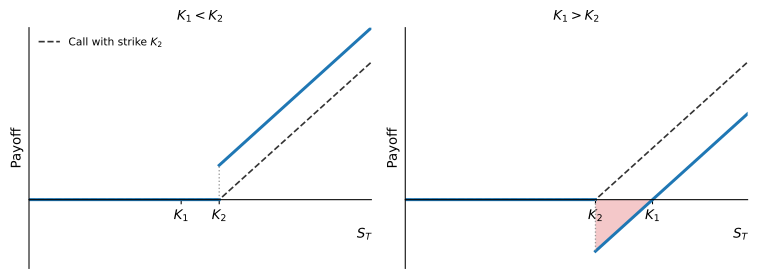
A gap call pays S_{T} - K_{1} when S_{T} > K_{2}, compared with a standard call with strike K_{2}. The shaded area marks negative payoffs when K_{1} > K_{2}.
Forward Start Options
- The option starts at a future time \tau and expires at T > \tau, typically struck at the money when it starts, K = S_{\tau}.
- Implicit in employee stock option plans. We do not know the strike today!
- Since \ln(S_{\tau}/K) = 0, d_{1} and d_{2} are known today, and at \tau C_{\tau} = S_{\tau} \left(e^{-\delta (T - \tau)} \operatorname{Φ}(d_{1}) - e^{-r (T - \tau)} \operatorname{Φ}(d_{2})\right) where d_{1} = \dfrac{(r - \delta + 0.5 \sigma^{2}) (T - \tau)}{\sigma \sqrt{T - \tau}} and d_{2} = d_{1} - \sigma \sqrt{T - \tau}.
- Today, C = \operatorname{E}^{*}(C_{\tau}) e^{-r \tau} with \operatorname{E}^{*}(S_{\tau}) e^{-r \tau} = S e^{-\delta \tau}, so C = e^{-\delta \tau} \times \text{(value of a similar option starting today)}
Example 4
- S = \$100, r = 10\%, \delta = 4\%, \sigma = 30\%. An at-the-money forward start call starts in 6 months and expires in 12 months. d_{1} = \frac{(0.10 - 0.04 + 0.5 \times 0.09) \times 0.5}{0.30 \sqrt{0.5}} = 0.2475, \quad d_{2} = 0.0354 \begin{aligned} C & = \left(100 e^{-0.04 \times 0.5} \operatorname{Φ}(0.2475) - 100 e^{-0.10 \times 0.5} \operatorname{Φ}(0.0354)\right) e^{-0.04 \times 0.5} \\ & = 9.69 \times 0.9802 = \$9.50 \end{aligned}
- A cliquet is a series of forward start options: for example, 20 at-the-money three-month options covering five years.
Chooser Options
- At time \tau (0 < \tau < T) the buyer chooses whether the option is a call or a put with strike K and maturity T.
- As with forward start options, we first value the contract at \tau: it is worth \max(C_{\tau}, P_{\tau}).
- From put-call parity: \max(C_{\tau}, P_{\tau}) = C_{\tau} + e^{-\delta (T - \tau)} \max\left(K e^{-(r - \delta)(T - \tau)} - S_{\tau}, 0\right)
- A call with strike K and maturity T plus e^{-\delta (T - \tau)} puts with strike \widetilde{K} = K e^{-(r - \delta)(T - \tau)} and maturity \tau.
Example 5
- S = K = \$100, r = 8\%, \delta = 0, \sigma = 30\%, T = 1 year, choice at \tau = 0.5 years.
- Call with K = 100 and T = 1: \begin{aligned} d_{1} & = 0.4167, \quad d_{2} = 0.1167 \\ C & = 100 \operatorname{Φ}(0.4167) - 100 e^{-0.08} \operatorname{Φ}(0.1167) = \$15.71 \end{aligned}
- One put with \widetilde{K} = 100 e^{-0.08 \times 0.5} = \$96.08 and maturity 0.5 years: \begin{aligned} d_{1} & = 0.4831, \quad d_{2} = 0.2710 \\ P & = 96.08 e^{-0.04} \operatorname{Φ}(-0.2710) - 100 \operatorname{Φ}(-0.4831) = \$4.85 \end{aligned}
- The chooser costs 15.71 + 4.85 = \$20.56.
Path-Dependent Options
Path-Dependent Options
- Some payoffs depend on the whole history of the stock price, not only on S_{T}.
- The closed-form prices above work because each payoff depends only on S_{T}, whose risk-neutral distribution is lognormal.
- A binomial tree handles path dependence directly, as long as we follow each path separately.
- The stock tree still recombines, but the path information does not: two paths that end at the same price can have different maxima or averages.
- A tree with n steps has n + 1 final prices but 2^{n} paths, over a million for n = 20.
- In practice: record at each node what the payoff needs (running maximum, barrier hit), or simulate risk-neutral paths and average the discounted payoffs.
One Path, Its Extremes and Its Average
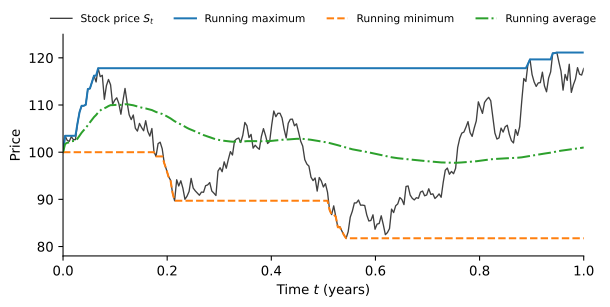
One simulated year of daily stock prices starting at S_{0} = 100 with \sigma = 0.30, with the running maximum, minimum, and average.
Lookback Options
- A floating lookback call pays S_{T} - S_{\textit{min}}: buy at the lowest price the stock reaches.
- A floating lookback put pays S_{\textit{max}} - S_{T}: sell at the highest price the stock reaches.
- A fixed lookback call pays \max(S_{\textit{max}} - K, 0).
- A fixed lookback put pays \max(K - S_{\textit{min}}, 0).
- S_{\textit{max}} and S_{\textit{min}} are taken over the whole life of the option, including S_{0}.
- Analytic formulas exist for all four types.
Asian Options
- The payoff depends on the average stock price \bar{S}_{T} from time 0 until T; on a tree, the arithmetic mean of the prices along the path, including t = 0.
- Average price: call \max(\bar{S}_{T} - K, 0), put \max(K - \bar{S}_{T}, 0).
- Average strike: call \max(S_{T} - \bar{S}_{T}, 0), put \max(\bar{S}_{T} - S_{T}, 0).
- Averaging smooths the path, so an average price option is usually cheaper than the European one: popular with firms that buy or sell regularly over a period.
- No exact analytic formula for the arithmetic average (options on the geometric average have one); approximations assume the average is lognormal.
Example 6
- A non-dividend paying stock trades for $100 and every 3 months can rise or fall by 5%. The risk-free rate is 6%.
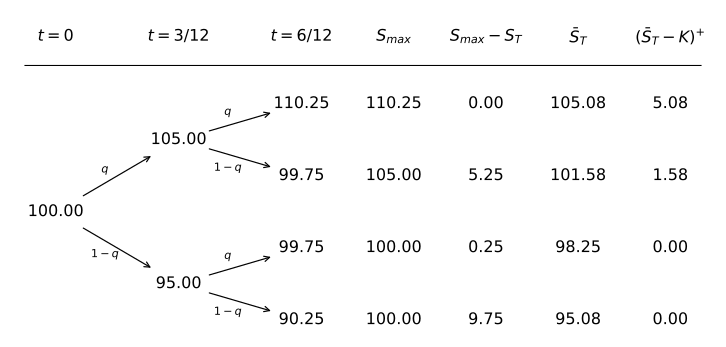
- We price a floating lookback put paying S_{\textit{max}} - S_{T} and an average price call paying \max(\bar{S}_{T} - 100, 0), both in 6 months.
Example 6 (cont’d)
- The risk-neutral probability of an up-move is q = \frac{e^{0.06 \times 3/12} - 0.95}{1.05 - 0.95} = 0.6511
- Working backward, the lookback put L and the Asian call A are worth \begin{aligned} L_{u} & = (0 q + 5.25 (1 - q)) e^{-0.06 \times 3/12} = 1.80 \\ L_{d} & = (0.25 q + 9.75 (1 - q)) e^{-0.06 \times 3/12} = 3.51 \\ L & = (1.80 q + 3.51 (1 - q)) e^{-0.06 \times 3/12} = 2.36 \\[4pt] A_{u} & = (5.08 q + 1.58 (1 - q)) e^{-0.06 \times 3/12} = 3.80 \\ A_{d} & = 0 \\ A & = (3.80 q + 0 (1 - q)) e^{-0.06 \times 3/12} = 2.44 \end{aligned}
Barrier Options
- Calls or puts that are activated or deactivated when the stock hits a barrier.
- In options come into existence only if the stock hits the barrier before maturity; out options die if it does.
- Up options require the stock to hit the barrier from below, down options from above.
- Eight combinations: up/down, in/out, call/put.
- An in and an out option with the same direction, strike, barrier, and maturity add up to the plain European option.
- A binomial tree tracks, along each path, whether the barrier has been hit; analytic formulas also exist.
In-Out Parity
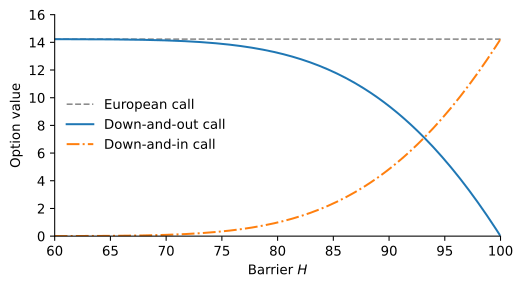
Black-Scholes prices of a one-year down-and-in and down-and-out call against the barrier H, with S = K = 100, r = 5\% and \sigma = 30\%. They add up to the European call, dashed.
Example 7
- A down-and-in call with barrier $90, strike $110, and maturity 6 months, on a stock at $100.
- The stock falls to $85 and finishes at $120: the call pays 120 - 110 = \$10.
- The stock never goes below $90 and finishes at $140: the call pays nothing, since it was never activated.
- The stock falls to $85 and finishes at $105: the call is activated but out-of-the-money, and pays nothing.
Barrier Options in Practice
- Monitoring. The contract states how often the barrier is checked: continuously, or at specified times such as daily closes.
- A barrier checked less often is hit less often: discrete monitoring raises knock-out prices and lowers knock-in prices.
- A tree checks the barrier only at its nodes, so it needs many steps to price a continuously monitored barrier.
- Hedging. Near the barrier of an up-and-out call, a small rise in the stock can wipe out a large payoff.
- The value falls steeply and delta is large and negative.
- Cash-or-nothing options have the same problem near the strike close to maturity.
- A delta hedger must trade large amounts of stock for small price moves.
Hedging Near the Barrier
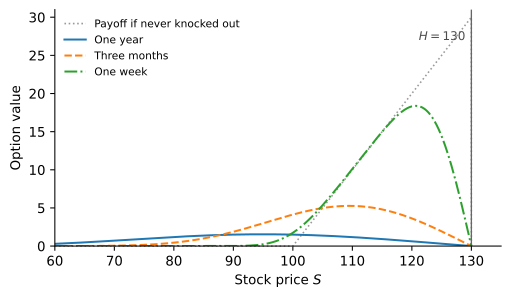
Black-Scholes prices of an up-and-out call with K = 100 and H = 130 for three maturities, with r = 5\% and \sigma = 30\%. The dotted line is the call payoff if never knocked out.
Other Exotic Options
Compound and Exchange Options
- Compound options are options on options: call on call, put on call, call on put, put on put.
- The equity of a leveraged firm is a call on its assets, so an option on the equity is a compound option.
- Valued analytically in the Black-Scholes framework; cheap relative to the underlying option.
- Exchange options give the right to exchange one asset U for another V: payoff \max(V_{T} - U_{T}, 0).
- In units of U, the payoff is U_{T} \max(V_{T}/U_{T} - 1, 0): a call on V/U with strike 1.
- The interest rate drops out, since the holder pays with U, not cash.
- The volatility of V/U depends on the correlation: assets that move together make a cheap exchange option.
Basket, Shout, and Non-Standard American Options
- Basket options are options on a portfolio of assets, valued by matching the first two moments of the basket to a lognormal.
- Shout options let the buyer shout once, at \tau, locking in the intrinsic value: a call pays
\max(S_{T} - K, S_{\tau} - K) = \max(S_{T} - S_{\tau}, 0) + S_{\tau} - K
- Similar to a lookback, but cheaper.
- Non-standard American options: exercisable only on specific dates (Bermudans), after a lock-out period, or with a strike that changes over time (warrants, convertibles).