The Fisher Model
Lorenzo Naranjo
Fall 2026
Utility Functions
Consumption
- The theory of finance is concerned with how investors allocate resources over time.
- Investors must decide today how much to save, how much to consume, and how to invest their savings.
- We would like to determine the best way to maximize the benefit that investors derive from their consumption today and tomorrow.
- We denote this consumption bundle by \{C_{0}, C_{1}\}.
Utility
- In economics, a very convenient way to rank consumption bundles is to use a utility function.
- The idea is to assign a real number to each consumption bundle.
- That is, in these notebooks a utility function is a functional U: \mathbb{R}^{2} \rightarrow \mathbb{R}.
- A consumption bundle is then preferred to another if the utility number is larger.
Example
- Consider the following function U(C_{0}, C_{1}) = \ln(C_{0}) + \ln(C_{1}).
- We can compute U(3, 2) = 1.79 and U(2.5, 2.5) = 1.83
- The agent prefers consuming 2.5 units today and tomorrow over consuming three units today and two units tomorrow, which we write as (2.5, 2.5) \succsim (3, 2).
- Note that U(2, 1) = U(1, 2) = 0.69, which we denote by (1, 2) \sim (2, 1).
- Therefore, the consumer is indifferent to some consumption bundles.
- The set of all consumption bundles that provide the same utility is called an indifference curve.
The Notion of Order
- The value of the utility function is irrelevant since applying any increasing function to a utility function will not change the rankings of consumption bundles.
- Since U(C_{0}, C_{1}) = \ln(C_{0}) + \ln(C_{1}) = \ln(C_{0} C_{1}), the new utility function V(C_{0}, C_{1}) = C_{0}C_{1} generates the same rankings of consumption bundles.
Indifference Curves
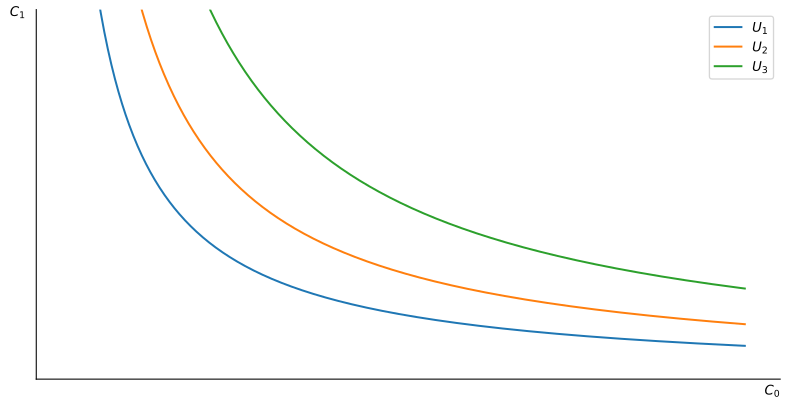
Figure 1: The figure shows three indifference curves.
Properties of Utility Functions
- The figure displays something that we expect to find in real life: utility should increase with consumption.
- In the previous example, we found that (1, 2) \sim (2, 1), but of course we would expect (1, 2) \precsim (1, 3).
- In other words, the marginal utility of consumption must be positive for consumption in both periods, i.e., \frac{\partial U}{\partial C_{i}} > 0.
- Marginal utility should also decrease with consumption, i.e., \dfrac{\partial^{2} U}{\partial C_{i}^{2}} < 0, since each additional unit of consumption can only increase utility at a lower rate.
Some Utility Functions
- In finance, it is common to use separable utility functions of the form U(C_{0}, C_{1}) = u(C_{0}) + \beta u(C_{1}).
- The choice u(C) = \begin{cases} \frac{C^{1 - \gamma} - 1}{1 - \gamma}, & \text{if}\ \gamma \geq 0, \gamma \neq 1 \\ \ln(C), & \text{if}\ \gamma = 1 \end{cases} is called power utility if \gamma \neq 1 and log utility if \gamma = 1.
- Another common choice for u(C) is u(C) = - e^{-a C}, usually called exponential utility.
Marginal Rate of Substitution
- We can compute the utility differential as dU = \frac{\partial U}{\partial C_{0}} dC_{0} + \frac{\partial U}{\partial C_{1}} dC_{1}.
- Since an indifference curve keeps the utility level constant, for all points in the indifference curve, we have that dU = 0, implying that \frac{dC_{1}}{dC_{0}} = - \frac{\frac{\partial U}{\partial C_{0}}}{\frac{\partial U}{\partial C_{1}}}. \tag{1}
- The absolute value of the derivative of C_{1} with respect to C_{0} is called the marginal rate of substitution (MRS) between C_{1} and C_{0}.
- The MRS compares how important it is to consume tomorrow versus today at any given point.
Production Functions
The Idea
- An investor must first decide how much to consume today and how much to save for the next period.
- Two factors determine this decision.
- On the one hand, the MRS determines how future consumption feels compared to current consumption.
- On the other hand, the ability to transform current consumption into future consumption is essential in deciding how much to consume today versus tomorrow.
- We model the ability to convert current consumption into future consumption through a production function.
Economic Setup
- All consumers start with a certain level of wealth, W, measured in terms of current consumption.
- Consumers can then decide how much to consume today, given by C_{0}^{*}, and how much to invest.
- An investment of K = W - C_{0}^{*} will generate C_{1}^{*} = f(K) of consumption tomorrow.
A Portfolio of Projects
- The production function combines all available investment projects and ranks them from best to worse in terms of return.
- Of course, if you have little to invest you want to use it in projects that have the best profitability.
- For example, consider the following portfolio of investment opportunities, ranked by internal rate of return (IRR).
| Project | Maximum Investment | IRR |
|---|---|---|
| I | 1 | 500% |
| II | 3 | 300% |
| III | 5 | 100% |
| IV | 11 | 0% |
A Production Function
Assuming that we can invest fractions of today’s consumption, we can then generate the following production function f(K).
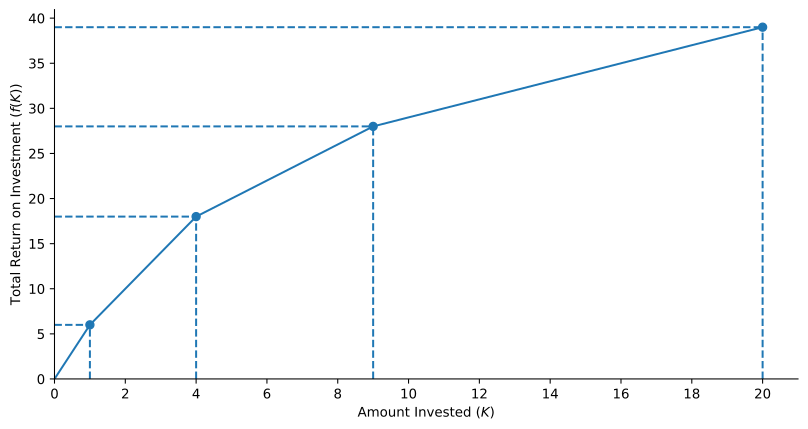
Figure 2: The figure shows a piece-wise linear production function.
Properties of Production Functions
- The production function we just built is continuous in its range of definition.
- It is also increasing in K as long as we assume limited liability.
- Note that Project IV has a net return of 0%, which means that each unit of consumption invested generates one unit of consumption tomorrow.
- The worst possible scenario under limited liability is that the IRR of the project is -100%, at which point the production function would be flat.
- The production function in Figure 2 is also convex, which is a consequence of investing in the projects with better profitability first.
Smoothness Assumptions
- Typically, we assume that the production function is smooth such that f'(K) > 0 and f''(K) < 0, which yields a continuous, increasing, and convex function.
- In the following, it is useful to express the function in terms of K = W - C_{0}, so that C_{1} = f(W - C_{0}).
- If the consumer decides to invest nothing and consume everything today, we have that K = 0 and C_{0}^{*} = W.
- If, on the other hand, the consumer decides to consume nothing today and invest everything, then we have that K = W and C_{0}^{*} = 0.
Investment Opportunity Set
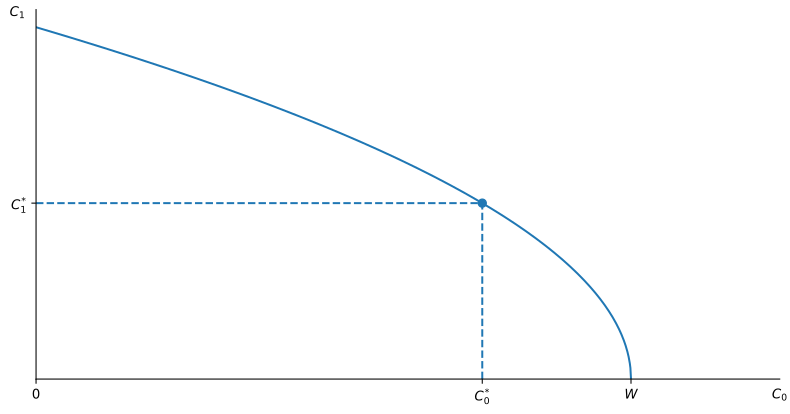
Figure 3: The figure shows the investment opportunity set available to an investor.
Maximizing Utility
The Investor’s Problem
- Consider now an investor with utility function U(C_{0}, C_{1}) and initial wealth W.
- The investor has the ability to invest K = W - C_{0} into a production function that yields next period C_{1} = f(K).
- We can write the investor’s problem as follows \begin{aligned} \max_{\{C_{0}, C_{1}\}} & U(C_{0}, C_{1}) \\ \text{s.t. } & C_{1} = f(W - C_{0}) \end{aligned}
- To solve the previous optimization problem, we can write the Lagrangian as \mathcal{L} = U(C_{0}, C_{1}) - \lambda (C_{1} - f(W - C_{0})).
The Solution
- The first-order conditions (FOC) are \begin{aligned} \frac{\partial \mathcal{L}}{\partial C_{0}} & = \frac{\partial U}{\partial C_{0}} - \lambda f'(W - C_{0}) = 0, \\ \frac{\partial \mathcal{L}}{\partial C_{1}} & = \frac{\partial U}{\partial C_{1}} - \lambda = 0, \\ \frac{\partial \mathcal{L}}{\partial \lambda} & = C_{1} - f(W - C_{0}) = 0. \end{aligned}
- At the optimum, the marginal rate of substitution (MRS) must be equal to the marginal rate of transformation (MRT) between C_{1} and C_{0}.
- The last FOC says that whatever the investor does not consume today is invested and can be consumed tomorrow to yield C_{1} = f(W - C_{0}).
Optimal Choice
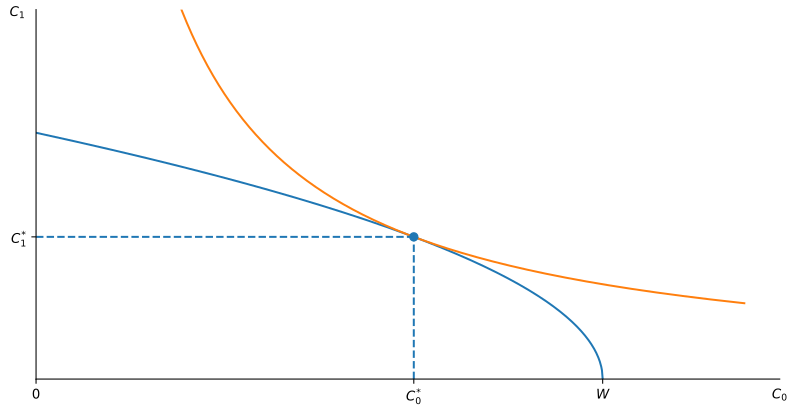
Figure 4: The figure shows the optimal consumption choice given a production function and initial wealth W.
Example
- Consider an investor with utility U(C_{0}, C_{1}) = \ln(C_{0}) + \ln(C_{1}).
- The investor has initial wealth W and can invest K = W - C_{0} in a technology that produces f(K) = \sqrt{K} next period.
- The investor maximizes her utility if her consumption (C_{0}^{*}, C_{1}^{*}) satisfies \text{MRS} = \frac{C_{1}}{C_{0}} = \frac{1}{2 \sqrt{W - C_{0}}} = \text{MRT}.
- Since C_{1} = \sqrt{W - C_{0}}, we have that \frac{\sqrt{W - C_{0}}}{C_{0}} = \frac{1}{2 \sqrt{W - C_{0}}}, which implies that C_{0} = \frac{2}{3} W and C_{1} = \sqrt{\frac{1}{3} W}.
The Role of Capital Markets
The Production Decision
- Investors can do better than autarky if they organize their economy differently.
- Let’s delegate the production decision to a manager with access to a technology f(K).
- Furthermore, assume that consumers have access to capital markets where they can borrow or lend at an interest rate r.
- The manager is given a certain amount of wealth W, and must decide how much to sell today, investing the rest in the technology for future production, which we denote by (Q_{0}, Q_{1}), respectively.
The Manager’s Problem
- Shareholders expect the manager to choose (Q_{0}, Q_{1}) to maximize the value of the firm V = Q_{0} + \frac{Q_{1}}{1 + r}.
- The manager faces the budget constraint that he can only invest what the firm does not sell today, i.e., K = W - Q_{0}.
- The problem that the manager must solve is given by \max_{\{Q_{0}\}} Q_{0} + \frac{f(W - Q_{0})}{1 + r}.
- The FOC is \text{MRT} = f'(W - Q_{0}^{*}) = 1 + r.
Optimal Production Choice
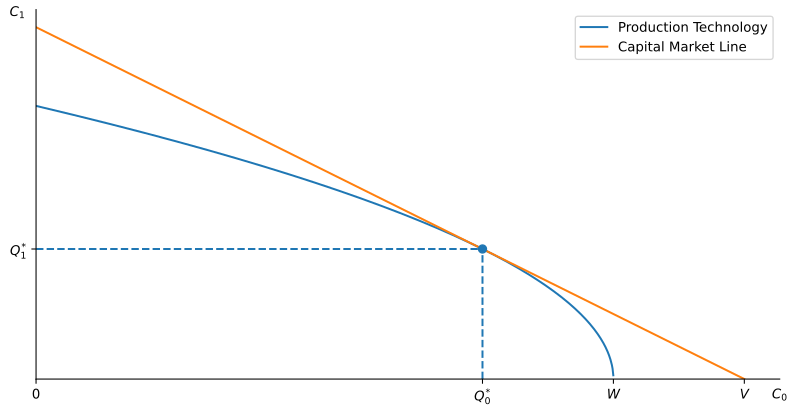
Figure 5: The figure shows the optimal production policy for the firm given a production function and initial wealth W.
Maximizing Firm Value
- The intercept of the CML with the x-axis determines the firm value.
- By choosing the tangency point between the two lines, the manager maximizes the firm’s value by selecting the intercept that is furthest to the right.
- To increase the firm’s size, the manager would need a more significant initial investment of W.
- The difference between V and W is the net present value (NPV) created using the technology.
- By investing an initial capital of W, shareholders now have an asset worth more than the initial investment.
- The manager should then accept all projects with positive NPVs!
Example
- Consider the same production function as the previous example, i.e., f(K) = \sqrt{K}.
- The market interest rate is r.
- The policy (Q_{0}^{*}, Q_{1}^{*}) that maximizes firm-value is such that \begin{aligned} \frac{1}{2 \sqrt{W - Q_{0}^{*}}} & = 1 + r, \\ Q_{1}^{*} & = \sqrt{W - Q_{0}^{*}}. \end{aligned}
- Thus, Q_{1}^{*} = \frac{1}{2 (1 + r)} and Q_{0}^{*} = W - \frac{1}{4 (1 + r)^2}.
- The value of the firm is then V = W - \frac{1}{4 (1 + r)^2} + \frac{1}{2 (1 + r)^{2}} = W + \frac{1}{4 (1 + r)^{2}} > W.
The Consumption Decision
- In the model, shareholders agree on how the firm should maximize its value, regardless of their utility for today’s and future consumption.
- An investor with initial wealth W can create the previous firm, hire a manager, and incorporate the firm.
- The firm will then produce Q_{0}^{*} today, invest K = W - Q_{0}^{*} and produce f(K) = Q_{1}^{*} for consumption next period.
- The investor could sell the firm for V, which can be used to consume C_{0} today and invest the rest to consume C_{1} = (V - C_{0}) (1 + r) next period.
The Investor’s Problem
- The investor’s problem is \begin{aligned} \max_{\{C_{0}, C_{1}\}} & U(C_{0}, C_{1}), \\ \text{s.t. } & C_{1} = (V - C_{0}) (1 + r). \end{aligned}
- The Lagrangian of the problem and the FOCs are \begin{aligned} \mathcal{L} & = U(C_{0}, C_{1}) - \lambda (C_{1} - (V - C_{0}) (1 + r)), \\ \frac{\partial \mathcal{L}}{\partial C_{0}} & = \frac{\partial U}{\partial C_{0}} - \lambda (1 + r) = 0, \\ \frac{\partial \mathcal{L}}{\partial C_{1}} & = \frac{\partial U}{\partial C_{1}} - \lambda = 0, \\ \frac{\partial \mathcal{L}}{\partial \lambda} & = C_{1} - (V - C_{0}) (1 + r) = 0. \end{aligned}
Interpretation of the Solution
- The first two FOCs imply that the MRS for the consumer is equal to the rate of return of the CML,i.e., \text{MRS} = \frac{\frac{\partial U}{\partial C_{0}}}{\frac{\partial U}{\partial C_{1}}} = 1 + r.
- The last FOC says that the present value of today’s and future consumption must equal V, i.e., V = C_{0} + \frac{C_{1}}{1 + r}.
Optimal Consumption With Capital Markets
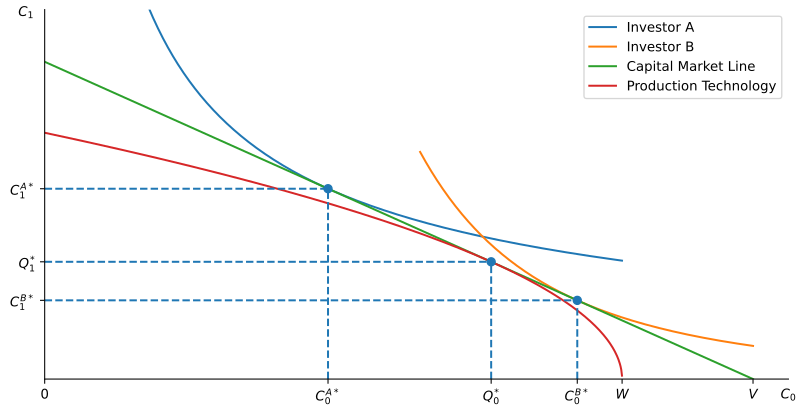
Figure 6: The figure shows the optimal production policy for the firm and optimal consumption decisions for two investors given a production function and initial wealth W.
Example
- Consider an investor with initial wealth W who owns the technology function of the previous example.
- By producing Q_{0}^{*} = W - \frac{1}{4 (1 + r)^2} and Q_{1}^{*} = \frac{1}{2 (1 + r)}, she maximizes the firm value at V = W + \frac{1}{4 (1 + r)^{2}}.
- Assume that the investor has a utility function of the form U(C_{0}, C_{1}) = \ln(C_{0}) + \beta \ln(C_{1}).
- At the optimum, \dfrac{C_{1}}{\beta C_{0}} = 1 + r.
- Since C_{1} = (1 + r) (V - C_{0}), we obtain C_{0}^{*} = \dfrac{1}{1 + \beta} V and C_{1}^{*} = (1 + r) \dfrac{\beta}{1 + \beta} V.
Fisher Separation
- The previous analysis suggests that we can separate the firm’s investment decision from the investment decision faced by the consumer.
- This separation result is known as Fisher Separation Theorem after economist Irvin Fisher.
- Well-functioning capital markets play a crucial aspect in creating this separation.
- All consumers are better off when firms maximize their values by undertaking positive NPV projects.
- It is the role of the firm’s manager to ensure that companies maximize their values to shareholders.